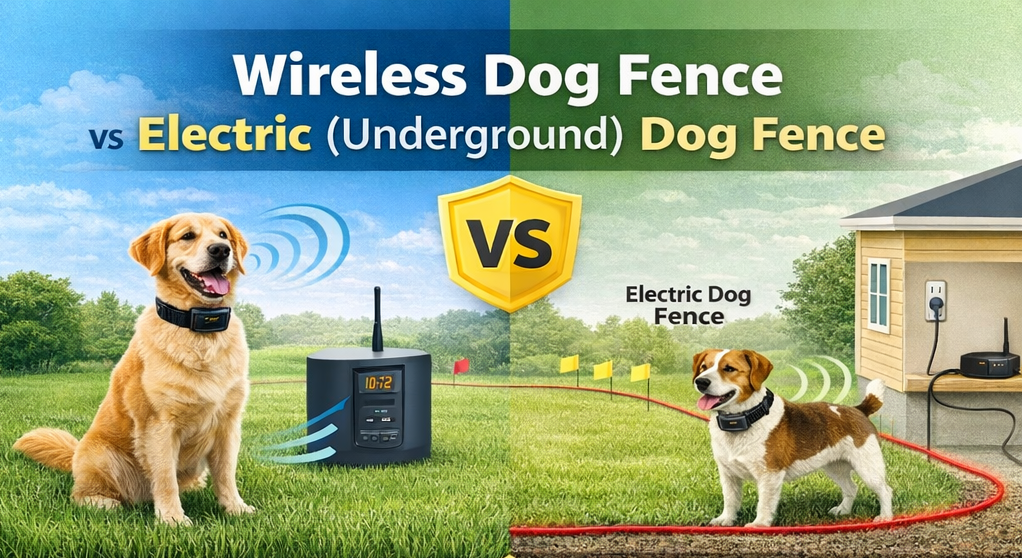
“Wireless dog fence vs electric dog fence” sounds like a dramatic Game of Thrones showdown. The reality? It’s a terminology mess that can make picking the right solution for you confusing. At the dog park, people talk about wireless, electric, and invisible like they’re interchangeable but they’re not really. Everyone has an opinion about what type of dog fence is best, but it’s really about what type of dog fence is best for your household.
Here’s the clean version:
- A wireless dog fence usually means either a base-unit radio system that creates a circular boundary or a GPS-based virtual fence.
- An electric dog fence usually refers to an in-ground wired system — often called an invisible fence — where a buried wire defines the perimeter.
All of them use collars. None of them are physical barriers. And the right choice has far more to do with your yard and your lifestyle than with which word sounds more modern.
If you want the full category breakdown first, start with our Complete Guide to Wireless Dog Fences. If you’re here to decide between systems, let’s untangle it properly.
Why This Question Causes So Much Confusion
The confusion comes from marketing language.
Retailers may label an in-ground wired system as “electric.” A base-unit circle system gets labeled “wireless.” A GPS collar is also technically wireless. Meanwhile, some brands lean into “invisible fence” as the consumer-facing phrase.
Underneath the terminology, there are really three technologies:
- Radio base-unit systems
- In-ground wired systems
- GPS virtual fences
Understanding those three is the only way to compare them honestly.
What a Wireless Dog Fence (Base-Unit Radio) Actually Is
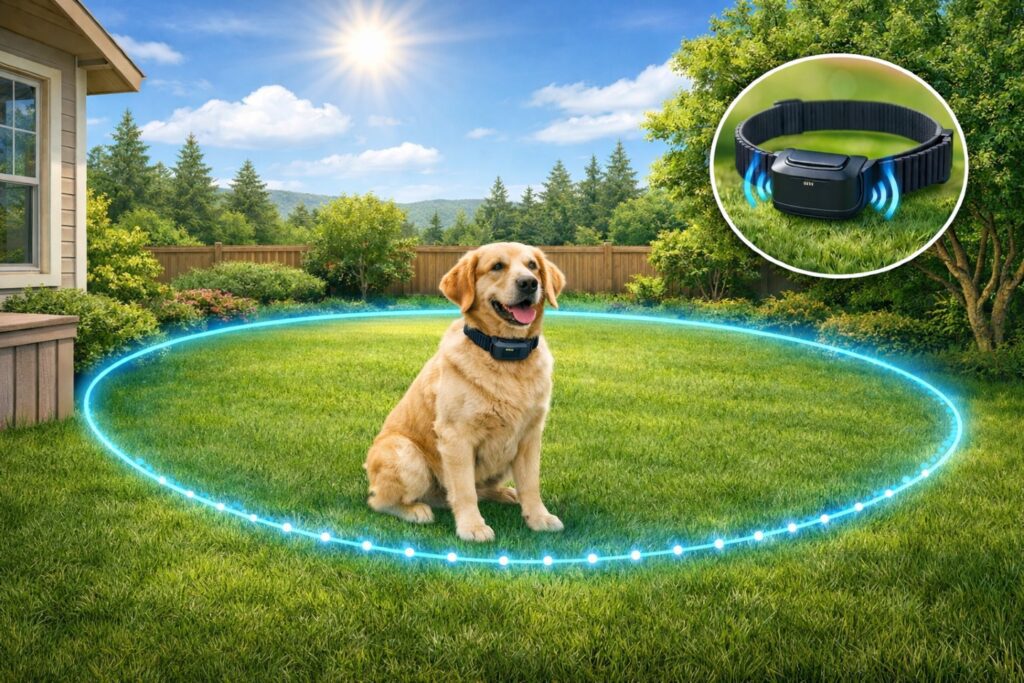
This is the version many suburban households picture first. You plug a transmitter into an outlet inside your home. That transmitter creates a circular boundary radius around it. As your dog approaches the edge of that circle, the collar issues a warning tone or vibration, and if they continue, it can deliver adjustable static correction. Systems like PetSafe’s base-unit wireless containment fall into this category.
Why people like it
It’s simple. You can often set it up in an afternoon. There’s no trenching through your yard and messing up your plants. No mapping. No app-based boundary drawing. If your yard works with a circle, it’s refreshingly low drama. It’s also typically the lowest upfront cost entry into invisible containment.
Where it breaks down
The circle is both the magic and the limitation. If your yard is long and narrow, wraps around landscaping, includes a driveway you don’t want to include, or has hazards you need to carve out — the geometry fights you. You don’t shape the boundary. You live inside the circle. Transmitter placement also matters more than most buyers expect. Furniture, walls, and interference can affect how that circle behaves. If your property is straightforward and suburban, this can work beautifully. If your lot is complex, you’ll feel the compromise immediately.
What an Electric / Invisible Fence (In-Ground Wire) Really Is
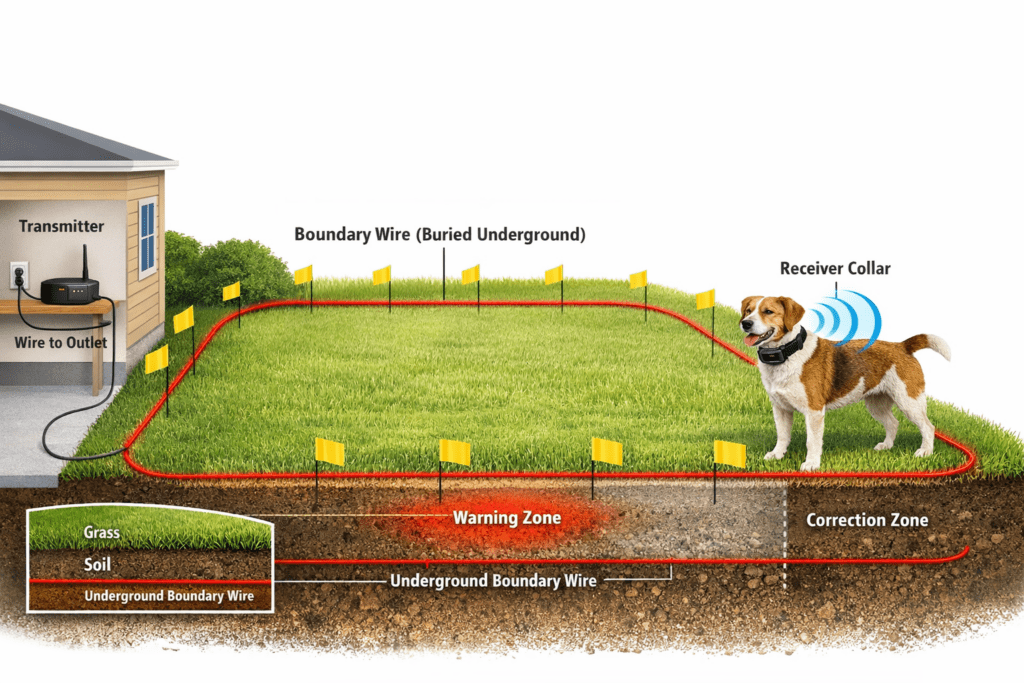
When someone says “electric dog fence,” they almost always mean an in-ground wired system. Here, a physical wire is buried around your perimeter. A transmitter sends a radio signal through that wire. The collar detects proximity to that signal and triggers cues when your dog approaches the boundary. Brands like SportDOG’s in-ground systems represent the DIY side of this category.
Why it’s still popular
Precision. You can trace your real property lines. You can carve out gardens. You can shape the boundary around a pool. You can create interior keep-out zones. If your yard is complex, this is the most controllable option. It also doesn’t depend on satellite conditions or cellular connectivity. Once it’s installed correctly, it’s predictable.
What you’re signing up for
Installation. Either you trench and lay wire yourself, or you pay someone to do it (which can cost a decent amount). Over time, wire breaks can happen. They’re fixable, but troubleshooting becomes part of ownership. And this is not portable. You’re installing infrastructure into the property, which is usually not an option for renters. How many landlords are game to let you dig up the yard? You barely got them to agree to your dog in the first place!
For permanent homes where boundary shape matters, wired systems often outperform everything else. For renters or people who move frequently, they’re impractical.
Where GPS Fences Fit Into This Debate
Now we add the modern layer. GPS fences are technically wireless. There’s no buried wire. No base transmitter creating a circle. Instead, you digitally draw your boundary on a map, and the collar enforces it. SpotOn GPS Fence allows containment without a mandatory subscription for fence functionality, while Halo Collar operates as a subscription-based ecosystem where GPS services require an active membership.
Why they’re attractive
You get custom shapes without digging. You can move the system between properties. You can use it at a cabin, an RV site, or a friend’s house. For people who travel with their dogs, this flexibility is powerful.
The real-world trade-off
With a GPS system, you’re now managing technology. You must charge the collar. You must test the boundary. GPS behavior can vary based on terrain, heavy tree cover, or environmental interference. It’s not set it and forget it. It’s set it, test it, and maintain it.
If you’re disciplined and tech-comfortable, GPS fences can feel modern and liberating. If you want something you never think about again, wired may feel calmer.
Boundary Precision: This Is the Real Decision
Instead of asking “wireless vs electric,” ask:
How precise does my boundary need to be?
- If your yard can function inside a circle, base-unit wireless works.
- If your yard needs custom shaping, in-ground or GPS is stronger.
- If you want custom shapes without digging, GPS wins.
- If you want physical infrastructure defining your line, wired wins.
Driveways, pools, and long property edges are usually the tipping point.
Portability: Are You Staying Put?
- Base-unit wireless systems can be moved, but only recreate circles.
- In-ground wired systems stay with the property.
- GPS fences travel with you.
Renters often lean GPS or base-unit. Long-term homeowners with acreage often lean wired.
Reliability: Predictable vs Flexible
In-ground wired systems are often the most predictable because the boundary follows physical wire placement.
Base-unit systems are predictable within the circle — but limited by geometry.
GPS fences are flexible but depend on environmental conditions and testing.
None are guaranteed. All require training. High prey drive dogs can challenge any invisible system.
Cost Overview
Base-unit wireless is usually the lowest upfront hardware cost.
In-ground wired systems range from mid-tier DIY kits to premium professional installations.
GPS fences are typically premium upfront; some brands add subscription costs for tracking services.
What They All Have in Common
- No physical barrier.
- No protection from outside animals.
- No replacement for training.
The collar cues reinforce a boundary your dog understands. The safest pattern is clear warning followed by consistent turn-back behavior.

Frequently Asked Questions about Wireless dog fence vs electric dog fence vs GPS dog fence
Is a wireless dog fence the same as an invisible fence?
No. Invisible fence usually refers to in-ground wired systems. Wireless can mean base-unit circle systems or GPS fences.
Which is more reliable: wireless or electric?
In-ground wired systems are typically the most predictable because the boundary follows physical wire placement. GPS systems require testing and charging discipline.
Which system handles driveways better?
Custom-shape systems — either in-ground wire or GPS — usually handle driveways more cleanly than circular wireless systems.
Do any of these keep other dogs out?
No. They create invisible containment boundaries. They do not create physical barriers. Sorry to break the bad news, but that mean dog from down the street will able to get into your yard and poop on your lawn, regardless of which of these systems you choose.
Final Take
If you want simplicity and your yard is cooperative, base-unit wireless fence works.
If you want precision and permanence, in-ground wired fence wins.
If you want flexibility and portability without digging, GPS fences are compelling.
The right answer isn’t wireless dog fence vs electric dog fence dual about which word sounds better. It’s about how your property behaves in real life. And once you choose, the most important factor isn’t the signal type — it’s the consistency of your dog training.