Imagine walking into your living room and hearing your dog press a button that says “outside.” Or “hungry.” Or, in some cases, “love you.” No, you’re not dreaming and you didn’t just wake up in a Disney movie. You’re witnessing the rising trend of dog talking buttons — also called dog communication buttons or dog sound buttons — a playful yet surprisingly sophisticated technology that lets pets “talk” to humans in a way we never thought possible.
From viral TikToks of dogs holding entire conversations with their humans to scientific studies exploring canine cognition, these little gadgets are at the forefront of the pet technology revolution. But are they just another buzzy gadget destined to end up at the bottom of the toy bin, or do they genuinely unlock a new way of connecting with our furry best friends?
This guide is the map for the whole topic. We’ll break down what talking buttons are, how they actually work, the main types of button systems (so you don’t buy the wrong thing), how to choose a setup your dog can actually use, and what the science does — and doesn’t — say. When you’re ready to compare specific kits, ourbest dog talking buttons roundup handles the head-to-head picks.
What Are Dog Communication Buttons?
At their core, dog communication buttons are simple soundboards — soundboard buttons for dogs work the same way whether you buy two or twenty. Each button is programmed with a word or short phrase like “walk,” “treat,” “play,” or “outside,” recorded in a human voice. When pressed with a paw or nose, the button speaks the word aloud.
Over time, dogs learn to associate specific buttons with outcomes. “Treat” means they get a snack. “Outside” means the leash comes out. Eventually, with repetition and encouragement, many dogs start pressing the buttons unprompted to initiate communication.
Think of it like a toddler learning to talk — except instead of forming words with their mouths, your pup’s using their paw as the mic drop.
One honest note before we go further: calling this “talking” is convenient shorthand, not a scientific conclusion. Researchers at the University of California, San Diego have found that soundboard-trained dogs can respond differently to familiar recorded words like “outside” and “play” even when the owner’s usual gestures and context are controlled for. That’s a real, meaningful finding about learned word associations. It is not proof of human-style speech, grammar, or a secret canine memoir waiting to be transcribed. Keep that in your back pocket — it’ll make you a better teacher and a happier button owner.
The Viral Moment That Sparked the Craze
The boom in talking buttons for dogs didn’t come out of nowhere. A California speech-language pathologist, Christina Hunger, started experimenting with a set of recordable buttons to communicate with her dog Stella in 2019. She programmed one to say “outside” and another to say “play.” Stella caught on fast, and soon Hunger was documenting how Stella used dozens of words to “speak” in sentences like “Want walk beach.”
Her journey went viral online, eventually spawning a book (How Stella Learned to Talk) and her own branded set of buttons under Hunger for Words buttons. Then came Bunny the sheepadoodle, whose enormous soundboard turned millions of viewers into believers and even fed into that UC San Diego research. From there, TikTok and Instagram took over, with countless videos of dogs surprising their owners (and millions of viewers) by “asking” for things with shocking clarity.
Suddenly, every dog parent wanted in.
How Do Dogs Learn to Use Them?
Training with dog buttons for communication requires patience, consistency, and a healthy sense of humor. Here’s the general process:
- Start Small. Most trainers recommend beginning with just one or two buttons: “outside” and “treat” are classics.
- Model the Behavior. Every time you take your dog outside, press the “outside” button yourself. Same for treats, meals, or play. The recorded word is only half the lesson — the action that follows is what gives it weight.
- Reinforce. When your dog paws at the button, answer promptly whenever it’s safe and reasonable. Follow-through is what keeps the cue meaningful. A calm “not now” routine is clearer than pretending a press didn’t happen.
- Expand. Once they get it, add new words like “water,” “toy,” or “bed.”
- Celebrate Progress. Every accidental press that turns intentional feels like a graduation ceremony.
A quick reality check on false presses: dogs investigate with paws, noses, and toddler-grade enthusiasm. A button pressed during zoomies may be telling you about your layout, not making a profound statement about existential freedom. Watch what your dog does next. If they tap “outside,” trot to the door, and wait, that’s a pattern worth honoring. If accidental bumps dominate, widen the spacing before inventing a dramatic interpretation.
Not every dog is destined to become a chatterbox, but many learn to use at least a handful of buttons to communicate real needs.
The Main Types of Talking-Button Products
Here’s the part that saves you from buying the wrong thing. “Dog talking buttons” is really an umbrella over a few different products, each suited to a different dog and a different level of commitment.
Full soundboard ecosystems

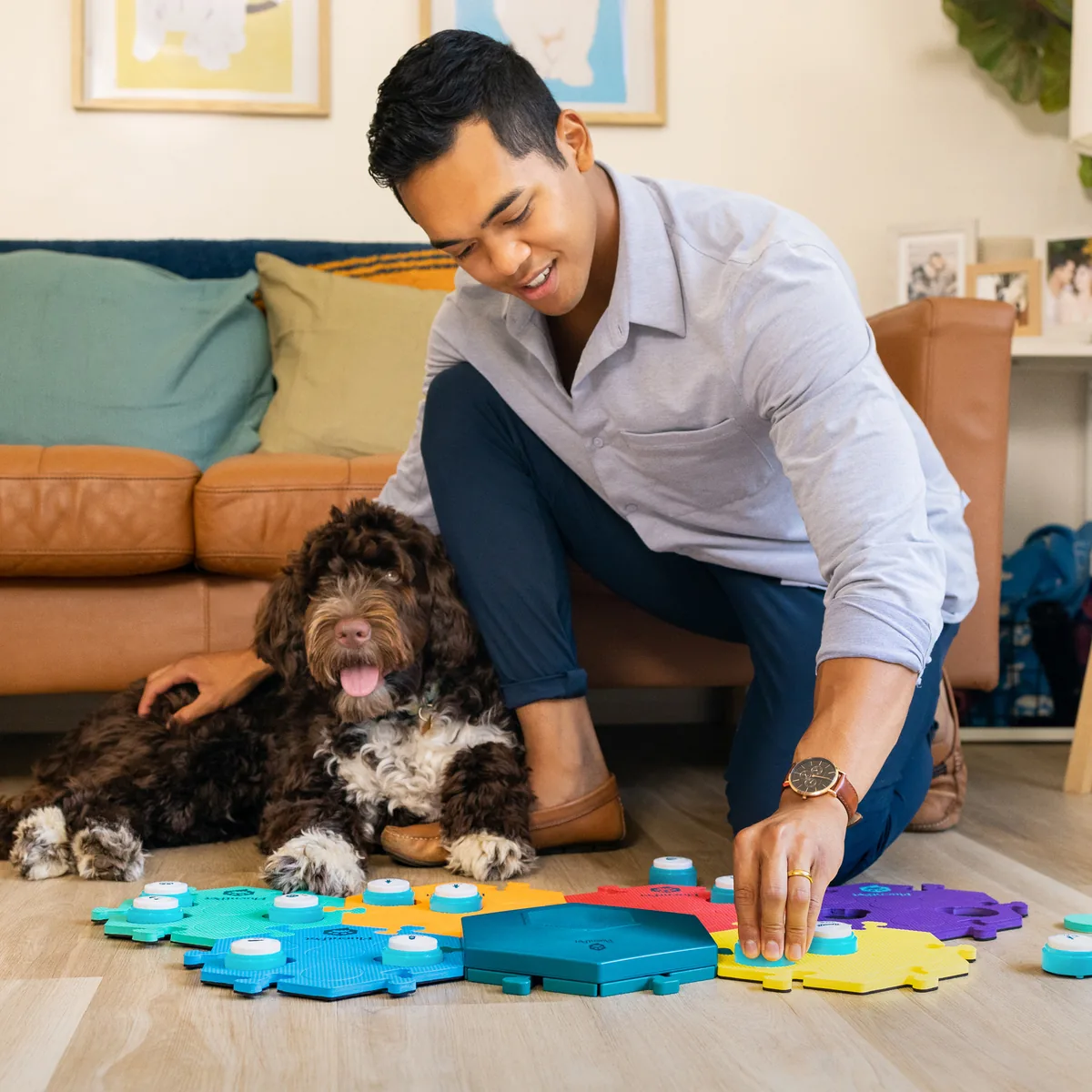
These suit people who want to grow beyond a single request and are ready to maintain an organized board. Brands likeFluentPet are the clearest example: recordable buttons that snap into modular, honeycomb-shaped tiles so you can group words into categories like “actions,” “places,” or “feelings.” The draw isn’t just button count — a stable, modular layout gives words consistent homes as the board grows, which keeps the whole thing manageable for the humans, too. The tradeoff is commitment: a bigger board needs thoughtful spacing, useful word groups, and regular modeling, or it becomes fancy floor décor. For the physical setup, seedog button board.
Starter kits and recordable button packs


Starter kits keep the focus on a few useful routines.Hunger for Words— the brand with the most direct claim to being “the original,” thanks to Christina Hunger — leans training-first, with beginner packs and plenty of guides.Mewoofun is a colorful, budget-friendly, mat-oriented option that’s a comfortable place to test the waters. We like these kits, but fair warning: supply is unreliable and the direct site is often sold out, so theMewooFun Amazon store is usually the better place to look. Just remember: the button pack is not the trainer. It works when the person holding the leash keeps modeling the cue and following through. Starting small is often the smarter move.
Mats, boards, and accessories
A dog button mat does more than make a board look finished. It stops buttons from skating across hardwood, keeps the pressing area familiar, and helps you preserve a consistent layout. Modular tiles help when vocabulary will grow; a simple row is kinder when you’re starting with two or three words. Fit the arrangement to the dog, not to the most photogenic setup on social media — a big enthusiastic paw needs wider spacing, and an urgent “outside” cue shouldn’t get lost in a packed grid.
Dog doorbells and potty buttons
This is the distinction that keeps people from overbuying. A dog doorbell or potty button usually handles exactly one request: “I want to go out.” It can be mechanical, electronic, recordable, or app-connected.Mighty Paw dog doorbell sits on the electronic-doorbell side;Paws2Go is the app-connected option with light, sound, and smartphone-notification features; and Hunger for Words even makes a Talking Pet Doorbell. Any of these can be perfect for a dog whose whole message is “door, please” — but none is an entry-level version of a twenty-word soundboard. If a clean outside cue is all you need, start there. SeeBest Dog Doorbells and Potty Buttons for Outside Requests anddog potty bell for the full breakdown.
Want the actual “which one should I buy” picks with pros and cons? That lives in ourBest Dog Talking Buttons for Communication comparison.
How to Choose a System Your Dog Can Actually Use
Four quick questions will get you to the right setup faster than any spec sheet.
Start with the request you want to make clearer. Picture the frustrating moment you’re trying to fix. A puppy scratching the door needs a sturdy outside-request device. A dog who’s wild about food, play, and backyard routines may love a small starter board. Someone who already knows they can model words daily and keep a layout stable may be ready for an expandable system. Those aren’t versions of the same purchase.
Check pressability and placement. Buttons need to be easy to find and activate without becoming accidental floor traps. Think about paw size, nose use, nail length, mobility, and the surface underneath. Keep an outside button near the exit your dog already uses, and give a starter board a quiet, reachable spot — not a corner behind the laundry basket.
Match the board to your training bandwidth. An expandable system is exciting because it leaves room for future words. It also gives you more words to model correctly. Begin with routines you can honor, then add cues while the existing board still feels easy. Our guide to thebest words for dog buttons explains why concrete, repeatable words beat trying to record the entire emotional range of a Shakespeare character.
Let an app earn its place. An app-connected system is handy if you want a log of presses or a phone alert from the back door. It is not automatically better training. A straightforward recordable button with a consistent consequence often beats a smart setup that adds charging, sign-ins, and more notifications to a household that just wants to hear the dog at the door.
Why Pet Parents Are Obsessed
- A Stronger Bond. Imagine your dog literally telling you they’re “sad” or “want cuddle.” Heart. Melted.
- Mental Stimulation. Dogs need more than physical exercise; learning to “talk” keeps their brains busy.
- Fewer Frustrations. No more guessing games about whining at the door or barking at the fridge.
- Social Media Stardom. Let’s be real: your dog hitting “play” on video is content gold.
The Limitations and Cons
Of course, no technology is perfect. Some reasons why communication buttons for dogs aren’t for everyone:
- Time-Intensive. If you can’t commit to modeling and reinforcing daily, your dog probably won’t progress far.
- Not Every Dog Cares. Some pups just don’t vibe with buttons. And that’s okay.
- Overuse or Demand. Beware: dogs learn “treat” very fast, and may press it with the persistence of a tiny customer-service department.
- Skepticism in Science. Studies show dogs can learn associations, but whether they “understand language” the way we do is still open. Enjoying a charming press and making a sweeping claim are not the same thing.
Tips for Success with Talking Dog Buttons
- Be Consistent. Press the button every single time you perform the action.
- Keep It Simple. Start with high-value words your dog already loves.
- Reinforce Immediately. Follow through so the word stays meaningful.
- Be Patient. Progress can take weeks or months. Celebrate tiny wins.
- Don’t Expect Shakespeare. If your dog learns “outside,” “treat,” and “play,” you’re already winning.
Beyond Dogs: Cats, Bunnies, and… Horses?
While dogs are the main stars of talking button videos, other pets are getting in on the act too. Some cat owners report real success (though true to form, many cats only use “treat” and ignore the rest). Parrots, bunnies, and even horses have been tested with buttons, proving this isn’t just a dog thing — it’s an interspecies experiment in communication. If you’ve got a mixed household, readcat talking buttons and ourBest Talking Buttons for Cats before assuming one layout and reward style will work for everyone.
Are Dog Communication Buttons Worth It?
If you’re the type of pet parent who loves bonding activities, enrichment, and a sprinkle of science-meets-play, then yes — they’re worth trying. There’s a system for nearly every budget and goal, from a potty button for dogs at the back door to a full modular soundboard.
But if you’re already struggling to squeeze in walks and playtime, this might feel like just one more chore. And a modest setup that actually gets used — even recordable answer buttons for dogs repurposed for the job — is far better value than a premium soundboard that becomes a colorful coaster.
Ultimately, the best-case scenario is life-changing: your dog genuinely communicates with you in ways you never thought possible. The worst-case scenario? You spent a little money, had some laughs, and your dog has some new toys to paw at.
Dog Talking Buttons FAQ
Do dog talking buttons really work? They can work as trained, recorded cues when you model the word, follow through consistently, and give your dog a reason to use it. They don’t guarantee a human-like conversation or a dramatic vocabulary.
What word should I teach first? Pick a concrete routine word with an obvious result. “Outside” and “play” are common starts because you can model the word and immediately do the activity. Start with what already matters to your dog.
Can a puppy use dog buttons? Yes. A puppy can learn a simple button or bell routine — just keep expectations modest. One dependable outside request beats rushing to build a big board during house-training mayhem.
Does a dog doorbell count as a talking button? It can be a button-based communication tool when it records or signals one request, usually “outside.” It’s not a substitute for a multi-word soundboard.
Can cats use pet communication buttons? Some cats learn associations when the motivator and timing are clear. Their interest and press behavior differ from a dog’s, so a dog-first setup sometimes needs tweaking.
How many buttons should I start with? Start with the smallest number you can model faithfully. Two to four useful words are plenty for most new households, and one outside-request device can be enough for a specific problem.
Final Thoughts
Whether you go all-in with a full modular soundboard, dabble with a couple of recordable buttons, or start your journey with a single doorbell at the back door, dog communication buttons are one of the most delightful tech innovations in the pet world.
They’ve already changed the way thousands of dogs “talk” to their humans, and they just might change yours too. The delightful part is seeing what your dog chooses to use. The grown-up part is refusing to turn every press into a speech. Keep both in view — and even if your pup only ever learns “outside” and “treat,” isn’t that still a conversation worth having?
So the next time your dog gives you those big pleading eyes, imagine a world where instead of guessing, they can simply press a button and tell you: “walk now.” That’s the magic of this new era of pet technology.