Anyone who lives with a cat already knows the training goes both ways — and that your cat is winning. She has a specific chirp for the treat drawer, a particular look for breakfast that arrives roughly four hours before breakfast, and a way of sitting on your keyboard that means “we are done working now.” You are, whether you admit it or not, extremely well trained. Talking buttons just move one of those signals from her private language into a word you can finally, reliably hear.
So yes: cats can use talking buttons. Not because your cat is secretly a person in a fur coat — she would be insulted by the comparison, humans being so needy — but because a clever, self-interested animal can learn that pressing a certain button reliably summons a certain wonderful thing. This is a guide to setting that up in a way your cat might actually agree to. Keep your expectations honest and your treats excellent, and you have a real shot at a shared word or two.
What buttons can — and cannot — do
Here is the honest version, because your cat respects honesty (and nothing else). Cats can learn associations and take part in reward-based training. That makes a well-modeled button routine genuinely plausible: your cat can learn that pressing a button is followed by a familiar, good event. What it does not prove is that your cat understands a recorded word as human language. The cat-specific research is thinner than the dog studies, and even the dog research shows contextually appropriate responses to familiar words and some non-random two-button combos — not grammar, not a diary, not a confession of love in complete paragraphs. Most of that groundwork is laid out in Talking Dog Buttons, and the mechanics carry over to cats — minus the eagerness to please.
Even BilliSpeaks, one of the most-watched button cats on the internet, is upfront about this: her people can say she uses a button in the right context most of the time, but not how deeply she understands it. That mix of wonder and humility is exactly the energy to bring home. A button your cat presses in the right moment is fascinating on its own. It does not have to settle the enormous question of what she truly thinks to be worth doing — and honestly, you already suspect what she thinks, and it is “more food.”
Viral clips can make all of this look inevitable. In your living room, your cat may press a button twice, achieve enlightenment, and never return. That is a completely normal outcome, not a reason to buy more buttons or apply more pressure.
Meet the cats who got there first
You are not the first person to look at your cat and think, “I bet she’d have opinions on a soundboard.” A handful of famous cats have already proven the concept is at least fun, and watching them is the best free training tutorial there is.
Billi (BilliSpeaks) is the headliner — a domestic shorthair who became an internet sensation pressing buttons for food, catnip, and, most memorably, “mad.” Reportedly her most-used word. If that does not perfectly capture the feline condition, nothing will.
Russell, the cat of creator CatManJohn, uses FluentPet buttons to demand play and very specific toys — including, at times, a beloved wire. Because of course the multi-hundred-dollar toy collection loses to a wire.
Bjørn (Bjørns Buttons) is a TikTok favorite known for expressive, faintly unhinged reactions and full-blown conversations on a custom board — proof that personality survives the jump to buttons intact.
And Steve B, a black-and-white cat, reportedly started on an AAC board at age eleven and became famous for leaning hard on his “outside” button. He is the exception that makes the rule below make sense: “outside” is a fantastic word for a cat who actually goes outside, and a pointless one for a cat who does not.
A gentle reminder your cat would want included: none of these cats are a promise about yours. They are inspiration and a proof of concept, not a guarantee that your specific genius will do anything but sniff the button and leave.
Start with what your cat already wants
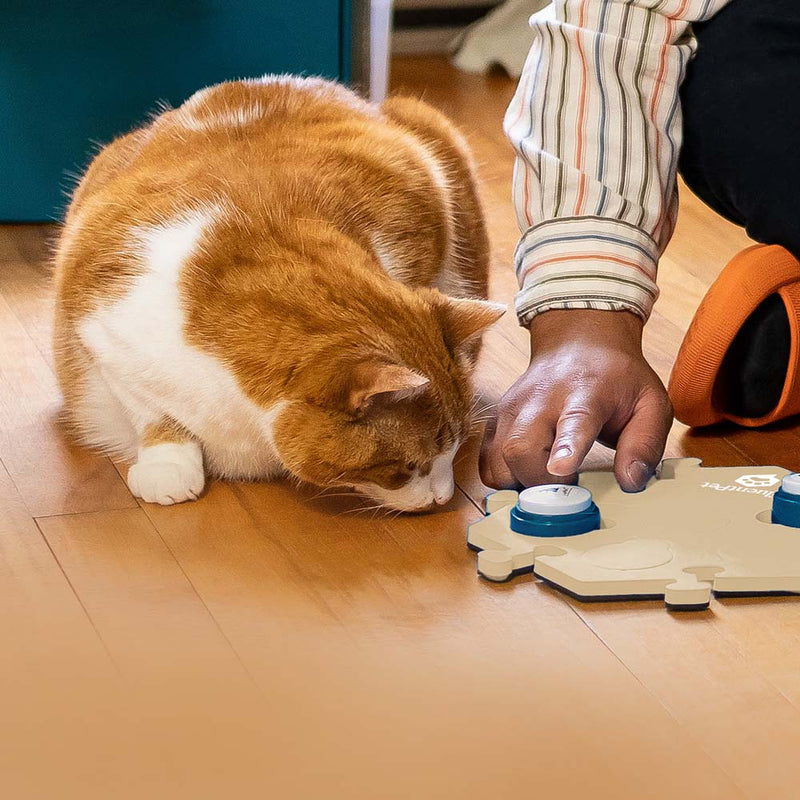
The single biggest mistake is starting with a word you want and a reward your cat merely tolerates. Cats do not work for praise the way dogs do — a fact dog people find tragic and cat people find correct. Your cat works for the thing. So begin with something she already schemes for and you can produce on the spot: a favorite treat, a specific play routine, a lap, a window, catnip, the brush she pretends to hate.
Keep sessions short — a minute or two, ending while she is still interested rather than after she has stalked off. Model the button as the good thing begins: press “treat,” then immediately produce the treat. You are not testing her. You are showing her a shortcut, and cats love a shortcut. Then step back and let her decide whether to try it. Voluntary is the whole game.
Never mash her paw down onto the button to “show” her. To a cat, being handled onto an object is a betrayal, and she will hold a grudge against the button, the routine, and possibly you. A slow, chosen press tells you something real. A forced one tells you nothing except that she now distrusts the mat.
The best first words for a cat
Dog button guides love to start with “outside,” because a dog asking to pee is the entire dream. For most cats, and especially indoor cats, “outside” is a trap. It points at a door that never opens, so all it can teach is frustration, and a frustrated cat simply deletes the word from her repertoire. (Steve B gets “outside.” Your third-floor apartment cat does not.)
Pick a first word that is concrete, that your cat already cares about, and that you can deliver instantly and consistently. Strong opening candidates:
- “Food” or “treat” — the classic, for good reason. The motivation is pre-installed.
- “Play” — ideal for the cat whose real love language is the wand or the wire.
- “Catnip” — powerful, but ration it, or the word loses its meaning to overuse.
- “Brush” — for the cat who body-slams the brush every morning.
- “Up,” “lap,” or “pets” — for the affectionate cat who wants access to you or a perch.
- “Water” — genuinely useful for the cat obsessed with the running faucet.
The rule across all of them: the word must trigger the same response every single time at first, and the response has to follow immediately. A cue with a predictable payoff is a fair thing to teach. A cue that sometimes works and sometimes gets ignored just teaches your cat that the button is unreliable — and an unreliable button, to a cat, is furniture. Save emotion words, time words, and elaborate phrases for much, much later, if ever. The concrete-first logic in Best Words for Dog Buttons holds for cats too, with the firm caveat that cats are not small dogs and will remind you of this daily.
Make the button easy for a small, opinionated paw
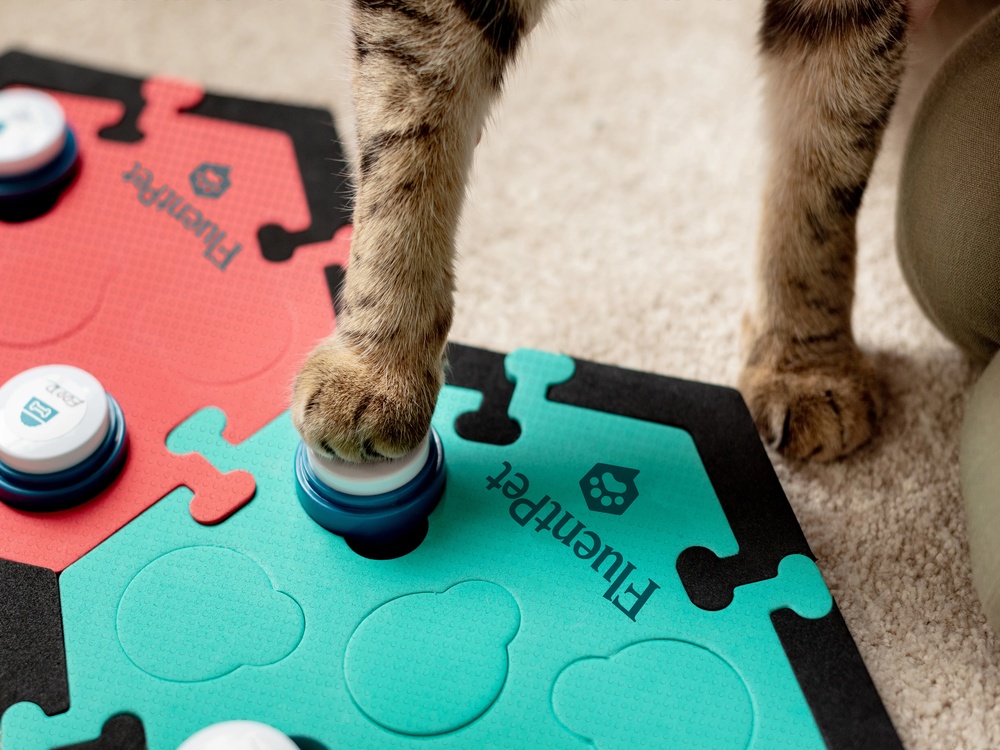
Press mechanics matter more for cats than for dogs, and this is where a lot of setups quietly fail. A cat presses with a light, precise, often bat-first paw — nothing like a dog’s confident stomp. Two things follow. First, the button has to trigger reliably without a heavy press; if it needs real force, your cat will tap it, get nothing, and correctly conclude it is broken. Second, it must not slide. A button that skids away on first contact is, in your cat’s expert opinion, defective and beneath her, and she will not give it a second audition.
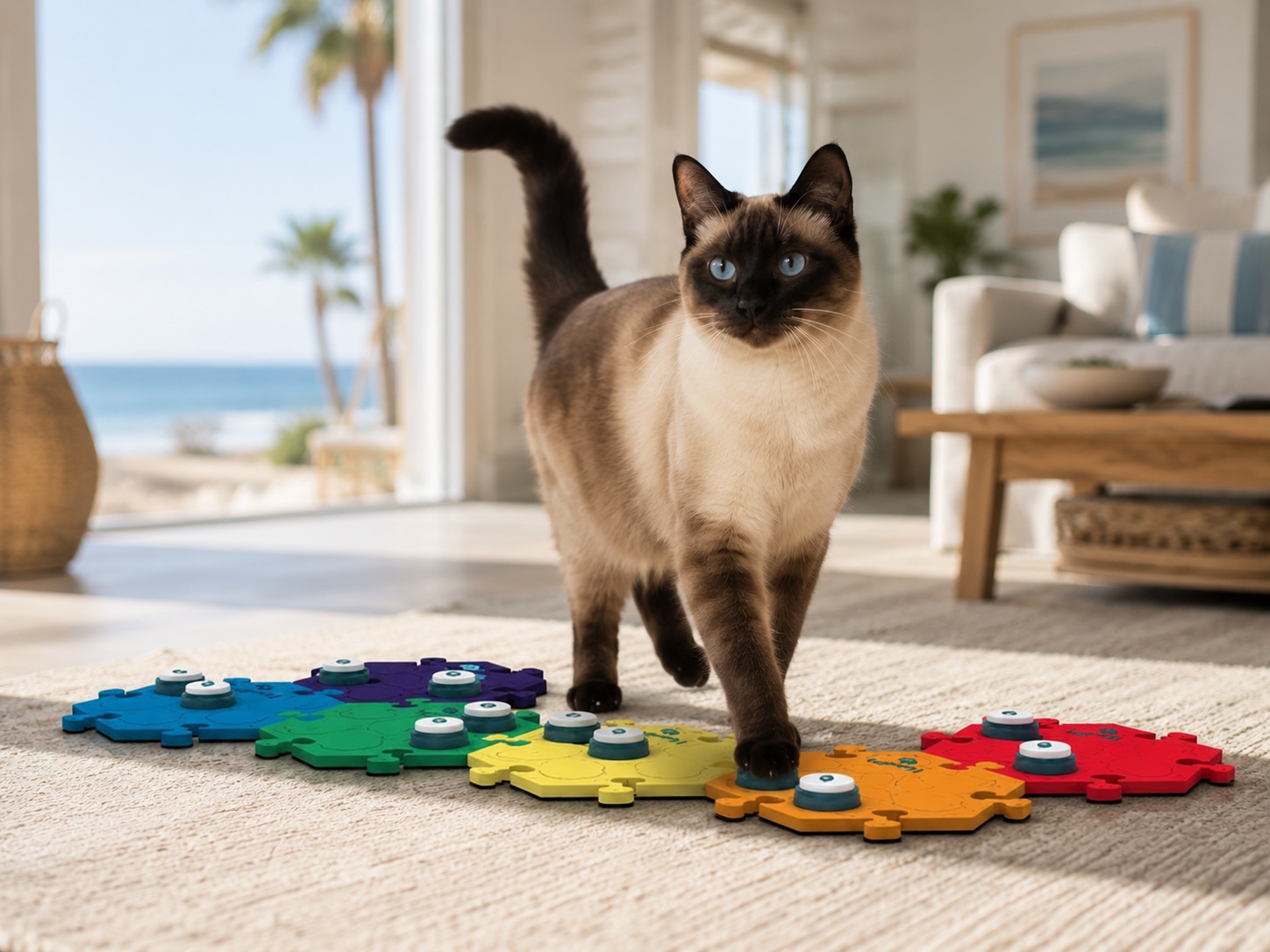
A stable surface solves both problems. A non-slip mat or a locked-in tile keeps the button from wandering and gives her paw a consistent target in the same spot every time. Dog Talking Button Boards, Mats, and Soundboards walks through surface stability and spacing — the mechanics apply directly to cats. And resist the urge to build a sprawling board on day one. One accessible, reliable button is a far better test than a crowded grid your cat has to navigate before she has any reason to care.
Put the button in her territory, not your traffic
Cats claim specific real estate and boycott the rest. A button parked in a busy hallway, next to a rumbling appliance, or beside a door that bangs is a button your cat will simply route around for the rest of time. Place the first one where she already chooses to be — beside the feeding station, under the sunbathing window, near the perch she runs the household from. Quiet, predictable, and hers. Location does more of the training than any feature on the packaging.
Volume counts too. Some cats do not care; others startle at a loud recorded voice and immediately file the button under “predator.” Record your cues at a calm, moderate volume, and if she flinches at playback, re-record it softer. A cue that spooks her is a cue she avoids.
Read her interest and believe what she tells you
Cats are not subtle once you know the dialect. A cat who looks at the button, drifts over during the familiar routine, or returns to the spot on her own is telling you she is open to another short round. A cat who leaves, flattens her ears, avoids the area, or suddenly becomes deeply invested in grooming has also told you something — she is done, and pushing further only teaches her that the button means being nagged. End the session, keep it positive, and try again later. The choice to engage is not an obstacle to the training. It is the training.
Keep your responses boringly consistent
If more than one person lives with the cat, agree on what the first cue means before anyone starts. If “play” sometimes summons the wand, sometimes produces a treat, and sometimes gets a distracted “in a minute,” your cat receives static instead of a signal — and a cat given static stops broadcasting. Pick one response and everyone uses it, at least until the association is solid. Consistency is unglamorous and it is the entire difference between a word that sticks and a button that becomes a very expensive coaster.
When not to add more buttons
The temptation, the moment your cat presses her first button on purpose, is to run out and buy twelve more. Do not. Add a second word only once the first is genuinely reliable and she is choosing to use it. Pause entirely if she has stopped returning to the button, if you cannot deliver the linked reward consistently, or if the whole thing has started to feel like homework — for either of you. One small, voluntary, dependable word is a real success. A sprawling board she ignores is just clutter she will eventually knock to the floor to make a point.
If and when she does prove she is interested and you want to choose a system to grow with, Best Talking Buttons for Cats compares the setups worth considering, from a single starter button to an expandable board.
A realistic measure of progress
Set the bar where your cat can actually clear it. Progress might be as modest as your cat calmly approaching the same stable spot during a valued routine, or pressing a button once, on purpose, with a look that says she always knew this would work and you were slow to catch up. A deliberate, repeated press may come later — or never, and that is still a fine outcome. The practical questions are simple: is the setup easy for her to reach and press, and can everyone in the home respond the same way? If yes, you have enough to decide whether a second word is worth trying.
Your cat is allowed to have the last word
A button routine should feel like enrichment, not an assignment. Offer one inviting cue, make the reward genuinely worth her effort, and let her decide whether this game belongs in her day. If she takes to it, you have a small, delightful new channel into a mind you will never fully decode. If she inspects the whole production, presses nothing, and delivers her review as a single slow blink before returning to her sunbeam — well. That is her answer, in her words, and it is a complete sentence. You wanted to communicate with your cat. Congratulations: she just told you no, and you understood her perfectly.