
The best dog gadgets feel a little bit magical. A tracker turns a heart-stopping “Where did she go?” into a moving dot on a map. A talking button gives your dog a gloriously dramatic new way to request OUTSIDE. A camera catches the exact moment your supposedly innocent angel climbs onto the dining table.
That magic gets even better when the technology fits the dog wearing, chasing, eating from, walking through, or communicating with it.
A petite Papillon should not have to carry a tracker built like a hockey puck. A determined Labrador can turn a delicate electronic toy into components before the app finishes pairing. A sound-sensitive rescue may need a quieter motor and a slower introduction. A rural roaming dog needs different location technology from a city dog whose favorite unauthorized adventure is the neighbor’s porch.
This guide matches smart dog gadgets to the lives dogs actually lead. It covers the electronic stars of safety, feeding, play, communication, wellness, access, and fur control without pretending one universal shopping list could suit every dog.
If you want the bigger dogs-and-cats view first, start with our Smart Pet Gadgets guide. Stay here when the question is wonderfully specific: What would make life with my dog safer, happier, easier, or more fun?
The Best Dog Gadgets at a Glance
There is no mandatory gadget starter pack. There is, however, a very good match for almost every recurring dog-parent thought:
- “My dog treats an open gate like an invitation to begin a side quest.” Look at dedicated GPS, cellular, or radio dog trackers.
- “Breakfast needs to happen on time, even when my calendar rebels.” Explore smart feeders, access-controlled feeders, and connected water devices.
- “I would love to know what happens after I close the front door.” A pet camera can show you settling, sleep, barking, mischief, and unexpectedly excellent comedy.
- “My dog’s brain needs something more exciting than another plush squirrel.” Try electronic toys, responsive puzzles, and app-controlled play devices.
- “My dog already communicates in sighs. I think we can expand the vocabulary.” Talking buttons and electronic dog doorbells create clear, repeatable cues.
- “Our fenced yard is ready for a smarter entrance.” Automatic and recognition-enabled pet doors add selective access and scheduling.
- “I want another electronic layer around outdoor boundaries.” Compare GPS, wireless radio, buried-wire, and connected boundary systems by property and training style.
- “I want to notice changes in activity, rest, or routine sooner.” Wearables and smart monitors can reveal trends worth watching.
- “The tumbleweeds are fur, and they have formed a government.” Robot vacuums, pet vacuums, air care, and powered grooming devices can keep up with the household your dog joyfully sheds into.
- “I need to know whether that tail belongs to a Beagle, a Husky, or an adorable plot twist.” A dog DNA test can turn curiosity into a seriously fun family reveal.
The words “best dog gadget” should always end with “for this dog.” Here is how to find that match.
Meet Your Dog Before You Meet the Feature List
Dog technology has an unusually hard design assignment. It must work for bodies that range from purse-size to pony-adjacent, mouths that range from dainty to demolition crew, and personalities that range from fearless explorer to suspicious household auditor.
Use the six checks below as your one buying checklist for every dog gadget in this guide. Start with your dog’s physical fit, habits, environment, and favorite ways to interact. The most dazzling feature becomes irrelevant if the hardware spins under a thick coat, the toy disappears into a large mouth, or the door asks for a movement your dog dislikes.
Measure the dog, not the marketing photo
For anything worn on the body, check your dog’s actual neck circumference and weight, then look at the complete worn setup. A small tracker may become much bulkier once its clip, collar mount, light, and charging shell enter the picture. Check whether the unit stays centered while your dog walks, runs, scratches, lies down, and shakes with full-body enthusiasm.
For doors, feeders, and interactive toys, measure reach as well as body size. Shoulder height and chest depth affect a pet-door opening. Muzzle shape changes how comfortably your dog can reach food in a deep bowl or retrieve a reward from a narrow opening.
Coat matters, too. Dense or long fur can hide indicator lights, interfere with sensors, trap a wearable at an odd angle, or make a seemingly comfortable strap irritating. A short-haired dog may be less forgiving of a hard plastic edge resting against the skin. Run your fingers around every contact point after a short trial.
Match the technology to your dog’s personality
Personality fit matters as much as physical fit. A fearless puzzle-solver, a sensitive homebody, a food-driven opportunist, and a power chewer can all meet the same device and deliver four completely different reviews.
Notice how your dog responds to novelty, sound, motion, touch, food, and frustration. One dog may adore a toy that darts unpredictably; another may prefer a slower puzzle that makes every reward feel achievable. One may come running when a feeder motor starts; another may need several happy introductions before dining beside the mysterious new robot. The strongest match works with the personality you already love.
Assume enthusiasm will test the hardware
Every powered toy deserves a meeting with your dog’s real play style. Does your dog nudge, chase, pounce, pin, shake, dissect, or carry toys away for private research? A device designed for supervised nose taps is not automatically ready for a power chewer who believes all seams are opening instructions.
Look for accessible batteries, removable covers, rubber caps, charging ports, cords, wheels, flaps, and small attachments. Inspect the device after early play sessions and retire it if the shell cracks, a part loosens, or your dog begins removing pieces. The American Kennel Club’s choking guidance notes that undersized balls can lodge in a dog’s throat and recommends choosing a ball wider than the diameter of the dog’s jaw. That size check matters just as much when the ball has a motor inside.
“Smart” describes what the electronics can do. It does not make a toy chew-proof, swallow-proof, or ready for unsupervised use.
Picture the gadget on your messiest day
Dog technology rarely lives in showroom conditions. It meets rain, mud, slobber, kibble dust, nose prints, shedding, tipped water, wet grass, and the occasional mystery substance nobody volunteers to identify.
Read the water-resistance claim closely. “Splash resistant” is different from waterproof, and neither phrase tells you whether a tracker can handle swimming, salt water, or repeated wet adventures. Check the stated operating temperature if the device will live in a garage, car, porch, or outdoor installation. For anything that handles food or water, look at which pieces detach, which can enter a dishwasher, and where residue can hide near electronics.
The best cleaning routine is the one you will cheerfully repeat. If a feeder requires a tiny brush, a screwdriver, and emotional preparation every three days, its automation may be creating the wrong kind of relationship.
Count every dog and human in the system
One app-controlled feeder may be simple. Two feeders, two dogs, a food thief, a dog walker, a partner, a pet sitter, and a veterinary diet can turn breakfast into systems engineering.
For multi-dog homes, ask whether the device identifies each dog, prevents shoulder surfing, records individual use, and gives everyone in the household the right level of app access. Watch the social scene around it. A selective feeder may protect one meal but become a spot another dog guards. A talking-button board may invite one dog to participate and inspire another to lie across the entire interface.
Shared access matters for people, too. Can more than one person receive an escape alert? Can a sitter operate the door without receiving years of camera history? Can you export wellness data for your veterinarian without handing over your login? The household should feel more connected, not trapped inside one person’s phone.
Make training part of the unboxing
Many dog gadgets ask for a new behavior: wear this, walk through here, touch that, wait for a sound, return when cued, or ignore a moving machine. Those actions are learnable, and teaching them can become part of the fun.
Pair the new object with rewards. Let your dog investigate while it is off. Add sound, movement, or automatic operation gradually. Keep early sessions short enough that curiosity wins. The American Veterinary Society of Animal Behavior supports reward-based dog training and advises against methods that rely on pain, fear, or intimidation, including electronic shock collars.
Bluetooth does not turn an aversive method into a kinder one. Barkytech’s version of exciting dog technology is tech your dog can learn to use with confidence.
The Best Dog Gadgets for the Life You Share
Now that you know how to judge the fit, match the technology to the moment you want to make better. These are the smart-device families most likely to earn a happy place in your dog’s routine.
Best for Escape Artists and Adventure Dogs: A Dedicated Pet Tracker
A dedicated dog tracker adds location technology to the safety plan. Cellular GPS devices are designed for app-based tracking across broad areas with compatible mobile coverage. Direct-radio systems can be a stronger match for backcountry or rural use, while Bluetooth and crowd-network finders depend on nearby compatible devices. Your dog’s size, usual terrain, attachment style, coverage, battery routine, and subscription tolerance will quickly narrow the field.
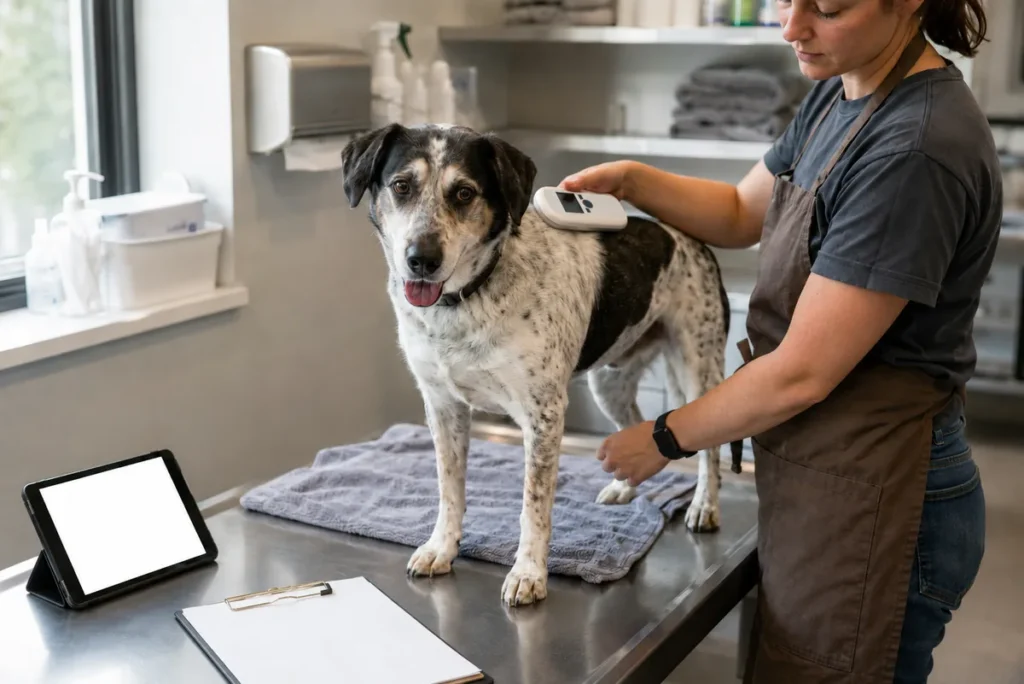
A tracker and a microchip solve different problems. The American Veterinary Medical Association explains that a microchip stores an identification number; it does not provide GPS location. Permanent identification helps a finder reconnect your dog with you, while a worn tracker helps you search actively. Our GPS pet tracker guide compares GPS, cellular, radio, Bluetooth, coverage, battery life, and subscriptions.
Best for Reliable Mealtimes: A Smart Feeder or Connected Water Station
Timed and app-connected feeders can keep meals consistent, while identity-aware models can protect one dog’s food from a four-legged pantry raider. Connected fountains and water monitors add reservoir, pump, filter, or usage alerts. Match the system to your dog’s food, muzzle, eating style, determination around storage, and the number of pets circling the kitchen.
The machine should carry out the feeding plan rather than invent it. AAHA includes automated and identity-aware feeders among the options for households where one pet eats another’s food, with measured portions still central to the plan. Its feeding-management guidance supports the smart routine; our automatic pet feeder guide goes deeper on capacities, food formats, schedules, access systems, cleaning, and backup power.
Best for Seeing the Secret Life of Your Dog: A Pet Camera
A pet camera can show whether your dog naps, patrols, barks, plays, or launches a forbidden dining-table investigation after you leave. Choose a view that covers the places your dog actually uses, then decide whether you want saved clips, household sharing, two-way audio, treat tossing, or simply the reassurance of a live look.
Video can also capture patterns worth sharing with a veterinarian or qualified behavior professional. AAHA notes that recordings may help them understand what happens during an absence, especially when a dog cannot settle, refuses food, injures themselves, or remains distressed. A camera can document the story; it cannot diagnose or treat it. For the much funnier side of home monitoring, see what happened when we watched two rambunctious Brittanys.
Best for Dogs Who Live for the Game: Electronic Toys and Smart Puzzles
Electronic dog toys add movement, timing, sound, responsive play, or food rewards to the room. The best match begins with your dog’s favorite verb: chase, sniff, nose, paw, solve, or retrieve. Choose difficulty and movement that end in delighted engagement rather than frantic frustration.
Powered play still has to fit jaw strength, toy size, chewing style, and supervision. Check the device after early sessions and follow the manufacturer’s unattended-use guidance. Our interactive dog toy guide goes deeper into responsive puzzles, motorized toys, remote play, durability, food delivery, and play styles.
Best for Dogs With Opinions: Talking Buttons and Electronic Doorbells
Talking buttons and electronic dog doorbells give your dog a clear, repeatable way to participate. A doorbell can own one extremely valuable message—OUTSIDE—while an expandable soundboard can build a family vocabulary around play, people, places, and routines.
Start with a word connected to an event your dog already understands, model it consistently, and choose hardware that suits paw size, activation force, sound clarity, and your dog’s temptation to pick up the button instead of press it. Our dog talking buttons guide covers systems, layouts, modeling, expectations, and the charming possibility that OUTSIDE will remain a valid request seventeen seconds after your dog comes back in.
Best for Smarter Backyard Freedom: An Automatic Pet Door
Automatic pet doors can recognize your dog, follow a schedule, report activity, or open a sliding door under motor power. They are especially exciting when a fenced yard is already part of family life and you want smarter control over who goes through and when.
Fit the opening to your largest dog, introduce movement and sound gradually, and make sure the door has sensible manual behavior during power or tag problems. AKC recommends correct sizing and positive, step-by-step dog-door training. That confidence-building approach pairs beautifully with connected hardware. Our automatic pet door guide compares access methods, installation formats, smart controls, weather sealing, and power plans.
Best for Electronic Boundary Awareness: A Wireless or GPS Dog Fence
Electronic fence systems use buried wire, a central radio transmitter, GPS coordinates, or connected location technology to create a trained boundary. Property shape, terrain, roads, trees, structures, signal behavior, and your dog’s temperament all affect which format belongs on the shortlist.
Choose a reward-led training approach and technology your dog can understand without pain or fear. Remember that an electronic boundary controls the equipped dog’s experience; it cannot prevent wildlife, another dog, a person, or a vehicle from entering. Our wireless dog fence guide explains the differences among GPS, radio, and buried-wire systems, including training, terrain, installation, and failure states.
Best for Wellness Pattern Spotters: A Dog Wearable or Smart Monitor
Activity wearables, rest trackers, smart scales, feeding records, cameras, and connected bowls can reveal what “normal for my dog” looks like across days and weeks. The most exciting data is personal: the activity rhythm, sleep pattern, or routine change that helps you pay closer attention to the dog in front of you.
AAHA recommends asking your veterinary team whether, how, and when they would like to receive wearable data and how they would use it. That conversation gives the dashboard context without treating an app label as a diagnosis. Our FitBark activity tracker story also shows how the numbers can inspire more shared movement—not merely more screen time.
Best for Homes With a Fur Forecast: Cleaning and Grooming Gadgets
Robot vacuums, pet vacuums, air cleaners, grooming vacuums, powered clippers, nail grinders, deshedding tools, and dog dryers attack the fur forecast from both directions. Cleaning machines collect what your dog leaves around the home; electronic grooming devices help manage loose coat, nails, and post-bath fluff closer to the source. The right device should fit coat type, sound sensitivity, flooring, furniture, room size, and your comfort using it around your dog.
Our pet vacuum guide compares cleaning formats for different floors and fur, while the pet air purifier guide covers room sizing, filtration, noise, filters, and odor expectations. For air care, avoid machines intentionally designed to produce ozone; the EPA identifies ozone as a lung irritant. With grooming tech, introduce motors and vibration gradually, protect skin and nails, and choose dog-specific equipment you can control confidently. The goal is not to erase every sign of your dog. It is to let great machines handle more of the fur while you enjoy the dog responsible for it.
Best for the Family Group Chat: A Dog DNA Test
A cheek swab can launch weeks of guessing, one dramatic results reveal, and a new appreciation for the science hiding beneath your dog’s magnificent ears. Tests may estimate ancestry, connect relatives, report traits, or screen selected genetic variants. Decide which of those experiences you want before comparing services.
Ancestry estimates depend on the provider’s reference data and analysis, while a health variant may indicate carrier status or predisposition without showing that your dog currently has a disease. Cornell University’s College of Veterinary Medicine recommends discussing medical-related findings with your veterinarian before making assumptions. Its canine DNA overview explains that nuance; our pet DNA test guide explains databases, report types, privacy, health panels, relatives, and sample quality.
Give a New Dog Gadget a Brilliant First Week
Let your dog meet a new gadget while it is quiet and still. Reward relaxed curiosity, then introduce one smart feature at a time: a feeder motor, moving door, rolling toy, camera voice, grooming-tool vibration, or vacuum route. Keep the early experience short enough that your dog would happily volunteer for another round.
During the first week, watch the entire routine rather than the app alone. Does the wearable rotate? Does another dog guard the feeder? Does the button slide? Does the camera miss the favorite nap spot? Does the powered groomer feel comfortable against the coat? Adjust placement, settings, access, and training while the experience is fresh. Test manual controls and outage behavior once, too. That is how a modern connected home stays confident on an imperfect day.
A Short Route for Puppies and Senior Dogs
Puppies deserve their own guide because cords, batteries, docks, detachable parts, rapid growth, collar weight, noise, and supervision change quickly. Cameras, electronic potty buttons, carefully chosen powered play, and connected feeding can be wonderful early helpers, but a device that fits today may be too small or too tempting to chew next month. Best Puppy Gadgets will organize those decisions by developmental stage instead of repeating this list.
For a senior dog, focus on electronic products that reveal changes, preserve engagement, or make communication clearer: comfortable wearables, cameras, smart feeding records, illuminated or vibration-based cues, electronic buttons, powered exercise equipment, and veterinarian-guided wellness devices. Gadgets for Senior Dogs will own those deeper ability and care questions without padding the article with passive ramps, conventional carts, or ordinary home accessories.
Dog Technology We Would Not Call “Best”
Pet technology is more fun when the standards are high. These are reasons to choose a better smart product, not reasons to give up on dog technology:
- Aversive training hardware dressed up as an app. Bluetooth does not make pain, fear, or intimidation an exciting feature.
- Hardware that overwhelms the dog using it. If it swings, rubs, restricts movement, or cannot survive normal play, choose a better-fitting design.
- A camera, wearable, feeder, or DNA result pretending to be a diagnosis. Data can sharpen attention and veterinary conversations without replacing an examination.
- A tracker without an honest coverage and charging story. The recovery layer has to work in your dog’s version of the world.
- An air cleaner designed to produce ozone. Modern filtration offers better directions for a dog-filled home.
- A subscription with a mysterious exit door. Know what happens to features, history, and exported data if the service changes.
Frequently Asked Questions About Dog Gadgets
What is the best dog gadget to buy first?
Choose the one that improves a moment you already care about. An escape-prone dog may lead you to a tracker. A clever indoor dog may adore an electronic puzzle. A multi-dog household may transform mealtimes with an identity-aware feeder. A champion shedder may inspire a grooming vacuum or robot cleaner.
The strongest first purchase has a clear role in the life you already share.
Are smart dog gadgets worth the money?
They can be spectacularly worth it when your dog accepts the hardware, the feature improves the intended moment, and the household will maintain it. Count subscriptions, filters, batteries, replacement parts, storage, and cleaning along with the purchase price.
Joy counts, too. A button that makes the family laugh every day or a camera that captures beloved clips can earn its place without solving a crisis.
Do dog gadgets need Wi-Fi?
Many do, but not all. Cameras, app-controlled feeders, smart doors, and some toys often use home Wi-Fi. Cellular trackers use mobile networks and GPS. Radio trackers communicate with a handheld receiver. Bluetooth accessories work over shorter distances or through compatible device networks.
Check the required connection and what remains available offline before buying.
Are electronic dog toys and grooming devices safe to use without supervision?
Follow the manufacturer’s instructions and your dog’s demonstrated behavior. Toy size, jaw strength, removable parts, batteries, cords, motion, heat, blades, grinding surfaces, and food residue all affect safe use. Supervise early sessions and inspect powered products often, even after they become familiar.
Are “new dog gadgets” always better than established smart devices?
New launches may improve batteries, sensors, motors, connectivity, or pet fit. They can also arrive with immature software or an unproven service model. Compare the feature that matters to your dog, the company’s support, warranty, replacement parts, data access, and offline behavior.
Fresh technology is thrilling. The most exciting choice is still the one that fits your particular dog.
How can I protect my dog’s data?
Use a unique password, turn on multi-factor authentication when offered, install updates, and review household sharing. Check what location, video, voice, wellness, genetic, and account data the company stores, along with how to download or delete it.
Also ask what happens if the company sells the product line, closes the service, or changes the subscription. The gadget belongs in your dog’s life; the data should not become impossible to retrieve from it.
Build the Smart Dog Life That Feels Like Yours
The best dog gadgets turn care into connection: a safer adventure, a perfectly timed breakfast, a game your dog cannot wait to start, a new word on the button board, a clearer pattern to share with the vet, or a fur-control machine that returns time to the family.
Choose for your dog’s body, personality, environment, and favorite moments. Introduce the technology with warmth. Watch what your dog tells you. Then keep the gadgets that make both of you wonder how life ever felt complete without them.