An automatic pet feeder should make mealtimes easier without asking your pet to adapt to the wrong routine. Maybe your cat begins breakfast negotiations at 4:52 a.m. Maybe your large dog needs dinner while traffic has you marooned three exits from home. Maybe two cats share an address but absolutely not a meal plan. One feeder will not solve all three of those problems.
Ignore the feature buffet for a minute. The useful question is, “What must this feeder do reliably for this pet, this food, and this home?” A dry-food hopper can schedule small meals for days. A rotating tray can uncover wet food for one day. An RFID feeder can protect one cat’s bowl without dispensing anything at all. A gravity feeder keeps a bowl supplied, but it cannot enforce mealtimes or portions.
Start with the part of mealtime you want to make easier. Reservoir size says nothing about portion accuracy. Two bowls say nothing about which pet gets the food. A battery icon says nothing about whether the app survives an outage. The safest way through the choices is to separate storage, delivery, access, cooling, monitoring, and backup behavior, then ask what your pet’s food, habits, and routine actually require. You are choosing a feeding routine, not auditioning appliances for the role of most impressive object beside the water bowl.
The Short Decision Tree
Before a single logo enters the chat, answer five questions:
- What food must it handle: dry kibble, wet food, or fresh food?
- Do you need it to dispense by time, keep food available, or control which pet gets access?
- Does one pet eat alone, or do multiple pets compete at the bowl?
- How long must the feeder work before you can refill, clean, and check it?
- Which failures matter most: a jam, a power outage, lost Wi-Fi, food warming, or a determined paw?
Depending on your needs, you should search for one of these feeder types:
The Main Types of Automatic Pet Feeder
Timed Tray Feeders
A timed tray feeder rotates or opens a covered compartment at a preset time. Some hold one or two meals; others use a circular carousel with several compartments. Because you load each meal directly, these feeders can accommodate food that would not travel through a dry-food dispensing wheel.
Timed trays are most useful for short schedules, medication-adjacent routines approved by your veterinarian, or a day of pre-portioned meals. They do not create refrigeration by magic. A model designed for wet food needs an actual cooling method, and the safe holding window still depends on the food, room temperature, and manufacturer instructions.
Dry-Food Hopper Feeders
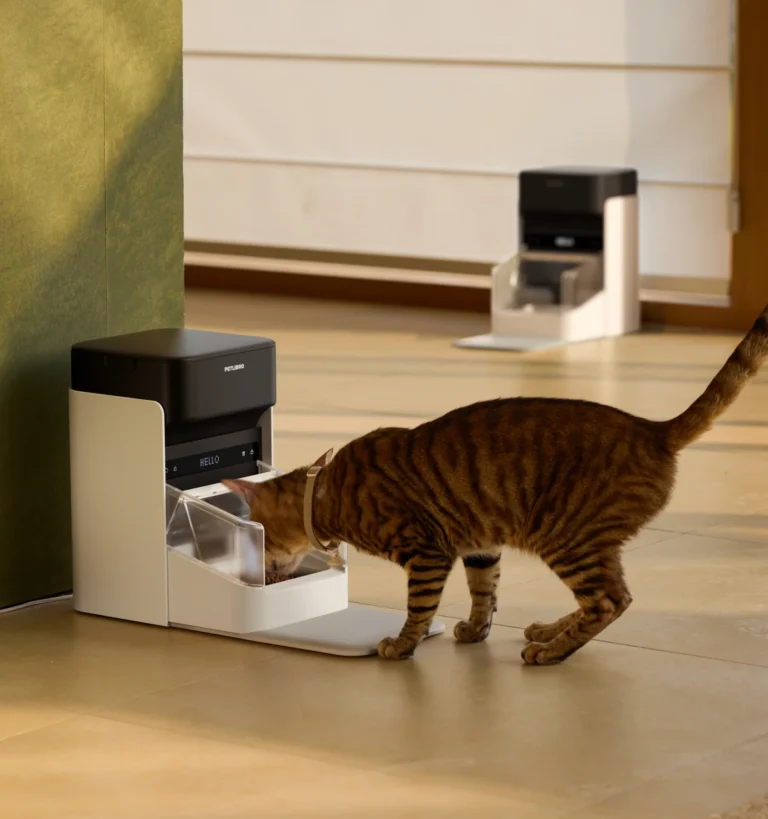
A hopper holds kibble above a dispensing mechanism. At each scheduled meal, a motor turns an impeller, auger, or segmented wheel and drops a programmed amount into the bowl. Hopper feeders are the familiar automatic dog food feeder and automatic cat feeder format because they combine scheduling with several days of storage.
They work best when the kibble fits the manufacturer’s size guidance and flows consistently. Oddly shaped pieces, oily food, crumbs, and an overfilled chute can change portions or cause jams. “Large capacity” also describes storage, not the amount a feeder can serve at once. Large dogs need adequate per-meal output, a comfortable bowl, and a cabinet that does not become a floor puzzle.
Programmable Offline Feeders
A programmable pet feeder stores meal times and portions on controls built into the unit. It may have no app at all. That can be a virtue: once programmed, a well-designed offline feeder does not care whether your router is sulking.
This is a good fit if you want timed portions without remote changes, notifications, or account setup. The tradeoff is that adjustments happen at the feeder, and the display may be less pleasant than an app. Our programmable pet feeder guide explains the motors, timers, sensors, and common jam points behind the plastic.
Smart and Wi-Fi Feeders
Smart feeders add an app for scheduling, manual dispensing, meal records, or alerts. Some continue following a schedule stored in the feeder when the internet drops; others lose remote features while offline. Those are separate questions from power backup.
Before buying, ask what is stored locally, what requires the cloud, whether the feeder supports your home’s Wi-Fi band, and what happens after a power interruption. Smart Pet Feeders and App Control: What Still Works Offline covers the useful pre-trip tests, including the wonderfully unglamorous “unplug the router and see what dinner does” test.
Camera Feeders
An automatic pet feeder with a camera lets you check the bowl area, confirm that food appeared, and notice patterns such as hesitation or another pet barging in. It does not prove that the intended pet ate every bite, and it is not a substitute for an in-person backup during a long absence.
Camera placement matters. A wide view of the room may miss the bowl; a bowl-level view may show whiskers and little else. Our automatic pet feeder with camera guide focuses on full-meal feeders, not treat-tossing cameras wearing a dinner costume.
Wet-Food Tray Feeders
Wet-food feeders divide into two practical groups. Chilled or refrigerated units actively manage temperature for a defined period. Ice-pack trays use passive cooling and usually cover a shorter window. Rotating trays can also expose several pre-portioned meals in sequence.
If your cat eats canned or fresh food, choose the cooling method before the number of app features. The best automatic cat feeder wet food compares a refrigerated option, a classic ice-pack tray, and a fresh-food feeder without pretending they are interchangeable.
RFID and Microchip Feeders
An RFID or microchip pet feeder solves access rather than timing. A lid opens when the registered cat approaches and closes when that cat leaves. This is a good fit when your pets eat different diets, one meal has medication in it, or one cat’s hobby is auditing everyone else’s bowl.
Some feeders read an implanted microchip; others use a collar tag; our surefeed automatic cat feeder review covers how recognition and training actually behave. Also plan the room around the feeder: a fast dog may learn to hover behind the cat whose chip or tag is registered. A dog proof cat feeding station combines protected access with placement and physical barriers. For how this plays out in a real two-cat house, read automatic cat feeder for two cats.
Dual-Bowl Feeders
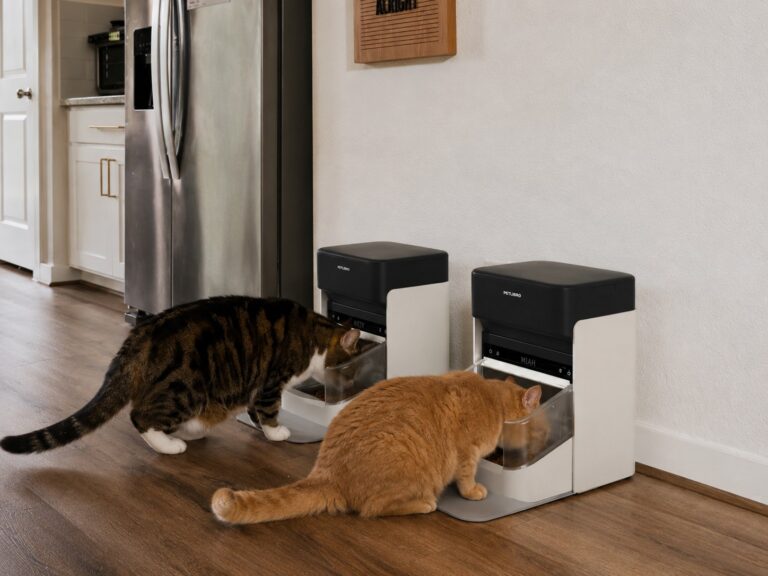
A dual-bowl feeder divides one dispensing event into two bowls. It can be convenient when two pets comfortably eat the same food, on the same schedule, in roughly appropriate portions. It does not identify each pet, stop swapping, or guarantee an even split. One cat can still finish early and become a freelance bowl consultant.
For two cats, decide whether you need simultaneous access or protected access. The best automatic cat feeder for multiple cats compares dual-bowl and RFID options side by side for exactly that reason.
Fresh-Food Feeders
Fresh-food feeders use cooling and sealed portions to serve food that cannot sit in a dry hopper. Our uahpet fresh food automatic pet feeder review takes a closer look at one of these feeders. Treat its food-safety limits, meal window, cleaning routine, and power requirements as core features—not footnotes underneath the app screenshots.
Gravity Feeders
A gravity feeder has no timer or motor. As food leaves the bowl, more drops from the reservoir. That is automatic refilling, not automatic portion control. It can reduce how often you need to top up dry food, but it cannot stop grazing, separate meals, or tell you when a pet ate.
If your actual problem is keeping the bowl supplied, gravity may be enough. If your problem is serving dinner at 6:00, it is the wrong tool. Gravity Feeder vs Automatic Pet Feeder: Which Problem Are You Solving? keeps that choice refreshingly binary.
Choosing an Automatic Dog Feeder
Dogs put more emphasis on physical fit and feeder security. A small dog may struggle with a deep, high bowl or need a genuinely small minimum portion. A large dog may need greater per-meal output, faster dispensing, a broad bowl, and enough cabinet stability to survive an investigative nose.
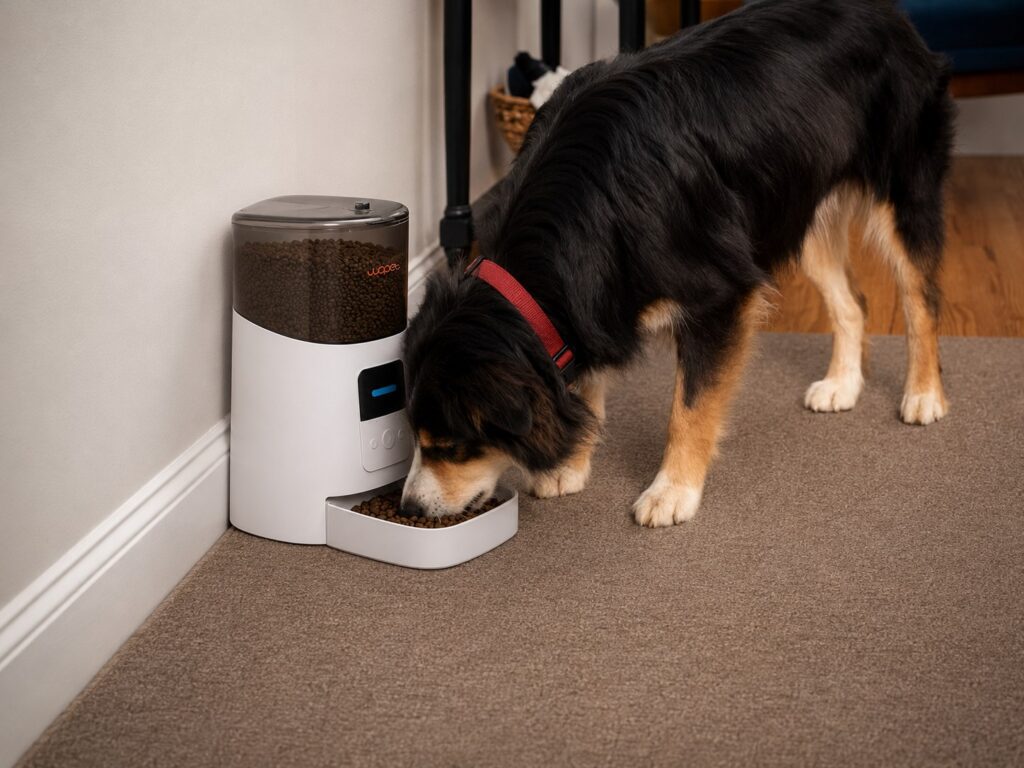
Check seven things:
- Bowl height and access: Can the dog reach comfortably without pressing into the chute?
- Minimum meal size: Is the smallest setting appropriate for the dog’s daily ration?
- Maximum meal output: Can one scheduled event serve the intended meal?
- Kibble tolerance: Does the dog’s food fit the approved size and shape range?
- Stability: Can the dog slide, tip, open, or unplug the unit?
- Refill cadence: Does capacity match how often you can inspect and clean it?
- Backup behavior: What continues after lost power or Wi-Fi?
Best Automatic Dog Feeders: Picks for Small and Large Dogs compares options for smaller and larger dogs and explains why reservoir capacity alone is a poor way to choose.
Choosing an Automatic Cat Feeder
Cats make minimum portions, food freshness, bowl shape, and multi-pet access especially important. For dry food, look for fine portion adjustment, a shallow bowl, a sealed hopper, and parts that are easy to wash. For wet food, start with cooling and the number of meals needed. For multiple cats, decide whether the cats can safely share or need individualized access.
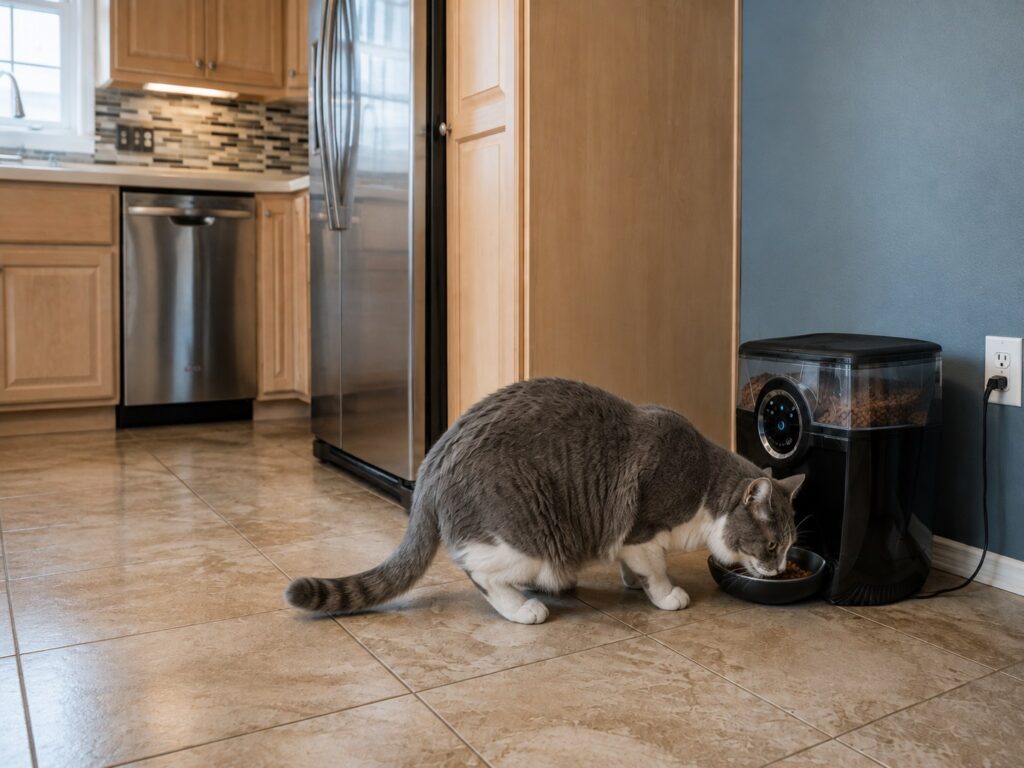
Best-of lists can make it sound as though every cat needs the same winner. Your cat will not cooperate with that idea. A feeder that is excellent for one dry-food grazer may be useless for two cats on different diets.
What Features Matter Most
Portion Control You Can Verify
Feeder “portions” are device units, not universal ounces, cups, or calories. Measure several test servings with your pet’s actual kibble. Weighing the output is more reliable than admiring the number on the screen. Repeat after changing food because size and density affect the amount delivered.
A Food Path That Matches the Food
Dry dispensers need a chute wide enough for the chosen kibble and a mechanism that does not crush it into crumbs. Wet and fresh-food units need defined cooling, covered compartments, and parts you can clean thoroughly. No feeder should become a long-term pantry for food the manufacturer did not approve.
Power and Offline Behavior
Battery backup protects against a power interruption. Local schedule storage protects against lost internet. They are not the same feature. Test both conditions while you are home, then check whether the clock, schedule, and portion settings survive.
Cleaning Without an Engineering Degree
Food-contact parts should come apart without a scavenger hunt for tiny screws. Look for removable bowls, accessible chutes, and clear guidance about which pieces are dishwasher-safe. Dry crumbs and oils accumulate where the hopper meets the dispenser; wet-food seals and tray edges deserve equally unromantic attention.
Tamper Resistance
Lid locks, recessed buttons, stable bases, guarded power cords, and secure food chutes matter in homes with persistent pets. “Pet-proof” is always relative. Observe the first several meals. Some pets see a feeder; others see a grant-funded research project.
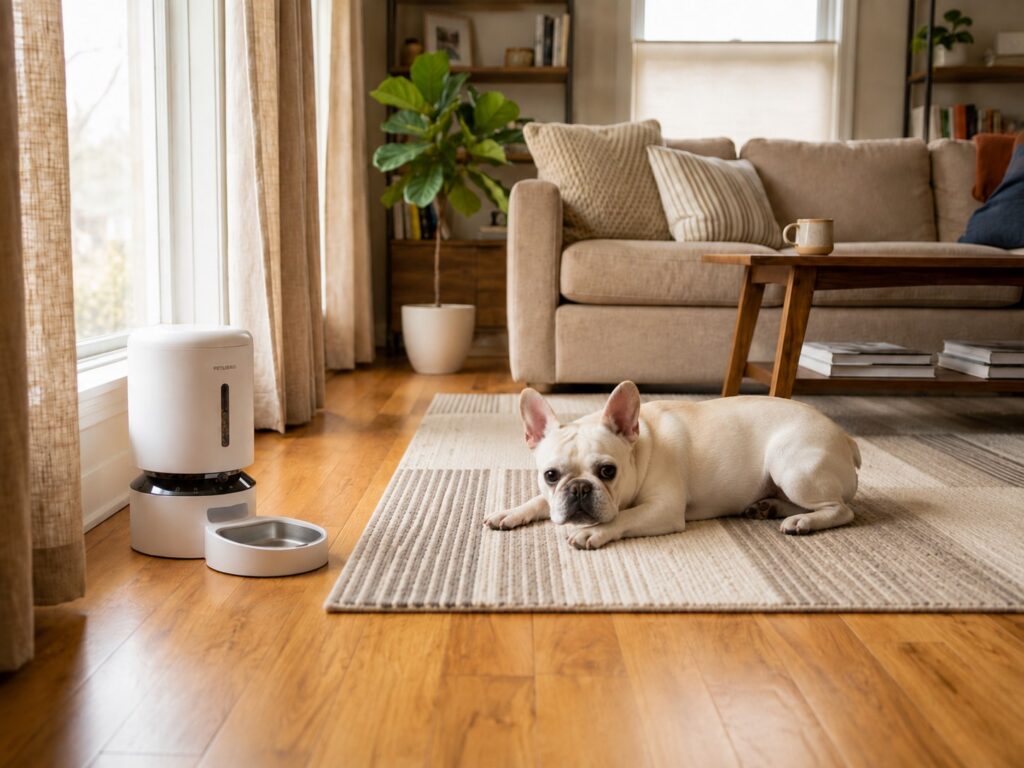
Brands to Consider for Different Feeding Routines
Once you know the feeding routine your pet needs, brand names become useful. We’d start with three: Petlibro automatic feeder spans dry, camera, wet-food, and RFID options; PETKIT automatic cat feeder separates Fresh Element Solo Automatic Feeder from YumShare Solo 2 Automatic Feeder with Camera and YumShare Dual-hopper 2 Automatic Feeder with Camera; and WOpet automatic feeder covers general, camera, and shared-bowl routines. PETKIT’s two reservoirs are a dual-hopper format—not two bowls, protected access, or individual feeding.
For cats, Oneisall automatic feeder review compares its Single Bowl Automatic Cat Feeder with App Control with its Stainless Steel Automatic Two Bowl Cat Feeder. Petmate automatic feeder covers straightforward timed and gravity feeding, Pet feeder robot is a premium dry-food option, and Uahpet covers fresh food.
Other brands you may come across include Arf Pets, Cat Mate/Closer Pets, Dogness, Geeni, Instachew, PawsPik, Pawsync, Pawpet, PetSafe, and SureFeed. PetSafe’s Eatwell 5-Meal Pet Feeder and Smart Feed Automatic Pet Feeder are additional examples, while SureFeed remains a specialist protected-access option. A familiar logo does not override food compatibility, fit, or the failure test.
Set Up the Feeder Before You Need It
Do not make departure day the feeder’s opening night.
- Wash the approved food-contact parts and dry them fully.
- Load the exact food you plan to use.
- Program several test meals and measure the output.
- Watch your pet approach, eat, and leave.
- Test a power interruption and, for smart models, an internet interruption.
- Confirm the schedule and clock afterward.
- Secure the cord and cabinet, then check for paw access to the chute.
- Arrange a human backup for longer absences.
A successful test is boring: food arrives, the right pet can reach it, nobody dismantles the lid, and the next meal remains correctly scheduled. Boring is an excellent feature in anything responsible for breakfast.
Frequently Asked Questions
Can an automatic pet feeder replace a pet sitter?
No. It can handle scheduled meals, but it cannot refill water, notice illness reliably, clean up a mess, fix a jam, or respond to a power failure. For extended absences, use the feeder as one layer of the care plan and arrange in-person checks.
Are automatic feeders good for portion control?
They can improve consistency when the meal setting is measured with the actual food. Do not assume one “portion” equals a standard volume or calorie count. Follow your veterinarian’s feeding guidance and verify the dispenser’s real output.
Will a smart feeder still work without Wi-Fi?
Some continue a locally stored schedule while remote controls and notifications stop; others depend more heavily on a connection. Check the model’s instructions and run an offline test before relying on it.
Can two pets share one automatic feeder?
Only when they can safely eat the same food on the same schedule without stealing or guarding. A dual-bowl splitter does not allocate food by identity. Different diets or persistent theft call for separate stations or protected RFID/microchip access.
What causes automatic feeders to jam?
Common contributors include kibble outside the approved size range, irregular shapes, oily residue, crumbs, overfilling, and food caught in the chute. Correct loading, routine cleaning, and test cycles reduce the risk but do not eliminate it.
The Bottom Line
Choose the feeder that fits how your pet eats, not the one with the biggest marketing halo. Use a hopper for scheduled dry food, a properly cooled tray for wet or fresh food, RFID access for diet protection, a dual bowl only for pets who share comfortably, and gravity only when continuous availability is actually the goal. The right feeder should make dinner boringly dependable—even if your pet remains committed to drama.
Then test the boring details: portions, food flow, power, offline behavior, cleaning, and pet interference. Apps and cameras can be useful. Reliable breakfast is the point.
If you would rather learn from someone else’s mistakes than your own, the stories are where the sharp edges show up. A large dog auto feeder became a nose-operated puzzle until the room changed, and a timed dog feeder delivered breakfast twice for a week because the human, not the machine, forgot the schedule. On the cat side, a timed feeder for wet cat food handled the meal but not the evening reset, five cats sorted themselves into the auto cat food dispenser each one actually needed, and one timed cat feeder worked perfectly right up until the tray was left out.