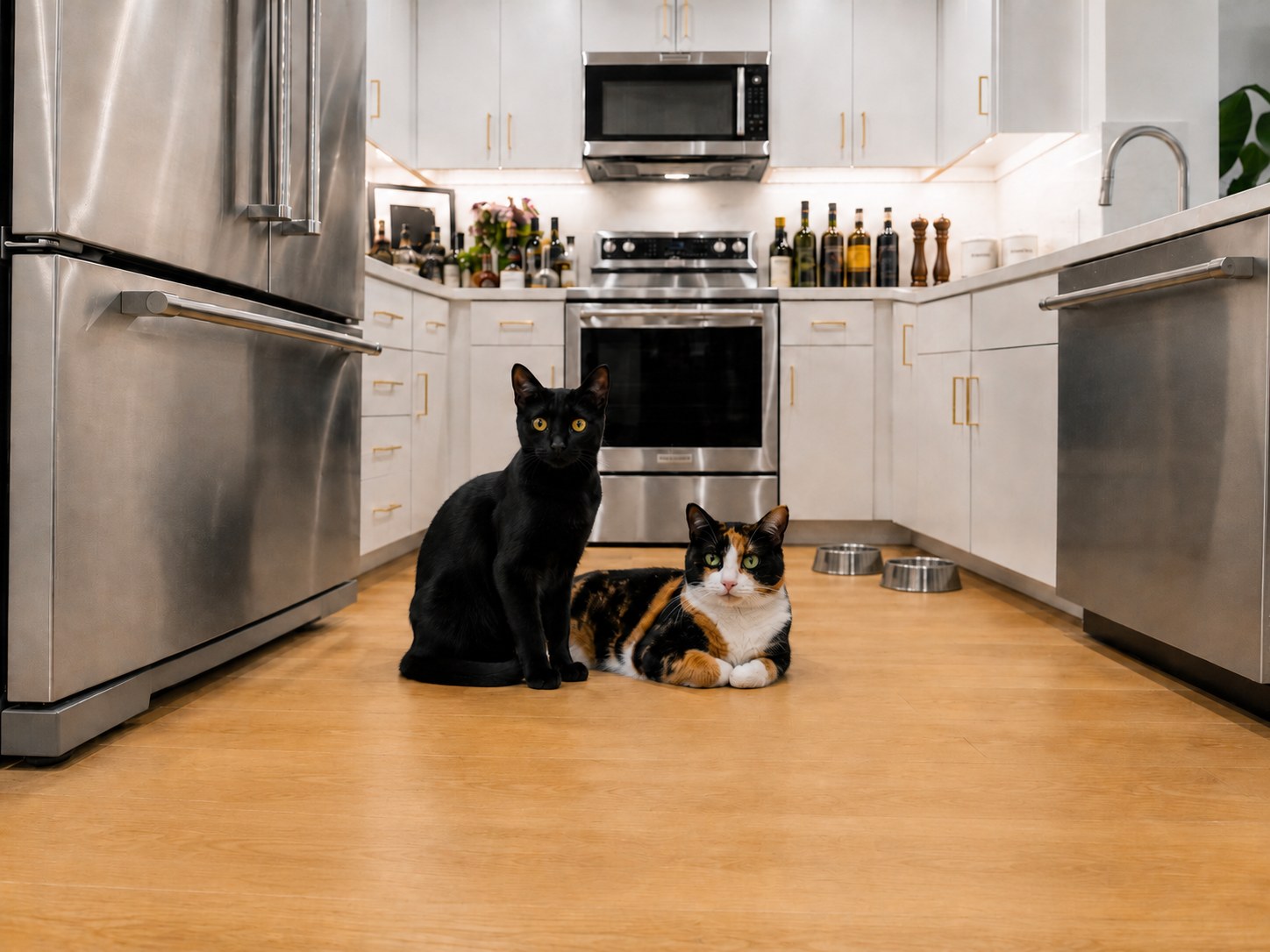
The baby started crying twelve minutes into my meeting.
I do not have a baby. I have Luna.
When Luna really commits to a complaint, she produces a sound that lands somewhere between a tiny human in distress and a fire alarm with feelings. Everyone on the call heard it. One person stopped talking. Another tilted her head toward her speakers, probably trying to decide whether asking about the baby would be polite.
“Cat,” I explained to my coworkers. This wasn’t the first time they’d heard that.
Luna yowled again from the doorway, removing any doubt that the cat had a follow-up statement.
This is how an automatic cat feeder for two cats entered my kitchen: one loud complaint, one missing cat, and one breakfast crime already in progress.
The breakfast complaint was justified
Luna was sitting very straight, tail wrapped around her paws, staring at me with the severe focus of someone who had already contacted customer service and found the response inadequate. Cali was nowhere in sight. That should also have told me something.
I muted myself and followed Luna into the kitchen.
There I found Cali with her face in Luna’s duck pâté.
Cali’s own bowl was empty. Luna’s was rapidly moving in that direction. Cali looked up with a streak of food on her chin and the open, friendly expression of a cat who had no idea why we were all making breakfast so complicated.
Luna yowled beside me.
Complaint substantiated.
Until that morning, I had been running a two-cat feeding system held together by personal preference. Luna likes chicken and duck, preferably smooth pâté. She eats a little, walks away, considers whatever mysterious business fills the rest of her calendar, and returns later.
Cali was my fish specialist. Give her tuna or salmon and she would lower her head, finish the assignment, and occasionally emerge wearing part of it.
The flavors created their own separation. Luna had duck. Cali had tuna. Luna could leave half a breakfast sitting there because Cali had standards.
Then Cali changed the standards.
Without circulating a memo, she decided duck was also delicious. So was chicken. Probably everything had always been delicious, and she had simply been conducting a long, highly disciplined study of tuna first.
This was excellent news for Cali’s personal growth and bad news for Luna’s leftovers.
Once I saw it happen, I noticed the whole pattern. Luna would eat several bites and walk away. Cali would check her own bowl, check Luna’s bowl, and make a sound business decision. A few minutes later, Luna would return to an empty dish and file another complaint with management.
Breakfast needed a guest list
I tried picking up Luna’s bowl when she left. This protected the food, but it also meant she had to ask me whenever she wanted it back. Luna is already comfortable asking me for things. She does not need programs that reward her for increasing the volume.
Smaller servings were worse. I became a breakfast waiter carrying teaspoons of duck pâté between the refrigerator and the kitchen while trying to work. My calendar did not have enough room for “Luna, second seating.”
A normal timed feeder could put food out at a chosen hour. Cali knows how to arrive at an hour. She also knows how to arrive early, remain late, and inspect anything another cat leaves behind. As I had learned while sorting through automatic pet feeder types, a timer answers when. My machine needed to recognize who was standing in front of it.
That was the moment an automatic cat feeder for two cats finally made sense to me. I needed two protected bowls and a way for each bowl to know which cat had arrived for breakfast.
The recognition method mattered
I chose two microchip-access feeders, one for each cat. The selective-access part solved the problem. The useful question was not which screen came with the bowl. It was which identity credential fit the cats we actually lived with.
Luna and Cali do not wear collars around the condo.
They enjoy being naked at home, because don’t we all?
They wear harnesses and tracking collars when I take them outside for supervised walks. Inside, they are two uncollared kitties with strong food opinions. I did not want to add breakfast credentials around their necks when two microchip-access bowls could use the implanted chips they already had.
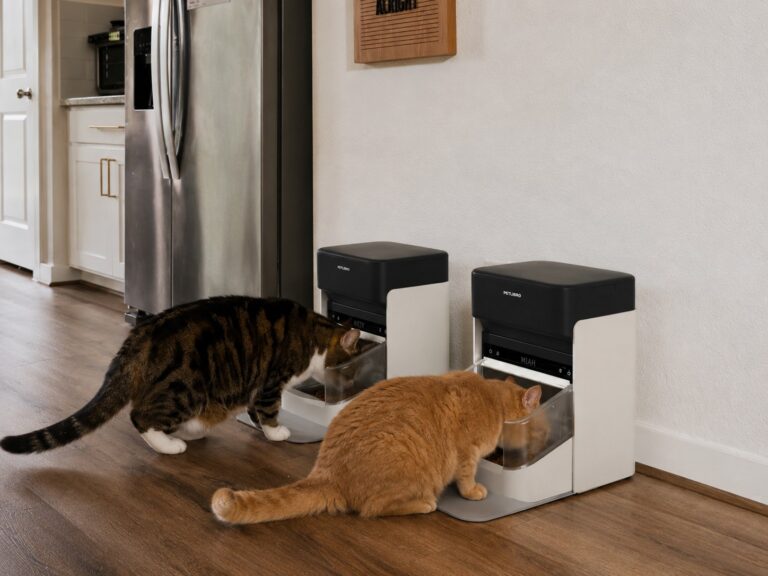
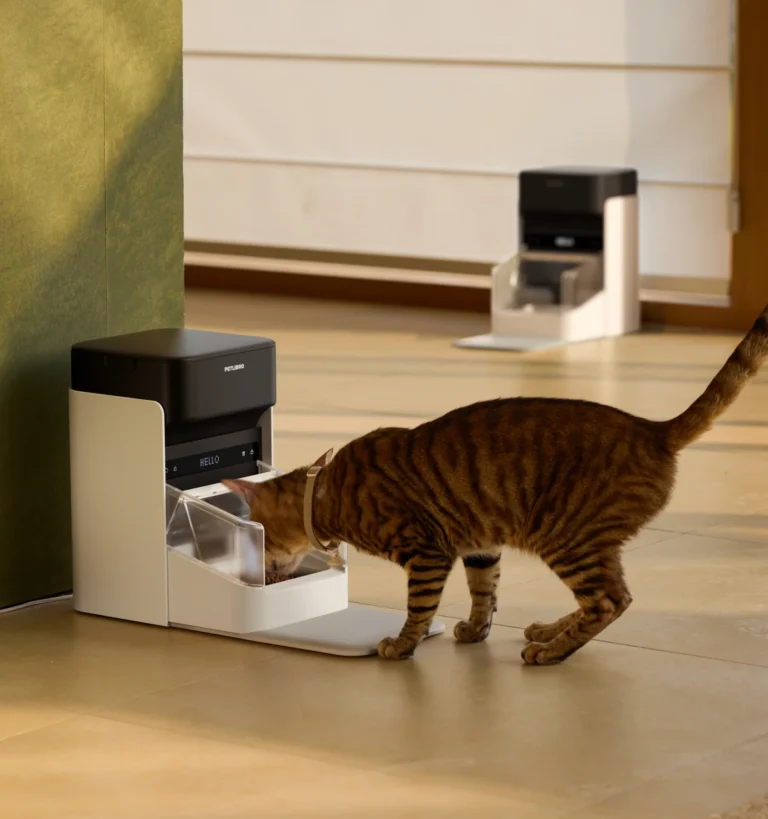
The food still went into the bowls by hand. The recognition system controlled which lid opened. When the registered cat put her head through the front hoop, the lid opened. An unauthorized cat approached and it stayed closed. It was less a food dispenser than a very small restaurant with a strict guest list.
That was the real household fit: Luna could keep her own lunch without wearing a collar, and Cali could not convert a shared kitchen into an all-you-can-eat duck buffet.
Luna needed diplomacy
Cali understood the food portion almost immediately. New bowl, food inside, head goes here. Great. She has never allowed administrative detail to stand between her and breakfast.
Luna needed diplomacy.
She is particular about objects moving near her, and the feeder lid moves. The training mode let me introduce that motion gradually, so I started with the lid open in her usual eating spot. Once she was comfortable, I added a little movement. Then a little more.
I did not rush her. You cannot rush a cat who already believes she is doing you a favor by participating.
During training, the feeders were not yet enforcing the full breakfast border. Cali remained interested in Luna’s bowl because Cali believes training is something other people do around her while she looks for snacks.
Luna kept coming back. The movement stopped being suspicious. The hoop over the top of the bowl became part of the furniture. Eventually, the lid could do its whole little mechanical slide without causing a formal objection.
Luna reminded me of the practical setup lesson: the best pet gadget feature works only after the cat agrees to put her face near it.
The duck was still there
The first real test after the bowls were fully programmed was almost boring, which is exactly what I wanted.
Luna ate some duck and walked away.
Cali finished her own meal, then wandered over to Luna’s feeder. She put her face near the hoop. The lid stayed shut. Cali looked at it, looked at me, and gave the front edge one thoughtful sniff.
There was no yowling. No drama. Just a cat discovering that the restaurant had hired a bouncer.
Later, Luna returned. The lid opened for her, and her duck was still there.
She took a few bites, neat as always, then walked away again.
Naturally, I checked both bowls. One was empty, one still held Luna’s duck, and the suspect distribution of pâté on Cali’s chin was no longer the only evidence available. Luna finishing lunch was the useful result. The calm kitchen was deeply satisfying to me.
I am not pretending two protected bowls created permanent peace in a home shared by two cats. Technology has limits, and Cali has free time. The feeders still need cleaning. Luna had to become comfortable with the lid. I still have to put the correct food into the correct bowl. A rule that is sometimes more difficult than it sounds if I’ve been out too late the night before.
In my kitchen, though, the bowls finally matched the way the cats actually ate.
Cali could be an enthusiastic member of the clean-plate club without accidentally enrolling Luna. Luna could graze without appointing me custodian of the duck. They both got breakfast, neither had to wear a collar indoors, and neither had to change her personality to make the system work.
The next time Luna interrupted a meeting, she was carrying her toy mouse and announcing it at full volume.
Different department. Same management.
For shoppers, the recognition method still comes first: SureFeed Microchip Pet Feeder and PawsPik Automatic Microchip RFID Pet Feeder are microchip-access examples, while Petlibro One RFID Cat Feeder is a collar-tag alternative for cats comfortable wearing its tag. Best Automatic Cat Feeders for Multiple Cats: RFID and Dual-Bowl Options compares protected access with shared bowls; the Complete Guide to Automatic Pet Feeders for Dogs and Cats closes the wider category map.