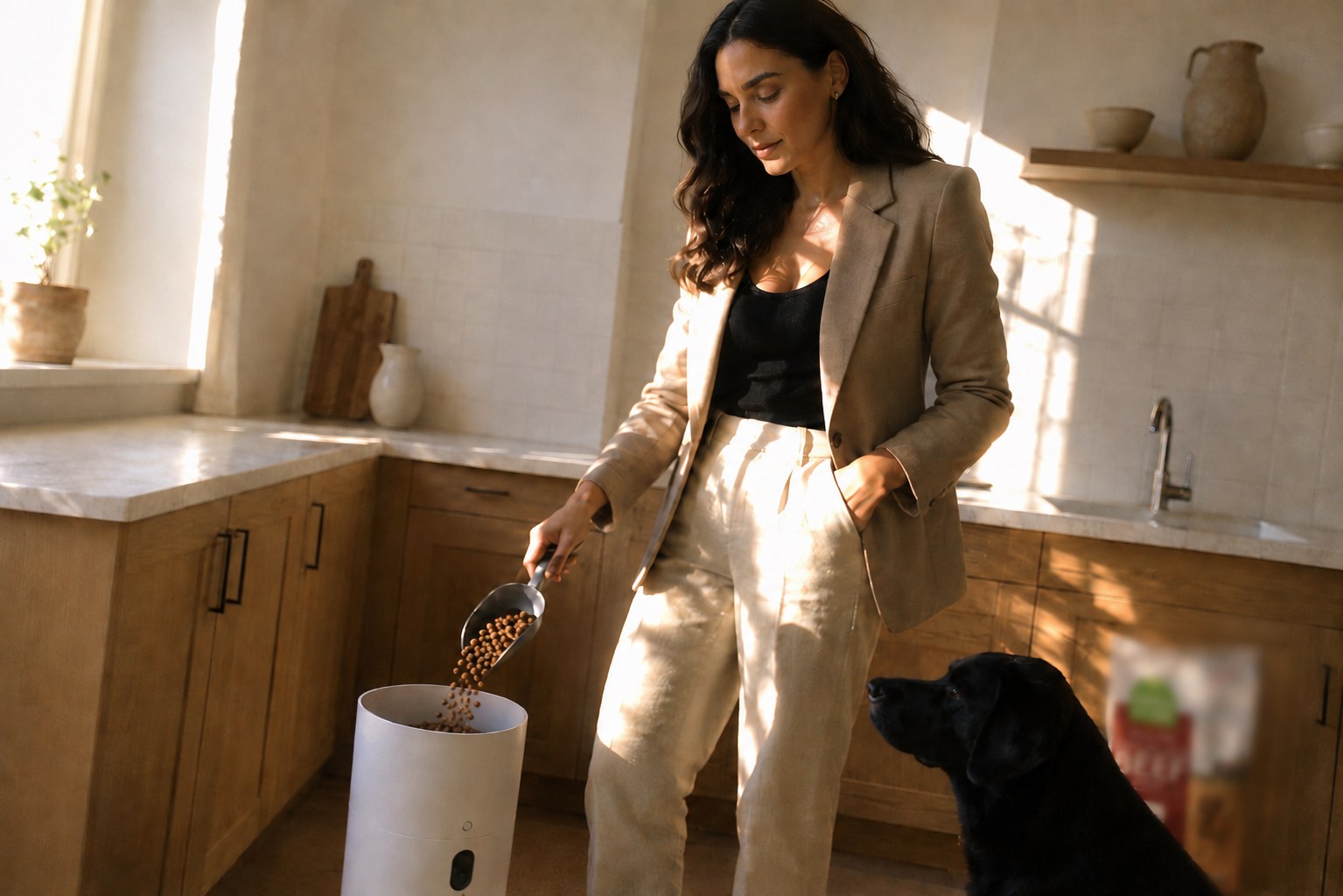
The best automatic dog feeder is not automatically the one with the biggest hopper. A small dog may need a shallow bowl and a genuinely tiny meal setting. A large dog may need several cups delivered on time, a comfortable eating position, and a cabinet that does not scoot across the kitchen under one enthusiastic nose. Capacity helps, but fit decides whether the feeder is useful. A large reservoir is storage, not proof of fit.
Skip the “big hopper, big dog” shortcut. Seven checks matter more: minimum meal size, maximum scheduled output, kibble tolerance, schedule precision, bowl access, refill cadence, and resistance to dogs who regard closed lids as personal criticism. Power backup and Wi-Fi behavior also get separate report cards. A battery can keep the motor running during an outage; it cannot restore a cloud connection.
Petlibro Granary WiFi leads the small-dog lane. For a larger dog, WOpet and Petmate lead, but neither reservoir size nor a dog silhouette on a product page earns an automatic crown. Measure meal output, bowl geometry, kibble fit, stability, and tamper resistance on the exact model. PetSafe follows only in Also considered because it is Secondary in this cluster.
Every pick still needs a kitchen test. Manufacturer portion units are not universal measurements, and the same setting can produce a different weight when kibble changes. We favor feeders with a clear job and a practical failure plan, then ask owners to verify real output, dog comfort, and recovery after an interruption before handing over a single unsupervised meal.
Quick Comparison
| Pick | Feeder | Best size lane | Why it stands out | Main tradeoff |
|---|---|---|---|---|
| Best for Small Dogs | Petlibro Granary WiFi Automatic Cat & Dog Feeder | Small to medium | Compact body, flexible scheduling, sealed dry-food storage | Confirm minimum serving with your kibble |
| Best for Large Dogs | WOpet Patrol Automatic Pet Feeder | Small to large after fit testing | Broad schedule control and a roomy bowl | Portion output and physical fit require home calibration |
| Best Offline Pick | Petmate Le Bistro Portion-Control Feeder | Small to large after fit testing | Straightforward timed dry-food delivery | Confirm current meal range, bowl height, and power method |
| Also Considered for Larger Meals | PetSafe Smart Feed Automatic Pet Feeder | Medium to large after fit testing | Broad serving range and slow-feed option | Large footprint and connected dependencies |
| Also Considered for Preloaded Meals | PetSafe Eatwell 5-Meal Pet Feeder | Small to medium | Owner-loaded compartments | Covers about a day before it needs refilling |
| Also Considered | Dogness Smart Cam Feeder | Small to medium | Connected scheduling with visual context | Camera does not prove delivery or intake |
| Also Considered | Arf Pets Automatic Pet Feeder | Small to medium | Straightforward timed dry-food format | Verify the current meal range and backup method |
| Also Considered | Geeni PetConnect Automatic Pet Feeder | Small to medium | App scheduling for existing Geeni homes | Check current support and backup behavior |
| Also Considered | PATPET Timed Automatic Double-Bowl Dog & Cat Feeder | Medium to large or two compatible pets | Large-capacity double-bowl format | Shared food is not individualized feeding |
Best Feeder for Small Dogs
Petlibro Granary WiFi Automatic Cat & Dog Feeder — Best Overall for Small Dogs
Quick Verdict: A compact, polished smart feeder that makes the most sense for small dogs when its minimum serving is calibrated to the actual kibble.
Pros:
- Compact footprint and sealed hopper design
- App-based scheduling and manual feeds
- Stainless food-contact bowl on current configurations
- Useful alerts and meal records on supported models
Cons:
- Device “portions” must be measured; they are not universal calories
- Connected features depend on network and account setup
- Kibble size and shape affect delivery consistency
Best For: Small dogs eating dry food on several scheduled meals, especially owners who value remote adjustments.
Key Specs: Granary WiFi family; dry-food hopper; app scheduling; compact bowl station.
Detailed Analysis: Petlibro’s Granary line is easier to place in a small-dog kitchen than a broad, high-output machine. The key is not assuming the smallest app setting is automatically small enough. Dispense at least ten identical test meals, weigh them, and compare the average with the daily amount set for your dog. Repeat if you change food.
The bowl should be comfortable for many small dogs, but short muzzles and flat faces deserve an actual fit check. Smart controls are convenient, not the foundation of reliability; confirm the stored schedule continues after the router is unplugged and check what happens after power returns.
Our Petlibro automatic pet feeder review covers the family’s details. See Petlibro’s current Granary options to choose the exact configuration.
Best Feeders for Large Dogs
WOpet Patrol Automatic Pet Feeder — Best for Large Dogs
Quick Verdict: A flexible app-controlled hopper for owners who want many daily meal events and are willing to calibrate portion units carefully.
Pros:
- Supports up to 15 scheduled meals per day
- Broad 1-to-50 portion programming range
- Accepts common dry-food sizes within the maker’s stated range
- Battery backup supports feeding during an AC interruption
Cons:
- Uses 2.4 GHz Wi-Fi
- Portion numbers are not direct calorie measurements
- The app cannot tell which dog ate the meal
Best For: Dogs whose routine benefits from several scheduled meals, provided the measured output, bowl height, and feeder stability fit the individual dog.
Key Specs: WOpet Patrol Automatic Pet Feeder; 6-liter class hopper; up to 15 meals; 1–50 portions; dry food; 2.4 GHz Wi-Fi.
Detailed Analysis: Fifteen possible meal events make the Patrol unusually flexible for splitting a daily ration. That does not mean a dog should receive fifteen meals; it means the schedule has room to match an owner-approved routine. The portion range is equally flexible, but it must be translated into grams using the food actually loaded.
The Patrol remains a single-bowl feeder. It cannot verify identity or stop another pet from arriving first. Battery operation helps during an outage, while remote control still depends on the network. Read our WOpet Automatic Feeder Review, then check the current WOpet Patrol Automatic Pet Feeder for exact availability.
Petmate Le Bistro Portion-Control Feeder — Best Offline Pick
Quick Verdict: A direct timed-hopper option for owners who want scheduled dry food without making an app the center of the routine.
Pros:
- Straightforward programmable dry-food delivery
- Single-bowl layout avoids shared-meal ambiguity
- Keeps its schedule through a router outage or a power cut
- Active Petmate review route for deeper brand context
Cons:
- Portion output still needs testing with the actual kibble
- Hopper capacity does not prove large-dog meal fit
- Bowl height, stability, and power behavior require an at-home check
Best For: Dogs whose owners value a simple local schedule.
Key Specs: Dry-food hopper; programmable portion control; single bowl; model-specific meal range and power method.
Detailed Analysis: Petmate Le Bistro Portion-Control Feeder solves the ordinary timing problem without pretending that simplicity removes calibration. Run repeated portions, weigh the results, and watch the dog approach the bowl. For a large dog, verify maximum output per event and cabinet stability; for a small dog, verify the minimum repeatable serving.
A single bowl also keeps the social contract clear. If two dogs share a station, the feeder cannot identify who arrived first or who finished the meal. Our Petmate Automatic Feeder Review explains the brand’s timed-feeding lane. View current Petmate feeder options before choosing the exact configuration.
Also Considered
PetSafe Smart Feed Automatic Pet Feeder — Also Considered for Larger Meals
Quick Verdict: A fit-limited option for owners who need a broad serving range, slow dispensing, and backup-power planning in one established platform.
Pros:
- 24-cup dry or semi-moist food capacity
- Schedules up to 12 meals per day
- Meal settings run from 1/8 cup to 4 cups
- Optional slow-feed delivery spreads a larger meal over 15 minutes
- AC power with optional battery backup
Cons:
- Takes more floor space than compact cat-oriented hoppers
- Remote features require compatible 2.4 GHz Wi-Fi
- The stainless bowl is wide, but some dogs may still prefer a raised feeding position
Best For: Medium and large dogs whose daily ration needs a wide per-meal range, especially fast eaters who benefit from slower dispensing.
Key Specs: 24-cup hopper; up to 12 meals; 1/8- to 4-cup meal range; 2.4 GHz connection; optional four-D-cell backup.
Detailed Analysis: PetSafe remains relevant in the secondary lane by addressing output, storage, and failure planning together. Four cups in one scheduled meal covers a much broader lane than feeders built around tiny portion units, while slow feed can break a meal into a 15-minute delivery instead of producing one glorious kibble avalanche. The hopper should reduce refill frequency, but it still needs routine checks; capacity is not permission to ignore crumbs, oils, or a blocked chute.
The bowl sits at floor level. Measure your dog’s comfortable stance and consider the entire station, not just the machine. Also test battery operation before travel, because installed batteries and a successful test are more useful than a backup icon on a product page.
PetSafe is worth a look, but it is not where we would start. Serving range, bowl fit, and power behavior are where it either suits a big dog or does not.
PATPET Timed Automatic Double-Bowl Dog & Cat Feeder — Also Considered for Large-Capacity Dual Feeding
Quick Verdict: A secondary large-capacity, double-bowl candidate for compatible pets.
Pros:
- Large 25.4-cup-class capacity across two bowls
- Double-bowl format
- Timed dry-food dispensing
- Retailer tracking route is available
Cons:
- Not individualized feeding
- Needs current-listing verification for controls and included parts
- Less feeder-specific support depth than the lead picks
Best For: Owners who want another large hopper and dual-bowl option after confirming both dogs can safely share.
Key Specs: PATPET double-bowl model; timed automatic format; double bowls; large-capacity dry-food storage.
Detailed Analysis: The double-bowl model is relevant because its combination of storage and two bowls serves a real household scenario: two dogs eating the same kibble at the same time. It is not a workaround for prescription diets or resource guarding.
Run measured test meals with your kibble and both dogs present. Check current PATPET feeder listings before deciding.
PetSafe Eatwell 5-Meal Pet Feeder — Also Considered for Preloaded Meals
Quick Verdict: A preloaded compartment tray for owners who portion by hand and only need a day covered, not a connected feeder.
Pros: Five owner-filled compartments; portions measured by you rather than a motor; simple battery operation.
Cons: One day of meals at most; no app, alerts, or feeding history; compartment depth limits a large dog’s ration.
Best For: Small to medium dogs on a single-day schedule, or a short absence where a person restocks the tray daily.
Key Specs: Five compartments; rotating tray; battery powered; dry or semi-moist food.
Detailed Analysis: Eatwell solves a narrower problem than the picks above. Because you fill each compartment yourself, portion accuracy is your measuring cup rather than a dispensing motor, which suits owners who already weigh meals. The tradeoff is horizon: five compartments cover roughly a day, so it does not replace a hopper feeder for a working week. A large dog’s full ration also rarely fits a tray compartment. Check the current PetSafe Eatwell configuration before assuming your dog’s meal size fits.
Dogness Smart Cam Feeder
Quick Verdict: Worth a look when you want connected scheduling with a camera view and find a current configuration that fits your dog.
Pros: Connected controls; on-board camera for visual checks; established pet-tech catalog; retailer route available.
Cons: Model names and feature sets can vary; confirm backup power, meal range, and bowl dimensions.
Best For: Small or medium dogs after hands-on fit and listing verification.
Key Specs: Smart dry-food hopper; app-controlled schedule; camera monitoring; model-dependent capacity.
Detailed Analysis: Dogness sits below the lead picks because the current listing must do more work than the logo. Compare its minimum and maximum output with your dog’s ration, then look for a removable bowl, a secure lid, and a clear offline schedule policy. Check current Dogness feeder listings rather than relying on an older model name.
Arf Pets Automatic Feeder
Quick Verdict: A conventional timed-hopper alternative for owners who prioritize local programming over a feature-heavy ecosystem.
Pros: Familiar dry-food format; programmable meals; typically straightforward controls.
Cons: Exact capacity and settings vary; support depth is lighter than the lead picks; buying routes run through the brand site rather than a major retailer.
Best For: Small to medium dogs when the current unit’s meal range and food fit check out.
Key Specs: Programmable dry-food dispenser; hopper and bowl configuration varies by current model.
Detailed Analysis: Arf Pets makes the list because a simple timer can be the right answer. Confirm the current manual, especially portion-unit size, power backup, and cleaning instructions. A bargain is not a bargain if the minimum serving is half a small dog’s day. Review Arf Pets’ current feeder catalog before purchase.
Geeni Smart Pet Feeder
Quick Verdict: Most relevant for households already comfortable with Geeni’s app, provided current support and offline behavior meet the feeding plan.
Pros: App scheduling; familiar platform for existing Geeni users; remote manual-feed potential.
Cons: Ecosystem convenience does not prove portion accuracy; current feeder availability may vary; backup behavior needs testing.
Best For: Small or medium dogs in an established Geeni smart-home setup.
Key Specs: Connected dry-food feeder; app-controlled schedule; current model determines capacity and power options.
Detailed Analysis: Using one app for several devices is convenient, but dinner deserves its own reliability check. Measure portions, disable Wi-Fi, interrupt power, and see which functions recover without intervention. If the feeder cannot pass those tests while you are home, it should not get a solo shift. See Geeni’s current pet-supply collection for availability.
How to Match a Feeder to Dog Size
For a small dog, begin at the bottom of the serving range. Confirm the smallest repeatable meal, bowl depth, lip height, and whether the dog can eat without leaning into the chute. For a large dog, begin at the top: maximum output per scheduled event, dispensing speed, bowl width, hopper refill interval, and base stability.
Do not use hopper capacity as a proxy for dog size. A large reservoir can feed a small dog for longer; it does not prove a big dog can receive enough food in one meal. Likewise, a compact feeder may produce adequate food but create an awkward eating position.
If your main question is storage versus scheduled portions, compare Gravity Feeder vs Automatic Pet Feeder: Which Problem Are You Solving?. Gravity keeps the bowl supplied. It does not enforce a meal time.
Setup and Safety Checks
1. Measure the intended daily ration using your veterinarian’s guidance. 2. Run at least ten test portions with the actual kibble and weigh the results. 3. Confirm the dog’s neck and muzzle position at the bowl. 4. Watch for paw access, lid lifting, cabinet sliding, and cord chewing. 5. Test an internet outage and a power outage separately. 6. Clean the chute and food-contact parts on the maker’s schedule. 7. Arrange human check-ins during longer absences.
An automatic dog food dispenser is a scheduling tool, not a substitute for observing appetite, water intake, comfort, and changes in behavior.
Frequently Asked Questions
What is the best automatic dog feeder for a large dog?
WOpet Patrol Automatic Pet Feeder is our pick for most large dogs: it delivers up to fifteen meals a day across a fifty-step portion range, so a big ration can be split rather than dumped, and its app records what actually dispensed. Choose Petmate Le Bistro Portion-Control Feeder instead if you want the schedule held locally with no account involved. Either way, measure the real output with your own kibble before trusting it.
What is the best automatic dog feeder for a small dog?
Petlibro Granary WiFi Automatic Cat & Dog Feeder is our top small-dog pick, but its minimum real-world output must be tested with your kibble. Petmate Le Bistro Portion-Control Feeder is the simpler local-timing alternative.
Can two dogs share a dual-bowl feeder?
Only if they eat the same food on the same schedule without guarding or stealing. A splitter cannot identify dogs or guarantee equal distribution. Use separate stations when portions or diets differ.
Will battery backup keep the app working?
Not necessarily. Batteries may keep the motor and stored schedule running, while the app still needs Wi-Fi and internet access. Test both failures independently.
How big a hopper does a large dog actually need?
Work backwards from the ration, not the label. A dog eating four cups a day empties a six-litre hopper in roughly six days, which is a sensible refill rhythm. Buying double that mostly buys stale kibble at the bottom, because dry food degrades once the bag is open regardless of which container it sits in.
Final Verdict
For a large dog, buy the WOpet Patrol Automatic Pet Feeder. Two things settle it: the fifty-step portion range lets you split a big ration across up to fifteen daily meals instead of dropping it in two avalanches, and the app keeps a dispensing log, so when your dog insists breakfast never happened you have a record rather than an argument. Petmate Le Bistro Portion-Control Feeder is the pick only if you specifically want the schedule held on the device with no account at all. Petlibro Granary WiFi Automatic Cat & Dog Feeder remains the sharper small-dog fit. PetSafe, Dogness, Arf Pets, Geeni, and PATPET are worth a look but are not where we would start.
Choose by meal range and physical fit first. Then verify the food path, power plan, offline behavior, cleaning routine, and dog-proofing. The right feeder should make dinner uneventful—which is high praise when your quality-control manager has four paws.
For the wider category map, read the Complete Guide to Automatic Pet Feeders for Dogs and Cats. Also compare the best automatic cat feeder for multiple cats and the best automatic cat feeder for wet food if your home includes feline coworkers.