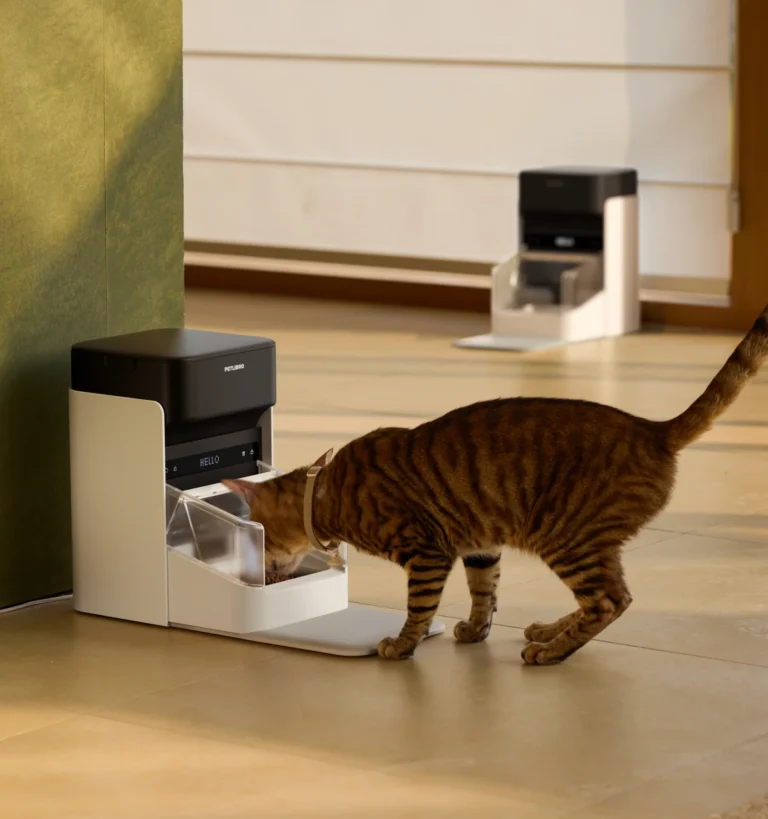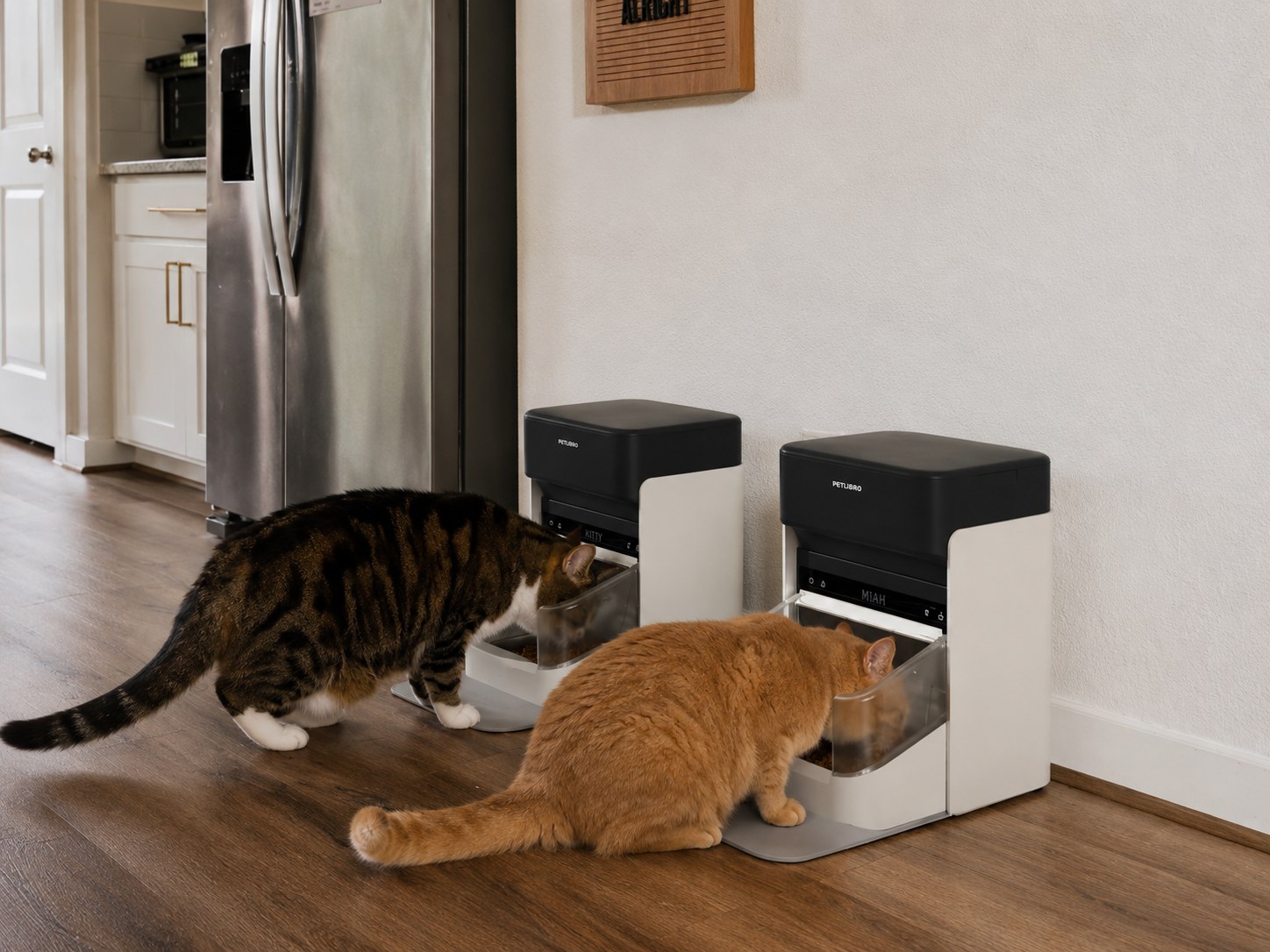
The best automatic cat feeder for multiple cats depends on what “multiple” is doing to dinner. If two friendly cats eat the same kibble, on the same schedule, with no theft or guarding, a dual-bowl feeder can serve them together. If one cat needs prescription food, one grazes, or one has the moral compass of a tiny buffet pirate, you need protected access instead.
A second bowl is extra seating, not a bouncer. A dual automatic cat feeder splits a scheduled dry-food delivery between two bowls, but it cannot identify the diner, promise a perfect 50/50 split, or stop a fast cat from touring both sides. An RFID or microchip feeder checks who may enter. Many protect food already in the bowl rather than serving a new meal on the clock. Decide whether dinner needs another chair or a guest list. Buying one while expecting the other is how meal plans unravel.
The winners therefore answer different household arguments. Petlibro Granary 2 Vision Duo leads the shared-meal group with scheduled dry food, two bowls, and a camera. SureFeed Microchip Pet Feeder leads protected access because it reads compatible implanted microchips as well as collar tags and stays focused on one job: keeping the wrong pet out of a covered bowl.
First choose shared access or protected access. Then compare the products inside that lane. PETKIT YumShare Dual-hopper 2 Automatic Feeder with Camera stores two foods, but it is not a dual-bowl feeder or a selective-access system and does not belong in either recommendation table.
We also considered training, bowl layout, power behavior, and how easily a second pet can exploit the setup. Electronics help most when the room supports them.
Quick Decision: Dual Bowl or RFID?
| Household problem | Choose | What it does | What it does not do |
|---|---|---|---|
| Two compatible cats share one dry food and schedule | Dual-bowl feeder | Dispenses a timed amount through a splitter into two bowls | Identify cats, guarantee equal portions, or prevent swapping |
| Cats eat different diets | RFID or microchip feeder | Opens a protected bowl for an authorized cat | Automatically refill the bowl unless the model also includes dispensing |
| One cat eats much faster | Usually protected access or separate stations | Limits access to the intended bowl | Change the fast cat’s behavior by itself |
| One cat grazes and one steals | RFID or microchip feeder | Lets the grazer revisit protected food | Keep a dog from hovering behind the cat without good placement |
| Both cats need scheduled portions and individual accountability | Two separate timed feeders, ideally in separate spaces | Gives each cat an assigned station | Requires more space, setup, and cost |
Best Dual-Bowl Automatic Cat Feeders
| Pick | Model | Best for | Standout | Main limit |
|---|---|---|---|---|
| Best Dual-Bowl Feeder | Petlibro Granary 2 Vision Duo | Owners who want premium shared feeding plus a camera | Two-bowl scheduled delivery with monitoring | Camera cannot prove which cat ate which portion |
| Best Dual-Bowl Without Camera | Petlibro Granary WiFi Automatic Two Cat & Dog Feeder | Compatible cats sharing a dry-food routine | Connected scheduling in a simpler dual format | Split delivery is not individualized feeding |
| Best WOpet Dual Option | WOpet Heritage View Automatic Pet Feeder with Camera, Dual Bowls | Shared meals with visual checks | Camera-equipped two-bowl format | Pet identity and equal distribution remain unverified |
| Best WOpet Simpler Option | WOpet Heritage Air Smart Pace Feeder, Dual Bowls | Shared dry-food schedules | Smart pacing without making video the centerpiece | Confirm current model and portion range |
| Best Large-Capacity Dual Pick | Oneisall Stainless Steel Automatic Two Bowl Cat Feeder | Two compatible cats and less frequent refills | Large hopper and stainless bowls | More food stored does not create portion accountability |
| Also Considered | PATPET Timed Automatic Double-Bowl Feeder | High-capacity shared feeding for infrequent refills | Large-capacity double-bowl candidate | Listing details and availability need verification |
Petlibro Granary 2 Vision Duo — Best Dual-Bowl Feeder
Quick Verdict: The premium shared-meal choice for owners who want scheduled dry food, two bowls, and a camera in one unit.
Pros:
- Two-bowl format built for simultaneous access
- Camera can show whether food arrived and what happened around the station
- Connected scheduling and manual-feed controls
- Sealed hopper design in the Granary family
Cons:
- Video cannot identify cats with certainty or measure each cat’s intake
- One cat can cross over after finishing
- Higher complexity than a basic two-bowl hopper
Best For: Two compatible cats that eat the same dry food on the same schedule, with an owner who values visual monitoring.
Key Specs: Granary 2 Vision Duo; two bowls; dry-food hopper; camera; app-connected scheduling.
Detailed Analysis: The Vision Duo wins this class because it is the most complete version of the shared-bowl idea, not because it turns one feeder into two private dining rooms. The camera can answer “Did food land?” and may reveal obvious pushing or no-shows. It cannot confirm exact consumption when cats swap places or share a bowl.
Treat setup as a small behavior study. Mark the bowls, record several meals, and see whether the splitter distributes acceptably with your kibble. Watch whether each cat stays on one side. If the answer is no, move to separate timed feeders or the protected-access table below.
Our Petlibro automatic pet feeder review covers the feeder family. Check Petlibro’s current dual-bowl camera configuration before ordering.
Petlibro Granary WiFi Automatic Two Cat & Dog Feeder — Best Dual-Bowl Without Camera
Quick Verdict: A cleaner fit when shared scheduling matters but live video does not.
Pros:
- Two-bowl scheduled dry-food format
- App control without paying specifically for a camera
- Compact shared station compared with two full hopper units
- Familiar Granary food-storage design
Cons:
- Does not identify pets
- Splitter performance depends on level placement and kibble flow
- Remote controls still depend on network access
Best For: Two cats that already share peacefully and whose owner wants remote schedule changes.
Key Specs: Granary WiFi two-cat/dog feeder; dual bowls; connected dry-food scheduling; shared hopper.
Detailed Analysis: Removing the camera does not change the essential fit test. Both cats must eat the same food, and the owner must be comfortable with shared delivery. Level the unit, measure each bowl after repeated test cycles, and do not assume the total serving lands evenly just because the bowls look symmetrical.
The simpler feature set may be preferable when the feeder sits in a low-traffic room and you already know the cats’ meal behavior. If you need proof of individual access, skip this category. Compare Petlibro’s current two-bowl models.
WOpet Heritage View Automatic Pet Feeder with Camera, Dual Bowls — Best WOpet Dual Option
Quick Verdict: A camera-equipped shared feeder for owners who prefer WOpet’s connected platform and accept the limits of a split bowl.
Pros:
- Dual bowls for simultaneous dry-food access
- Camera provides a view of the feeding area
- App-based schedule and manual-feed functions
- Useful alternative to Petlibro’s premium duo
Cons:
- Camera view is not individual intake data
- Exact camera angle and model availability should be checked
- One cat can still raid the other bowl
Best For: Compatible cats sharing a schedule in a household that wants visual checks.
Key Specs: Heritage View family; camera; shared hopper; dual bowls; connected scheduling.
Detailed Analysis: Heritage View belongs in the same honest box as Vision Duo: helpful monitoring around a shared station, no identity control. Place it where the view includes both bowls rather than a dramatic close-up of one ear. Test nighttime visibility if the important meal happens before sunrise.
WOpet model names can sit close together, so confirm you are viewing the dual-bowl camera model—not a single-bowl camera feeder or a treat device. Read our WOpet Automatic Feeder Review, then verify the current Heritage View configuration.
WOpet Heritage Air Smart Pace Feeder, Dual Bowls — Best WOpet Simpler Option
Quick Verdict: The WOpet lane for owners who want shared smart feeding without making video the deciding feature.
Pros:
- Dual-bowl shared format
- Scheduled dry-food dispensing
- Smart pacing emphasis can suit divided meal routines
- Less camera complexity than Heritage View
Cons:
- Still cannot assign a bowl to a cat
- Current portion increments and backup method need model-level confirmation
- Shared meals are unsuitable for different diets
Best For: Two compatible cats whose main need is timed shared kibble.
Key Specs: Heritage Air Smart Pace family; dual bowls; dry-food hopper; smart scheduling.
Detailed Analysis: Heritage Air is the more focused WOpet choice when your question is “Can two cats get breakfast together?” rather than “Can I watch them do it?” Calibration remains the chore that matters. Run repeated servings, compare the bowls, and observe whether the cats maintain their lanes.
If either cat needs a precise ration, two independent feeders provide clearer accountability. See WOpet’s current dual-bowl lineup.
Oneisall Stainless Steel Automatic Two Bowl Cat Feeder — Best Large-Capacity Dual Pick
Quick Verdict: A strong shared-bowl candidate when hopper capacity and easy-clean bowls outrank cameras.
Pros:
- Large-capacity hopper for less frequent refills
- Two stainless bowls
- App-supported timed feeding on current smart configurations
- Good value when two cats can safely share
Cons:
- Stored capacity can encourage overlong refill intervals
- Does not recognize either cat
- Bowl swapping and uneven distribution remain possible
Best For: Two compatible dry-food cats whose owner wants fewer refills and washable bowls.
Key Specs: Oneisall 20-cup class two-bowl feeder; stainless bowls; shared dry-food hopper; programmable delivery.
Detailed Analysis: Oneisall emphasizes the practical parts of the dual-bowl class: plenty of dry-food storage and bowls that are straightforward to remove and wash. Those are useful qualities, but a full hopper still needs inspection for crumbs, oils, and stale food. Refill cadence should follow food quality and cleaning needs, not just the moment the bin reaches empty.
This model is not a fix for a food bully. Watch several meals and separate the station if one cat controls both sides. Our Oneisall automatic pet feeder review adds brand context. Check the current Oneisall feeder lineup for the exact two-bowl configuration.
PATPET Timed Automatic Double-Bowl Feeder — Also Considered
Quick Verdict: A high-capacity double-bowl candidate for households that refill infrequently, once the current retailer listing checks out.
Pros:
- Double-bowl timed format
- Large 25.4-cup-class capacity across two bowls
- Useful retail fallback route
- Sold through a major retailer with a standard return window
Cons:
- No pet identification
- Current controls, accessories, and return terms require listing verification
- Less feeder-specific support depth than the primary brands
Best For: Compatible cats sharing dry food after careful listing and portion checks.
Key Specs: PATPET timed double-bowl feeder family; large dry-food hopper; timed delivery; double bowls.
Detailed Analysis: PATPET gives the comparison a lower-profile alternative without inventing a new feeding class. Its double bowls are useful under the same narrow condition as every other splitter: both cats can share. If one needs a different calorie target, “close enough” is not a feeding plan.
Then test distribution on a level floor. Check current PATPET listings before purchase.
Best RFID and Microchip Cat Feeders
| Pick | Model | Recognition method | Best for | Main limit |
|---|---|---|---|---|
| Best Protected-Access Feeder | SureFeed Microchip Pet Feeder | Compatible implanted microchip or collar tag | Different diets and food theft | Protects a loaded bowl; does not schedule hopper meals |
| Best RFID Dispenser | Petlibro One RFID Cat Feeder | Included collar tag | Timed dry food plus identity-controlled access | Requires the collar tag; not an implanted-chip reader |
| Best Compact Collar-Tag Option | PawsPik Automatic Microchip RFID Pet Feeder | Collar tag | A smaller protected-access footprint | Verify current tag, power, and warranty details |
SureFeed Microchip Pet Feeder — Best Protected-Access Feeder
Quick Verdict: The best choice when the primary problem is keeping one cat’s food away from another pet.
Pros:
- Reads compatible implanted microchips
- Can also use a collar tag
- Covered bowl helps limit casual theft and exposure
- Focused design for individual access
Cons:
- The owner loads the food; it is not a timed hopper dispenser
- A persistent dog may hover behind the authorized cat
- Separate units are needed for multiple protected bowls
Best For: Cats on different diets, slow grazers, and homes where another pet steals from an open bowl.
Key Specs: Microchip or collar-tag access; covered bowl; training mode; single authorized feeding station.
Detailed Analysis: SureFeed wins the protected lane because its purpose is admirably specific. The lid opens for a registered pet and closes when that pet moves away. That makes it useful for prescription food, calorie separation, or a cat who wants to revisit a meal without leaving it open to roommates.
It is access control, not scheduled replenishment. You still portion and refresh the food. Use training mode gradually, and observe the cat’s comfort with the lid movement. In a dog household, place the station so the cat can approach while the dog cannot stand immediately behind it.
Our SureFeed Microchip Pet Feeder review covers training and fit. Check the current SureFeed listing if protected access is the job.
Petlibro One RFID Cat Feeder — Best RFID Dispenser
Quick Verdict: The strongest hybrid for owners who want scheduled dry-food dispensing and collar-tag-controlled bowl access in one station.
Pros:
- Combines a dry-food hopper with protected access
- Included RFID collar tag identifies the assigned cat
- App-supported scheduling and feeding records
- Better fit than a simple lid feeder when fresh scheduled portions matter
Cons:
- Does not read an implanted microchip
- The cat must wear the compatible tag
- One unit serves one protected station
Best For: A cat that needs both timed dry meals and protection from food theft.
Key Specs: Petlibro One RFID Cat Feeder; collar-tag recognition; covered bowl area; dry-food hopper; app controls.
Detailed Analysis: Petlibro One bridges the two classes without erasing their distinction. It dispenses by schedule and limits access using its tag, making it useful when an open timed bowl would become community property. The tag requirement is the crucial fit question. Cats that do not tolerate collars are not good candidates, regardless of how elegant the app looks.
Introduce the moving cover and tag gradually. Test whether the authorized cat can approach from a comfortable angle and whether another pet can tailgate. Review the Petlibro feeder family and confirm the current Petlibro One RFID Cat Feeder package before ordering.
PawsPik Automatic Microchip RFID Pet Feeder — Best Compact Collar-Tag Option
Quick Verdict: A secondary collar-tag option for protected access when its current specifications and support terms fit the household.
Pros:
- RFID access-control concept addresses food theft
- Relevant alternative outside the two primary brands
- Direct brand route is available
- Suits a station where a smaller footprint matters
Cons:
- Requires current verification of the included tag and recognition setup
- Support and replacement-part depth may be lighter
- Collar-tag access is not implanted-microchip access
Best For: Owners comparing lower-profile RFID feeders who are comfortable verifying the live model carefully.
Key Specs: PawsPik RFID feeder family; collar-tag recognition; protected bowl access; exact current configuration varies.
Detailed Analysis: PawsPik is an “also verify” recommendation, not a reason to relax the checklist. Confirm how many tags are included, whether replacements are available, what happens when power fails, and whether the lid stays safely open while the registered cat eats.
The distinction between RFID and microchip compatibility matters. A collar-sensor product does not automatically read the chip implanted by a veterinarian. Check PawsPik’s current RFID feeder and its return terms before choosing it over the better-documented leaders.
How to Build a Multi-Cat Feeding Setup
Map the Cats Before the Products
Write down each cat’s food, daily amount, meal timing, eating speed, collar tolerance, and theft habits. If the rows differ, a shared feeder deserves skepticism. If the rows match and the cats eat calmly, a dual bowl may work.
Give Each Station an Escape Route
Do not wedge a feeder where one cat can block the only exit. Protected access prevents bowl entry; it does not prevent hallway politics. Space stations apart and use furniture or gates to break sight lines where needed.
Train One Change at a Time
Introduce the feeder while you are present. For RFID lids, use the maker’s training steps and reward calm approaches. For dual bowls, observe actual meal behavior before leaving the cats alone with the system.
For the household comedy hiding inside that setup work, read Luna Filed a Breakfast Complaint. We Needed an RFID Automatic Cat Feeder for Two Cats.
Add Dog Resistance if Necessary
An authorized cat can still open a protected bowl while a dog waits inches away. Elevation, cat-sized pass-throughs, room layout, and gated zones can do as much work as the electronics. Our dog proof cat feeding station guide builds those layers without pretending one gadget wins every household.
Frequently Asked Questions
What is the best automatic cat feeder for two cats?
For two compatible cats sharing one dry food, Petlibro Granary 2 Vision Duo is our top dual-bowl pick. For two cats on different diets, use protected RFID or microchip access—or separate stations—rather than one shared hopper.
Does a dual cat feeder divide food equally?
Not necessarily. Splitters can distribute unevenly depending on kibble and placement, and cats can change bowls. Measure repeated cycles and supervise before relying on it.
Is an RFID cat feeder the same as a microchip cat feeder?
No. Some RFID feeders read only a proprietary collar tag. A microchip-compatible feeder can read supported implanted chips and may also accept a tag. Recognition method varies by model, tag or chip.
Can one RFID feeder serve several cats?
It can often authorize more than one pet, but that creates shared access rather than individualized portions. If cats need separate diets or intake records, each protected meal plan generally needs its own station.
Will an RFID feeder keep a dog out?
It helps by covering the bowl, but placement still matters. A dog may hover, tailgate, or push at the unit. Combine protected access with a cat-only route or room layout.
Final Verdict
Choose the class before the brand. Petlibro Granary 2 Vision Duo is the best dual-bowl feeder for two compatible cats sharing timed dry meals. SureFeed Microchip Pet Feeder is the best protected-access choice when diet theft is the problem. Petlibro One RFID Cat Feeder is the better hybrid when the cat needs both scheduled kibble and collar-tag-controlled access.
Dual bowls are convenient, not individualized. RFID access is individualized, but not always timed dispensing. Once that sentence is clear, the rest of the comparison gets much easier—and at least one cat’s criminal enterprise gets considerably less profitable.
For the wider category, read the Complete Guide to Automatic Pet Feeders for Dogs and Cats. You can also compare Best Automatic Dog Feeders: Picks for Small and Large Dogs and the best automatic cat feeder for wet food.