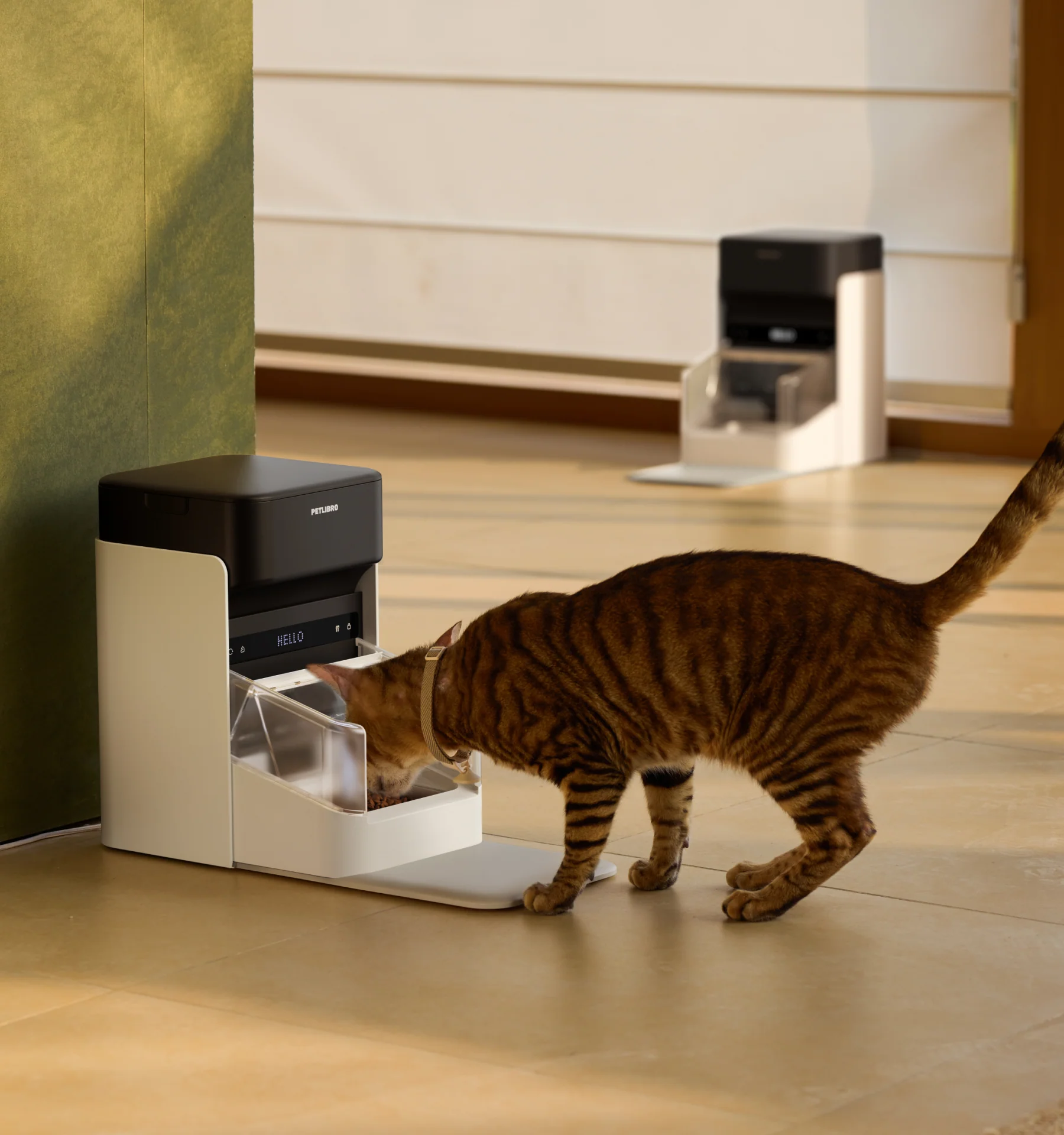
A Petlibro automatic feeder can solve five different versions of the same 6 a.m. problem. One Granary drops dry food into a single bowl. Another splits a shared meal between two bowls. A newer Granary 2 Vision Duo adds a camera and separate bowl-scale feedback. Polar refrigerates scheduled wet meals. One RFID dispenses dry food behind a lid that opens for a supplied collar tag. They share a logo, but not a job description.
Petlibro’s catalog is a choose-your-own-breakfast adventure, so pick the ending before the hardware. Two cats sharing kibble may benefit from dual bowls; two cats on separate diets need controlled access. A wet-food cat needs temperature management and daily cleaning, not a bigger hopper. A dog still needs the unglamorous fit checks—kibble, bowl geometry, capacity, stability, and tamper resistance—before “pet feeder” becomes “right dog feeder.”
The important Petlibro question is therefore not whether the brand makes smart hardware. It does. The question is which mechanism earns space in the feeding routine after the novelty wears off. The Complete Guide to Automatic Pet Feeders for Dogs and Cats helps sort timer, hopper, camera, cooled-meal, and access-control needs before the model names start blurring together.
A useful rule is to describe the current feeding failure in one sentence before opening a product tab. “Breakfast is late” leads somewhere different from “the second cat eats both servings.” That sentence also reveals whether the household needs a larger reservoir, a second eating position, stronger evidence about the bowls, temperature control, or a door that only one pet can open.
About Petlibro
Petlibro is best understood as a pet-tech brand with several distinct feeder lanes. Granary covers scheduled dry food, with single-bowl, dual-bowl, and camera variations. The Granary 2 family adds food-weight feedback and, on selected versions, camera-based pet recognition. Polar handles refrigerated wet-food timing. One RFID combines scheduled dry-food dispensing with collar-tag access.
The Petlibro app connects several of those products, but app support does not make their mechanisms interchangeable. Model names, food limits, backup-power behavior, cleaning steps, and accessories differ from one feeder to the next.
Petlibro automatic feeder features at a glance
Across the range, Petlibro leans into schedules, feeding records, low-food or blockage alerts, and connected controls. The useful extras vary. A camera can show activity near the bowl. A scale can report how much food remains. A dual outlet can reduce crowding. A collar-tag lid can restrict access. None of those features automatically supplies the others.
Ownership costs are modest but real. Dry-food models use desiccant packs that need replacement, and camera or scale models reward careful placement and regular cleaning. Polar adds the recurring labor of washing food-contact parts and resetting meals. One RFID adds collar-tag fit and replacement planning. The app may be free, but the routine is not maintenance-free.
Petlibro feeder categories
Choose the category before the feature bundle:
- Granary single-bowl models: scheduled dry food, with a camera on selected versions.
- Granary dual-bowl models: one shared dry-food supply split between two eating positions.
- Granary 2 Vision Duo: shared dry-food dispensing with a camera and separate bowl-scale feedback.
- Polar: refrigerated wet-food scheduling.
- One RFID: scheduled dry food with supplied collar-tag access.
The two dual-bowl Granary lanes are not selective feeders. They can make side-by-side eating easier, but they do not enforce separate diets or stop one pet from visiting both bowls.
Petlibro feeder comparison
| Product Name | Pet Tech Category | Best For | Key Feature | Additional Key Feature | Key Specs | Price Range |
|---|---|---|---|---|---|---|
| Granary Smart Camera Feeder | Camera dry-food feeder | One-pet dry-food schedules with a bowl-area view | App scheduling | 1080p camera on the camera model | 5 L; up to 10 meals; 2-15 mm dry kibble | Upper midrange |
| Granary WiFi Automatic Two Cat & Dog Feeder | Shared dual-bowl dry feeder | Two pets on the same food and schedule | Meal splitter and two bowls | 2.4/5 GHz app control | 5 L; up to 10 meals; 2-15 mm dry kibble | Midrange |
| Granary 2 Vision Duo | Camera and scale dual-bowl feeder | Two cats sharing food when per-bowl feedback matters | Independent bowl weighing | Dual-channel dispensing and camera recognition | Dry food up to 18 mm; about 1/12 cup per portion | Premium |
| Polar Smart Wet Food Feeder | Refrigerated wet-food feeder | Timed wet-food meals | Active cooling | Rotating meal compartments | Refrigerated wet-food system | Premium |
| One RFID Smart Feeder | Tag-gated dry-food feeder | One tag-wearing cat that needs protected scheduled meals | Supplied collar-tag access | App schedules and feeding logs | 3 L; 2-15 mm kibble; one tag per feeder | Premium |
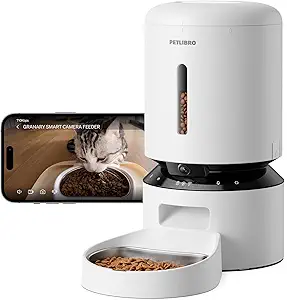
Granary Smart Camera Feeder for one dry-food routine
Quick verdict
Granary Smart Camera Feeder is the straightforward camera lane: dry food arrives on schedule, and the camera adds a view of the bowl area. It works best when timing is the main job and the video answers a specific question, such as whether a shy cat approached after the room became quiet.
Pros
- Scheduled dry-food feeding with app controls
- Camera view, night vision, and two-way audio on the current camera model
- Large enough to reduce frequent refills without entering giant-hopper territory
Cons
- Video does not prove how much a pet swallowed
- No selective access for a food-stealing housemate
- App, lens placement, food size, chute cleanliness, and power all need testing
Best for
One cat or small pet eating compatible dry food, with an owner who will use the camera for context. It is not the right answer when the real problem is food ownership between pets.
Biggest tradeoff
The camera adds useful visibility and extra setup at the same time. It can document a sibling stealing breakfast in excellent resolution. It cannot stop the theft.
Key specs and detailed analysis
Petlibro lists a 5 L hopper, up to 10 meals or snacks daily, 2-to-15 mm dry kibble, dual-band Wi-Fi, and a 1080p camera for the camera model. Granary names and accessories sit close enough together to invite accidental substitutions. Run several feeds with the household kibble, review the bowl angle, and check whether alerts change what the owner will actually do.
The ongoing costs include replacement desiccant packs and routine cleaning. Basic camera use does not require a paid plan, while saved video history uses Petlibro’s optional Video Cloud service. A camera lens near a feeding station will also need the occasional wipe unless abstract kibble smears are part of the viewing experience.
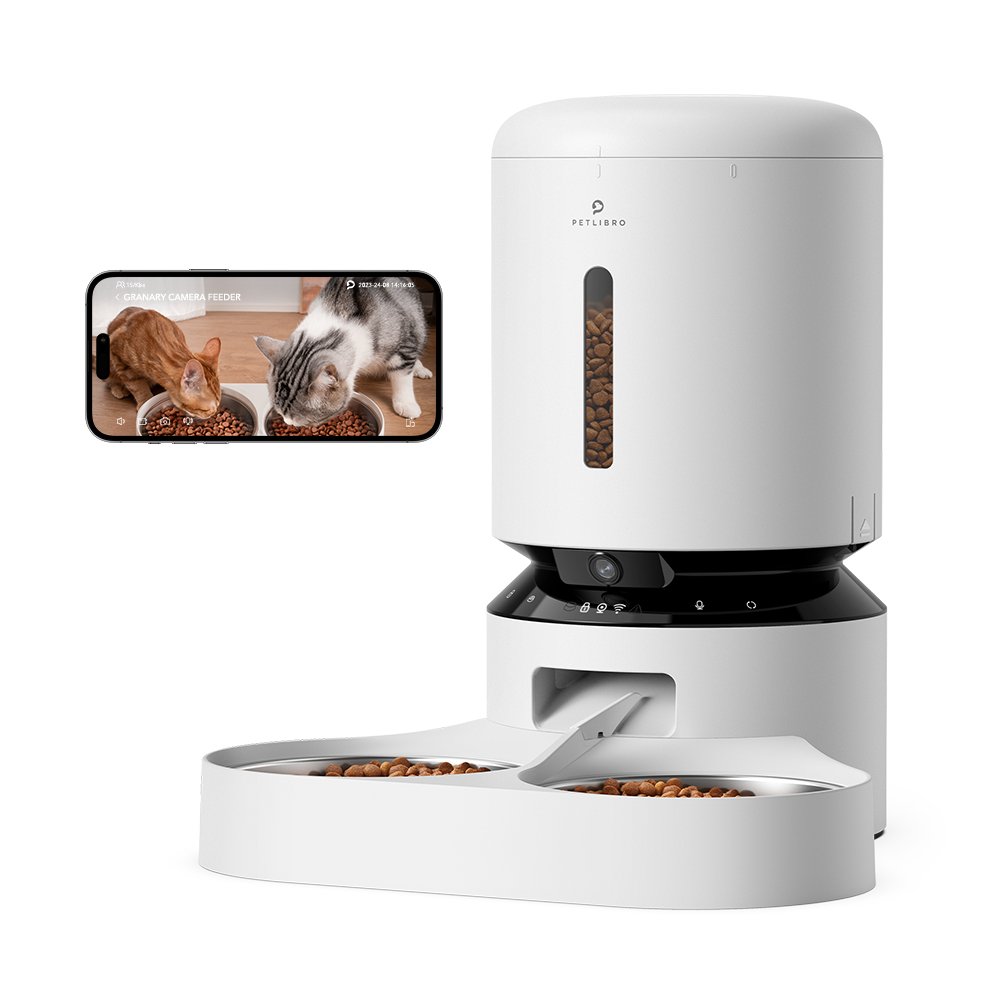
Granary WiFi Automatic Two Cat & Dog Feeder for shared meals
Quick verdict
The Granary WiFi dual-bowl model is the simpler shared-food choice. One 5 L hopper feeds through a splitter into two stainless-steel bowls. That can reduce shoulder-to-shoulder crowding for two pets on the same food, but the portions are still shared.
Pros
- Two bowls fed from one scheduled hopper
- Up to 10 meals or snacks daily
- 2.4 GHz and 5 GHz Wi-Fi plus battery backup support
Cons
- Splitter adjustment affects how food divides between bowls
- No pet identification or protected access
- Does not stop one pet from eating both servings
Best for
Two cats, or small-to-medium pets, that already share the same dry food and can eat side by side without serious conflict. It is a convenience tool for a compatible pair, not a diet-enforcement system.
Biggest tradeoff
Two bowls create two places to stand, not two private accounts. If one pet eats faster, the slower eater may still lose part of the meal.
Key specs and detailed analysis
Petlibro lists a 5 L hopper, 1-to-10 meal settings, 1-to-50 portion settings, 20 ml per portion, 2-to-15 mm kibble, and three optional D batteries for backup. The included meal splitter can be positioned to change the left-right distribution. That is useful during setup, but it also means owners should measure several cycles rather than assume the bowls receive identical weight.
Cleaning the bowls and splitter is easy to understand; keeping the outlet clear and replacing the desiccant pack are the recurring ownership chores. Test the setup with both pets present. A mathematically even split is not the same as an evenly eaten meal.
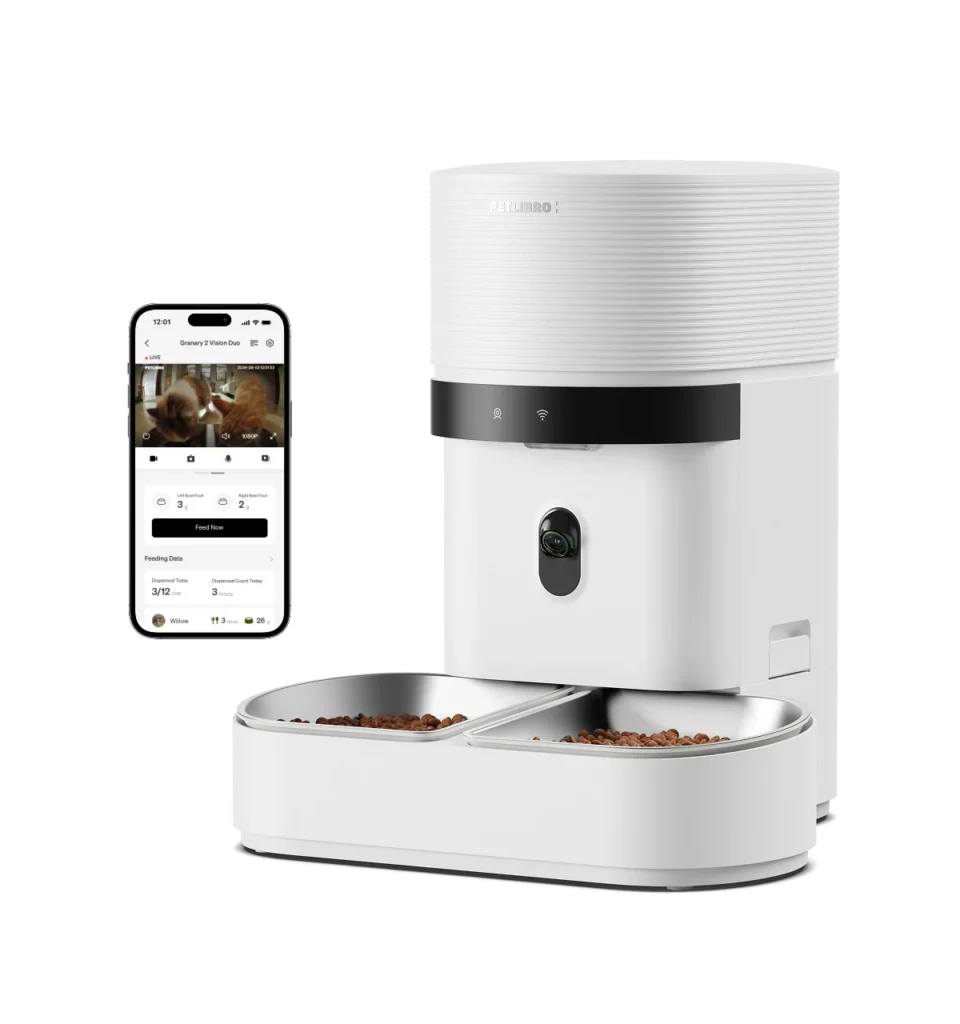
Granary 2 Vision Duo for shared bowls with better feedback
Quick verdict
Granary 2 Vision Duo is Petlibro’s flagship in this lineup. It leads because it adds independent weighing beneath the two bowls and combines that feedback with camera-based multi-pet recognition. Its dual-channel dispenser is also designed to distribute food evenly between the bowls. Those are meaningful upgrades for an owner who wants to understand a shared dry-food routine rather than merely watch it.
Pros
- Independent scale feedback for each bowl
- Dual-channel dispensing designed for close left-right distribution
- Camera recognition and meal records add more context than a basic splitter
- Blockage and low-food alerts plus remote controls
Cons
- Shared food remains accessible to both pets
- Camera recognition and bowl scales do not create separate diets
- Electronic scale areas require careful cleaning and a stable floor
Best for
Two cats that eat the same compatible dry food, where separate bowl-level feedback would help an attentive owner understand the routine. It is a strong fit for shared meals with observation, not for prescription diets or food theft that requires a lock.
Biggest tradeoff
Granary 2 Vision Duo knows more about the bowls than the simpler model does, but it does not own the bowls on behalf of each cat. Recognition can associate activity with pets; it cannot physically stop a cat from switching sides.
Key specs and detailed analysis
Petlibro says the dual-channel system is designed to keep distribution variance below 5% between sides. The model adds independent weighing for each bowl, while the Granary 2 family uses approximately 20 ml or 10 g per portion and supports dry kibble up to 18 mm. The washable pieces are the stainless-steel bowls and holders; the electronic area beneath them should be wiped rather than rinsed. A flat, stable surface supports more reliable weight readings.
This is the most feature-rich dry-food choice here, but the owner still has to interpret the data. If one cat visits both bowls, a scale reading is evidence about food movement, not proof of a fair meal. Its ownership costs include desiccant packs, careful cleaning, app attention, and enough floor space for two cats to approach comfortably. Petlibro Care is required for some trend insights, while recording and playback require a Video Cloud AI subscription.
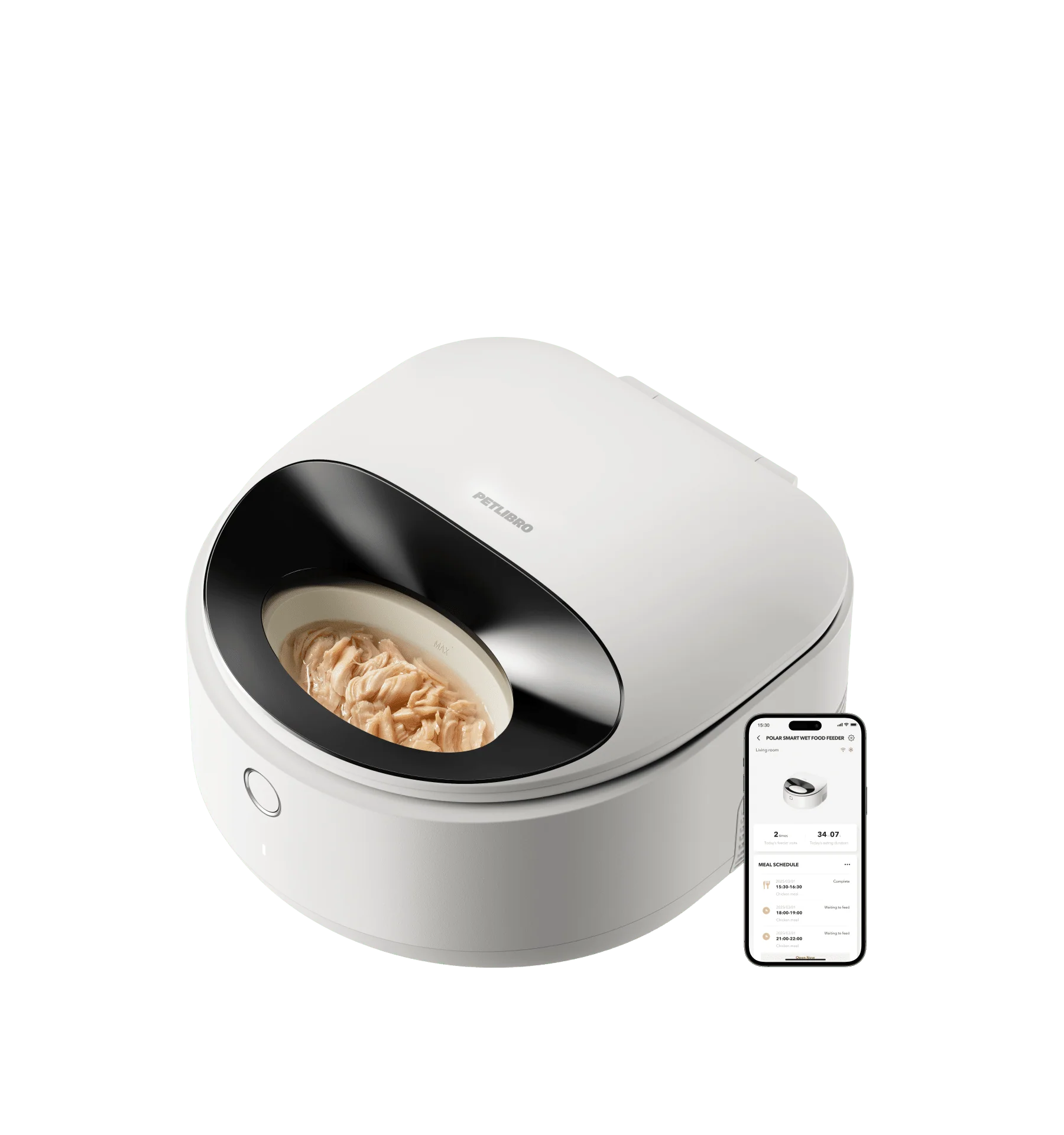
Polar for refrigerated wet-food routines
Quick verdict
Polar is the Petlibro answer when wet-food timing is the entire point. Its cooling system and rotating compartments put it in a different category from every Granary hopper.
Pros
- Designed around timed wet-food meals
- Active cooling rather than an ice-pack-only tray
- App controls and meal rotation on the current product lane
Cons
- More cleaning and food-handling work than a dry hopper
- Shorter refill horizon than a large dry-food reservoir
- No selective pet access
Best for
A cat household that already serves wet food and accepts a disciplined load, clean, and reset routine. Polar is specialized convenience, not a way to make food-contact chores disappear.
Biggest tradeoff
Active cooling improves the waiting conditions for prepared meals. It does not turn neglected food or dirty compartments into a safe long-term plan.
Key specs and detailed analysis
Confirm current instructions for loading, temperature behavior, food-contact cleaning, and outage response before relying on Polar. Its ownership cost is mostly labor: portion the meals, wash the parts, dry them fully, and reset the schedule. It earns its premium only when refrigerated wet-food timing is already the household’s recurring friction point.
Explore Petlibro Polar if refrigerated wet-food timing matches the meals already served at home.
One RFID for tag-gated scheduled dry food
Quick verdict
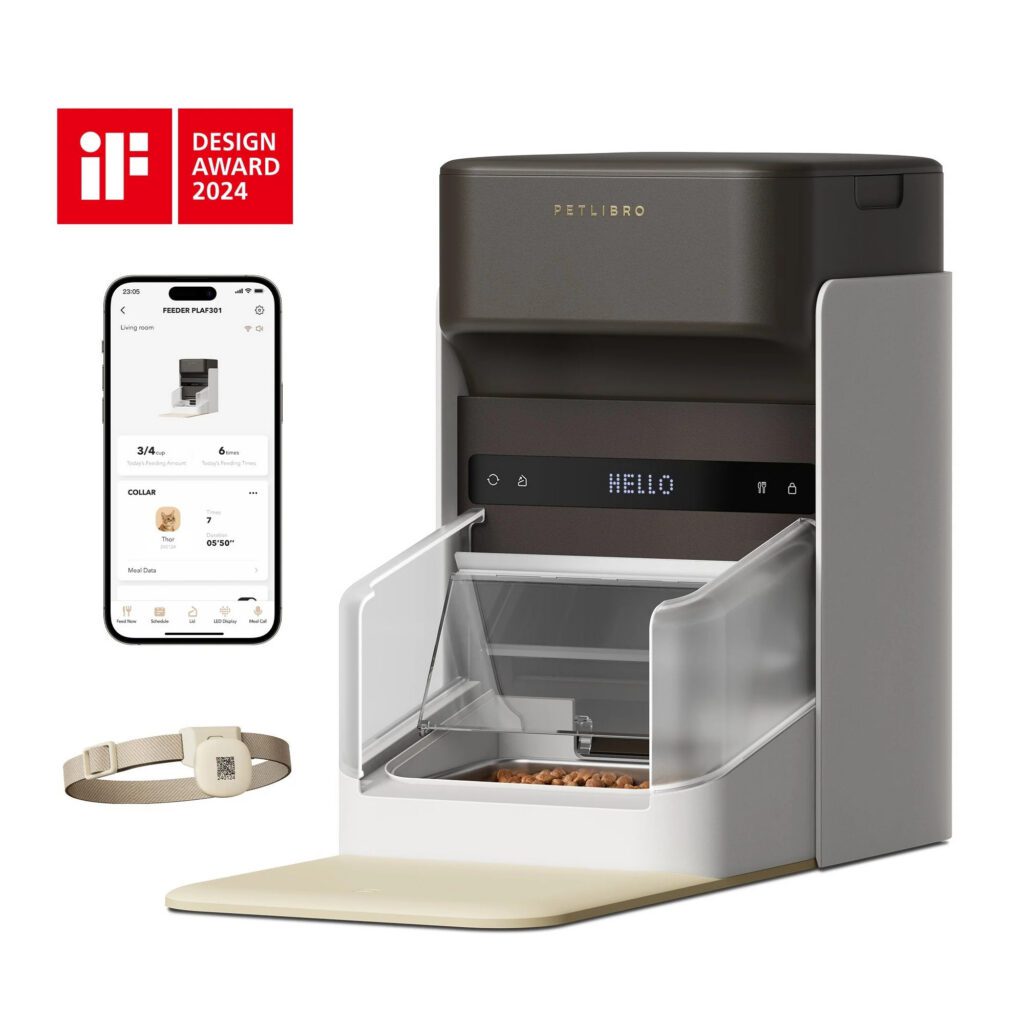
One RFID combines a scheduled dry-food hopper with a lid that responds to Petlibro’s supplied collar tag. That makes it the Petlibro lane for one cat whose meal needs both timing and a degree of protection from housemates.
Pros
- Scheduled dry-food dispensing plus collar-tag access
- Up to 10 meals or snacks daily
- Feeding records and app controls
Cons
- Does not read an implanted microchip
- One feeder pairs with one supplied tag
- Not a protected wet-food bowl
Best for
A collar-tolerant cat in a multi-pet home who needs a personal dry-food schedule. It is narrower than a generic camera feeder and much more relevant when access is the actual problem.
Biggest tradeoff
The feeder depends on the right cat wearing the right tag. A cat that will not wear a collar, routinely loses it, or feels trapped by another pet near the entrance may need a different access setup.
Key specs and detailed analysis
Petlibro lists a 3 L tank, 2-to-15 mm dry kibble, 2.4 GHz and 5 GHz Wi-Fi, and optional three-D-cell backup power. One RFID is not an open protected bowl; it dispenses scheduled kibble into a gated eating station. Plan for tag fit, feeder placement, cleaning, and how the household will handle the one-tag-per-feeder limit.
See One RFID when one tag-wearing cat needs scheduled dry food behind controlled bowl access.
Choosing among Petlibro models
Start with food format. Polar is the only lane here built around refrigerated wet meals. For dry food, decide whether the household needs one bowl, two shared bowls, better shared-bowl feedback, or controlled access for one tag-wearing cat.
Granary Smart Camera Feeder is enough when timing plus a bowl-area view is useful. Granary WiFi dual bowl is the practical shared-food setup. Granary 2 Vision Duo is the stronger premium choice for two-cat dry-food homes because its separate bowl scales and dual-channel dispensing provide better feedback. One RFID is the specialist when access matters more than camera analytics.
Where Petlibro falls short
Petlibro’s breadth creates homework. Similar Granary names can hide different cameras, scales, bowl layouts, accessories, and cleaning rules. The app may be familiar across products, but a familiar screen cannot correct a feeder chosen for the wrong food or household dynamic.
The range also has hard boundaries. Dual bowls do not enforce separate diets. Cameras do not prevent theft. Polar is not a vacation-length dry hopper. One RFID does not read implanted microchips or serve wet food. A large dog still needs a feeder assessed for portions, physical stability, bowl access, and tamper resistance rather than logo recognition.
FAQ
Does a Petlibro feeder still work if Wi-Fi goes out?
An already-programmed schedule may continue while the exact model remains powered, but remote controls and alerts will not behave as though the connection is healthy. Smart Pet Feeders and App Control: What Still Works Offline explains why local schedules, backup power, and app access are separate checks.
Can a Petlibro camera prove which pet ate?
It can add visual context, and Granary 2 Vision Duo adds pet recognition plus bowl-scale data. That is still not the same as guaranteed consumption or selective access. Automatic Pet Feeder with Camera: Monitoring Can Make You a Better Pet Parent covers that boundary.
Are Petlibro dual-bowl feeders good for separate diets?
No. Granary dual-bowl models distribute one food supply into shared eating positions. Use a true access-control setup when each pet must be kept out of the other’s food.
Is One RFID a microchip feeder?
No. It recognizes the supplied Petlibro collar tag, not an implanted microchip or an arbitrary third-party tag.
Can a Petlibro automatic dog feeder work for a large dog?
Possibly, but model capacity is only one check. Measure the dog’s portions, confirm kibble size, consider bowl height and feeder stability, and assume a determined nose will test every seam.
Which Petlibro model is the flagship?
Granary 2 Vision Duo is the flagship among the models covered here because it combines separate bowl weighing with camera-based recognition and a dual-channel dispensing system. Polar and One RFID remain better choices when the problem is wet-food timing or controlled access rather than shared dry-food insight.
Final recommendation summary
For a compatible two-cat dry-food home, Granary 2 Vision Duo is Petlibro’s most convincing answer. Independent bowl scales make the shared routine easier to read, and the dual-channel dispenser is more deliberate than a basic meal splitter. Polar wins the entirely different wet-food assignment; One RFID belongs where a tag-wearing cat needs protected scheduled kibble.
For dog-specific capacity, stability, and bowl-fit decisions, continue to Best Automatic Dog Feeders: Picks for Small and Large Dogs.
For refrigerated and timed wet-meal alternatives, compare Best Automatic Cat Feeder for Wet Food.
For the difference between shared dual bowls and protected access, use Best Automatic Cat Feeders for Multiple Cats: RFID and Dual-Bowl Options.