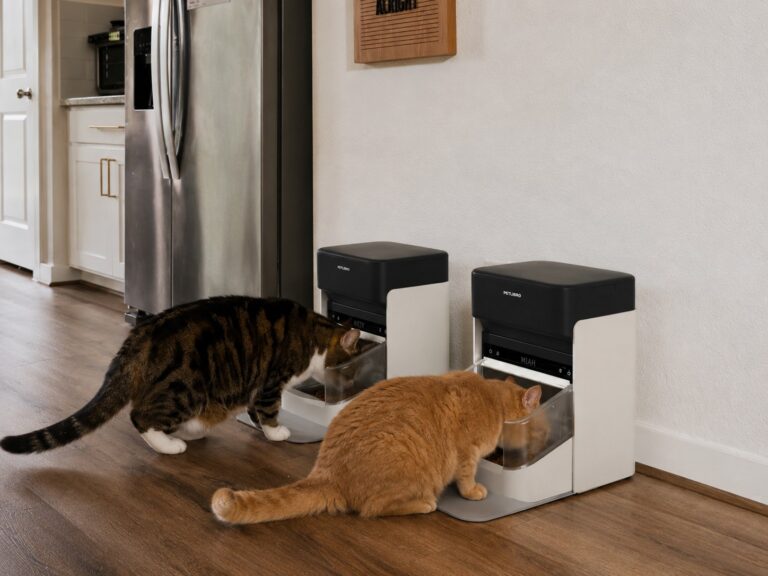
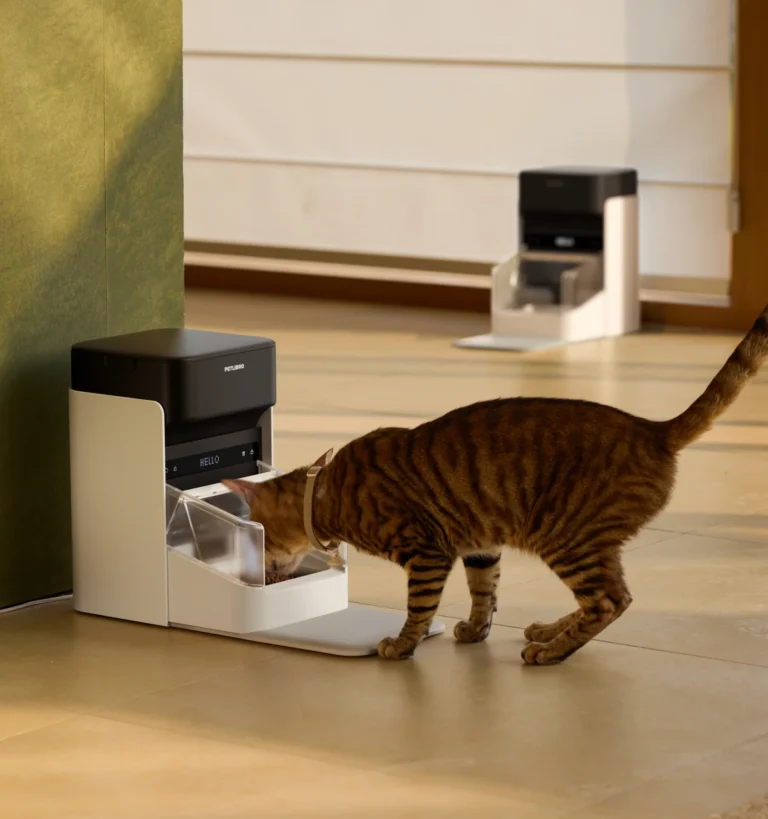
The Uahpet automatic pet feeder takes on a job most dry-food hoppers should never attempt. It holds prepared soft meals in two stainless-steel bowls, cools them while they wait, and gently warms each bowl before its scheduled opening. UAHPET lists cooling from 37.4 to 44.6°F and warming from 78.8 to 86°F, with independent temperature control for the two bowls.
For a short wet- or fresh-food routine, that is genuinely useful—and very easy to romanticize. Cooling improves the waiting conditions for prepared meals; it does not grant them immortality, clean the bowls, or turn the appliance into a full refrigerator. The owner still prepares the food, follows its storage directions, washes both bowls, and resets the short schedule.
The current model is cat-first, with a possible small-to-medium-dog fit only after the actual serving fits the bowls and the dog can use the low station without moving or raiding it. It has no app, camera, hopper, or access control. That narrowness is a strength when fresh-meal timing is the problem and a reason to skip it when the household needs almost anything else.
Run a two-day rehearsal: prepare the same number of meals the feeder would hold and follow that routine manually. If the loading, short reset interval, and daily washing already feel reasonable, automation may remove useful clock-watching. If the trial feels like a chore, adding cooling hardware will not make the cleanup disappear. This is meal prep with a timer, not pantry automation. That distinction saves expensive disappointment.
About UAHPET’s fresh-food lane
UAHPET makes one feeder, and it sits apart from dry hoppers, passive ice-pack trays, RFID feeders, and camera feeders. The programmable timer runs on a seven-day cycle, so you set which days a meal fires; the two bowls hold four scheduled meals before they need reloading. Bowl capacity and power-outage behavior are the two specs UAHPET does not publish, so confirm both with the seller.
Uahpet automatic pet feeder snapshot
| Product Name | Pet Tech Category | Best For | Key Feature | Additional Key Feature | Key Specs | Price Range |
|---|---|---|---|---|---|---|
| UAHPET Fresh Food Automatic Pet Feeder | Temperature-managed timed bowl feeder | A short, carefully maintained wet- or fresh-food routine | Independent cooling and warming | App-free local controls | Two stainless bowls; 4 meals over 2 days; capacity not published | Upper midrange |
UAHPET Fresh Food Automatic Pet Feeder
Quick verdict
UAHPET is a compelling specialist for a cat household that prepares soft meals and accepts a two-day refill-and-clean rhythm. Its active cooling and warming are meaningful differences from a basic tray. Limited published documentation and unknown bowl capacity make a supervised home test essential.
Pros
- Two bowls with independent temperature control
- Active cooling and gentle warming
- Four scheduled meals over two days
- Local buttons with no Wi-Fi or app requirement
- Removable dishwasher-safe stainless-steel bowls
Cons
- Short four-meal horizon
- No remote changes, alerts, camera, or feeding history
- Per-bowl capacity and backup-power behavior are not published on the accessible page
- No RFID or microchip access control
- Limited independent long-term ownership evidence
Best for
A cat-first household that already prepares wet, fresh, mixed, or other soft meals and wants a few future servings timed. UAHPET also names small-to-medium dogs, but the fit remains unverified until the dog’s portion, muzzle access, and appliance behavior are checked.
Biggest tradeoff
The feeder moves labor to a more convenient time; it does not remove labor. Every cycle begins with food preparation and ends with soft-food residue that needs prompt attention.
Key specs and detailed analysis
UAHPET lists independent dual-bowl temperature control, cooling at 37.4–44.6°F, warming at 78.8–86°F, four meals over two days, app-free buttons, and removable dishwasher-safe stainless-steel bowls. It describes the model for wet, fresh, mixed, and other soft foods rather than dry-kibble storage.
The cooling range deserves careful language. A temperature setting is not a promise of indefinite food preservation, and the upper end of the listed range may not match the storage directions for every product. Load chilled food as directed, keep the bowls and surrounding surfaces clean, and use the feeder for a short planned interval rather than stretching the schedule because the appliance feels refrigerator-adjacent.
Independent temperature control does not mean independent pet access. One cat can visit both bowls after they open. In a two-pet home, the model suits shared or supervised food routines, not strict separate diets.
There is no app to pair, which removes network troubleshooting and remote monitoring at the same time. Confirm how the feeder behaves after a power interruption and whether the schedule must be reset. Bowl capacity is also a purchase-day question: measure the pet’s real serving and compare it with the physical bowl before assuming the “small-to-medium dog” language settles the fit.
Choose the UAHPET Fresh Food Automatic Pet Feeder when a short, carefully cleaned soft-meal schedule is the exact job.

Buying discussion and daily cleaning
Let the menu decide. A dry-kibble household wanting a large stored supply needs a hopper. A meal that can open at room temperature may only need a simpler timed tray. UAHPET enters the conversation when active cooling and warming solve a specific prepared-food problem.
Wash the bowls after each soft-food cycle and inspect seams, lid surfaces, and nearby areas for residue. Follow current instructions for the appliance body, and dry parts fully before reassembly.
The Complete Guide to Automatic Pet Feeders for Dogs and Cats helps compare this cooled-bowl mechanism with dry hoppers, passive trays, and selective-access bowls.
Who should skip Uahpet
Skip this feeder for a dry-kibble household, a large dog needing high-capacity portions, pets that require separate diets, or an owner who cannot clean soft-food surfaces promptly. Skip it when remote alerts, a camera, app changes, or verified backup power are essential.
It is also a poor fit for a long absence. Four meals over two days is a short convenience window, and fresh-food routines benefit from a human check rather than optimistic schedule stretching.
Where Uahpet falls short
The largest weakness is documentation depth. The official page confirms the cooling, warming, bowl, and schedule claims but leaves bowl capacity and outage behavior unclear. The seven-day timer sets which days a meal fires; it does not extend how many meals the two bowls hold.
The product also has limited independent long-term evidence. That is not proof of unreliability; it is a reason to make the recommendation conditional on an at-home test and a conservative absence plan.
FAQ
How is a cooled feeder different from a dry hopper?
A cooled feeder manages prepared meals in bowls, while a dry hopper stores kibble and dispenses portions. How Automatic Pet Feeders Work: Timers, Portions, Sensors, and Jams explains how those mechanisms fail in different ways.
Does the Uahpet feeder need an app?
No. It uses local buttons. Smart Pet Feeders and App Control: What Still Works Offline helps compare local schedules with remote controls and connection-dependent features.
Can UAHPET replace a dry-food hopper?
No. UAHPET positions it for wet, fresh, mixed, and other soft foods. It is not a large dry-food reservoir.
Is the Uahpet feeder a refrigerator?
Treat it as a temperature-managed short-run feeder, not indefinite refrigerated storage. Follow the food’s handling directions and the current feeder instructions.
Is it suitable for large dogs?
Do not assume so. UAHPET names cats and small-to-medium dogs, while the accessible page does not state bowl capacity. Large-dog portions and physical fit need a different check.
Can two cats use the two bowls separately?
They can approach separate bowls, but the feeder does not identify cats or stop one from taking both meals. Two bowls are not selective access.
Final recommendation summary
UAHPET fits a short, cat-first soft-food routine built around cooling, warming, and frequent cleaning. The independent bowls are the draw. Unpublished capacity, unclear outage behavior, and the short schedule demand an at-home test.
Choose the UAHPET Fresh Food Automatic Pet Feeder when prepared soft meals, a two-day reset rhythm, and diligent cleaning already fit the household.
For a side-by-side look at cooled and timed wet-meal options, continue to Best Automatic Cat Feeder for Wet Food.