The first warning was the sound of plastic scraping slowly across my kitchen floor.
This was not the outcome I pictured when I went looking for a large dog auto feeder.
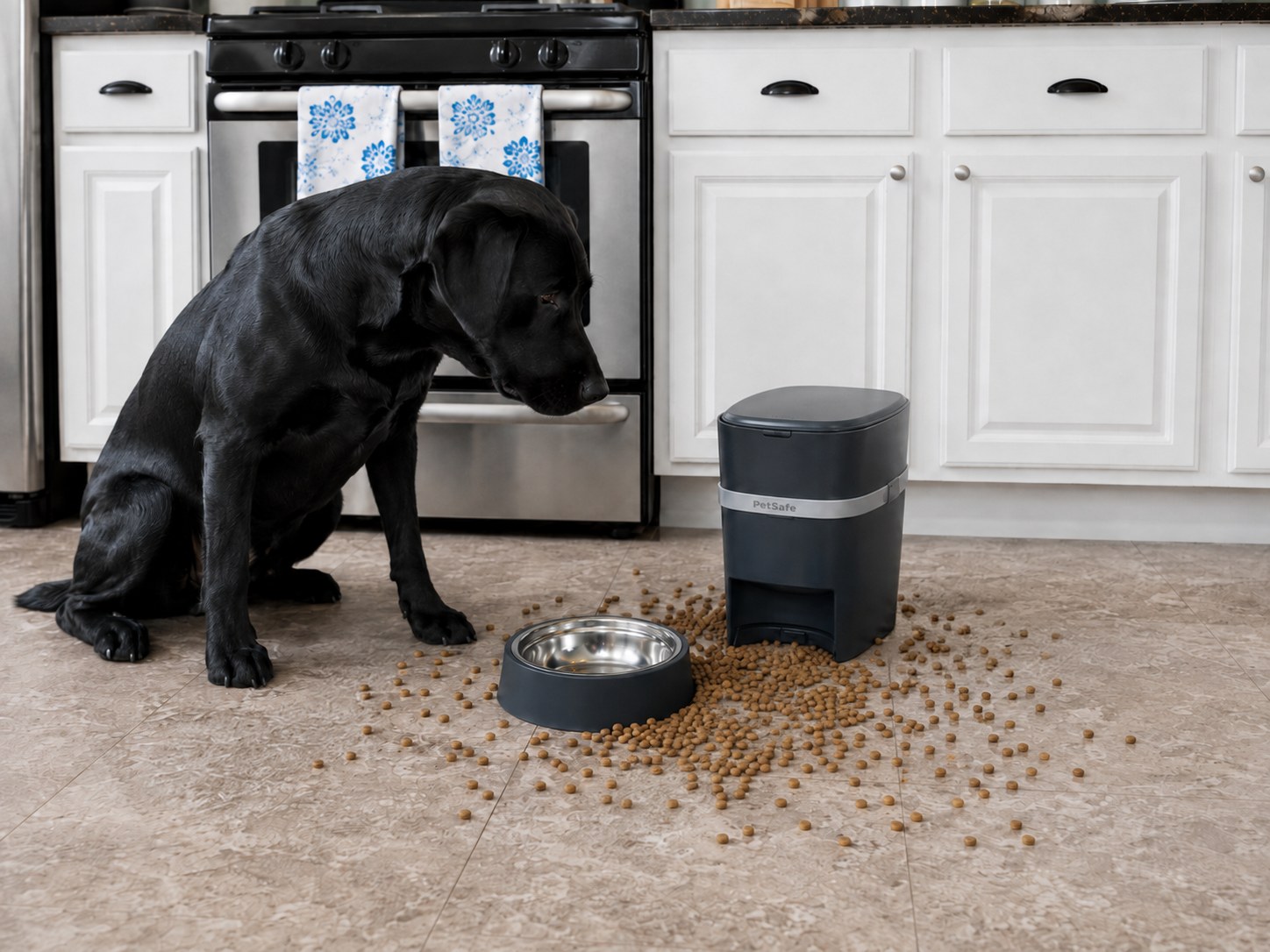
Batman had his nose pressed against his new auto dog feeder. He pushed. The machine moved an inch. He changed his angle and pushed again.
By the time I crossed the kitchen, my 70-pound black Lab had moved it about three inches and rotated it toward the center of the room. He looked up with the calm satisfaction of someone who had been asked to improve the floor plan and had delivered.
I slid the feeder back.
Batman watched very closely.
This should have told me everything.
Batman’s three-inch product review
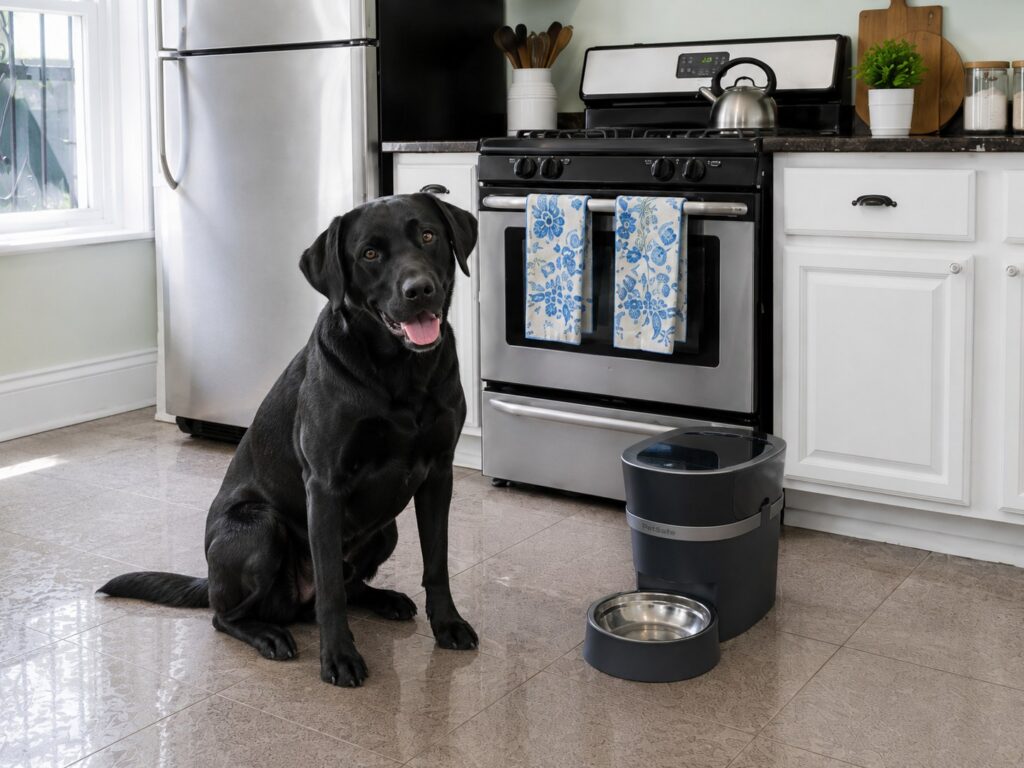
I had put the PetSafe Smart Feed Automatic Pet Feeder near the dog-food storage and an outlet because the spot was perfect for me. I could reach the lid, remove the hopper when it needed cleaning, slide out the bowl, and wipe around the base. It also looked tidy, which matters in a one-bedroom apartment where every appliance has to audition for permanent square footage.
From standing human height, I had created a convenient feeding station.
From Batman height, I had created a food-scented object with access on all four sides and a secret feature: it moved when you pushed it.
His first inspection happened after a supervised meal. He finished his dry food, checked the bowl for any kibble hiding under another piece of kibble, and followed the smell back to the machine. Then he rested his nose against the side.
Scrape.
I laughed. Batman is curious in the specific way Labs are curious, which is less “I wonder what this is” and more “I will now investigate this with my entire body.”
I put the feeder back and redirected him.
At the next meal, he approached from the other side. The feeder moved. Batman stopped, looked at it, looked at me, and nudged it once more as if checking whether the result could be repeated.
It could.
Over the next few supervised meals, moving the feeder became the game. He did not force the lid, get extra food, or chew the cord. He had learned that steady nose pressure produced a satisfying response.
The plug ended the joke
Then he rotated it far enough that the power connection pulled loose.
Nothing dramatic happened. There were no sparks or damage. I reconnected the power and checked the feeder. The backup batteries kept its scheduled meal on track, exactly as intended.
Batman, meanwhile, seemed delighted that his kitchen renovation now included utilities.
A couple of meals later, he moved it again and the connection came loose again.
That was when the joke stopped being “Batman has discovered furniture” and became “I have designed a daily problem for myself.”
Backup power was covering an interruption. It was not permission to build repeated disconnection into our routine. Returning the feeder to the same open spot just made me unpaid support staff for Batman’s interior-design firm.
Capacity was not the same as fit
When I looked for a large dog auto feeder, I gave a lot of weight to hopper capacity while sorting through automatic pet feeder options. This one held 24 cups, which sounded generous, and its removable pieces made cleanup easier.
Those facts were true. They did not answer Batman’s questions.
Could a large dog approach it from every side? Turn it? Reach the back? Pull the power connection tight just by changing the direction it faced?
The manufacturer described this feeder for cats and small-to-medium dogs. I had seen that information. I had let a big hopper answer a pet-size question, and those are not the same thing.
If you are shopping for an automatic dog feeder for large dogs, the machine has to make sense at nose height, not just from the top of a product page. Capacity tells you how much food it can hold. It does not tell you what happens when a large, curious dog decides it belongs eleven inches to the left.
So I stopped asking Batman to ignore an interesting object in the middle of his world and changed the world around it.
The feeder became boring
The feeder moved into a protected kitchen nook. Its back faced a solid boundary, and the layout kept Batman from circling it or rotating it away from the outlet. I routed the cord outside his normal reach and set the machine on a hard, level surface with the connection secure.
I did not wedge it into an inaccessible cave. I left room above it to reach the lid and refill the hopper. The front stayed open so I could remove the bowl and clean the feeding area. Batman lost access to the vulnerable sides; I kept access to the parts I needed.
It was less “beautiful product photo” and more “tiny kitchen loading dock,” but it worked for the room we lived in.
After the next meal, Batman returned for his inspection. He pressed his nose against the feeder once.
Nothing interesting happened.
He tried a different angle. Still nothing. There was no route behind it, satisfying rotation, or slow scrape across the floor.
The machine had become boring.
I rolled his ball across the kitchen. Batman chased it immediately, because the ball was the one object in the room whose job description included moving.
That became my rule for any feeder sharing a kitchen with a big dog: easy access for the human, boring access for the dog. Backup power stayed backup. The cord stayed protected. The lid and bowl stayed reachable.
And Batman retired from kitchen design after a short but influential career.
Batman solved the placement problem. If your feeder problem is still roaming the kitchen, the Complete Guide to Automatic Pet Feeders for Dogs and Cats puts it back in the right lane.