I decided to order an at home cat dna test because Luna yelled at a toy mouse.
That is not the scientific version of the story, but it is the honest one. She had dragged this gray mouse into the hallway and was making the kind of sound that makes you wonder if your cat has discovered rent.
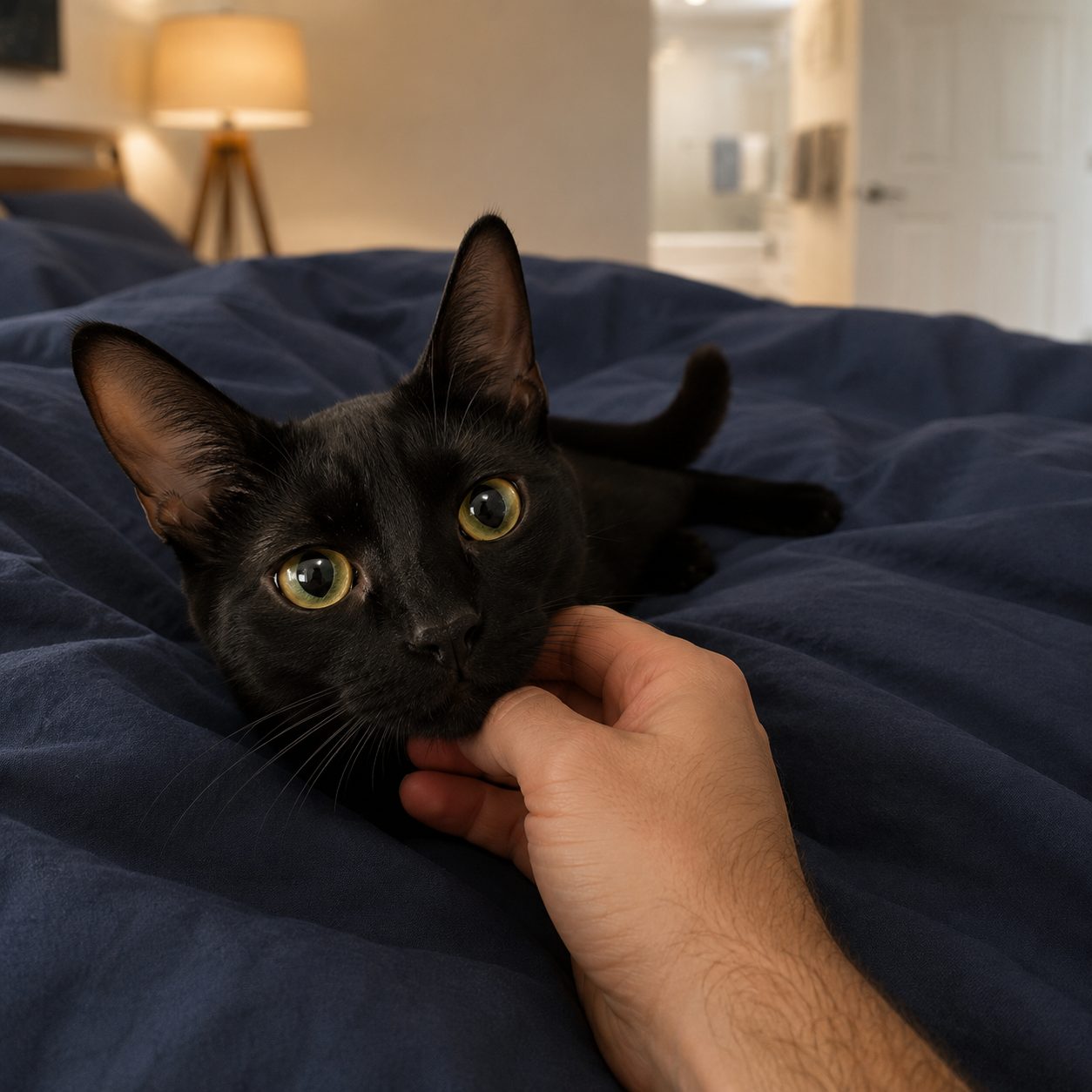
Luna is black. That is how I think of her first. Black cat. Short hair. Long sleek body. In afternoon sun, though, the black breaks open and you can see warm brown hiding underneath.
She has always had that long, elegant look people associate with Siamese cats, plus the voice. Especially the voice. Luna does not meow so much as yowl remarks. She has opinions about closed doors, delayed meals, and my habit of standing up after she has made a lap decision.
The old Siamese theory
“Siamese mix” was part of her story before she moved in with me. Not as a certificate or a breeder fact. More like one of those adoption-background sales labels that gets passed along because somebody is trying to get people interested in a black cat. I knew there had been a mom cat. I did not know anything about the dad cat, a blank space a cat owner can pretend not to care about for years.
Then one night your black cat screams at a toy mouse with the posture of a tiny opera singer, and suddenly you are on the internet at 11:40 p.m. looking up whether black Siamese cats are a real thing.
Siamese cats, at least in the official-looking breed descriptions I found, were not just “sleek cat who talks too much.” They had point coloring, blue eyes, wedge-shaped heads, and the whole elegant alien-lord structure. Oriental Shorthairs were basically Siamese-style cats without the points, and black, or ebony, was right there in the neighborhood.
So I had this cat in front of me who was black with brown hiding in the sun, long and sleek, loud enough to moderate a panel, but not quite as angular as the Oriental breed pictures online. Her head was softer than that. Still sharp when she was judging me, obviously, but not show-cat sharp.
That left me with the dumbest possible emotional state: sincerely curious about my cat’s unknown dad.
Picking a DNA test without pretending it could solve everything
I did not think a feline DNA test was going to hand me a birth certificate. But I did want to know whether the old Siamese-mix label had anything under it, or whether Luna was just a domestic black cat with premium cheekbones and main-character lungs.
So I looked for a consumer cat DNA test the way a normal person looks for a lamp and a weird person looks for a family secret. I wanted an ancestry-style report first. I was not trying to diagnose Luna, build a medical file, or turn a black rescue cat into a spreadsheet. I wanted breed and population clues that might point toward the right corner of the cat map.
That was the whole emotional bargain. A cat ancestry test could be interesting. It could give me language. It could maybe nudge the Siamese theory closer to “reasonable suspicion” or farther into “you made this up because she is loud.” It was not going to identify Luna’s dad by name and ask him to start paying for pate.
The swab negotiation
Ordering an at home cat dna test sounds more dramatic than it feels. A small kit shows up. You activate it. You look at the swab. Your cat looks at you. Somewhere in that silence, the relationship is renegotiated.
Luna is not an aggressive cat, but she has strong policies. Her mouth belongs to her, and human confidence should be punished early before it spreads.
I waited until she was relaxed and approached with the soft voice people use when they are about to do something suspicious. She gave me the same look she gives new furniture and unexpected delivery boxes.
There was a point where I had one hand around her tiny black shoulders, the swab near her cheek, and the sudden awareness that I had become the villain in a very low-budget medical thriller. Luna did not fight exactly. She made her whole body into punctuation. Then it was done, and she walked away to clean herself with the focus of someone removing evidence.
I mailed the sample, told myself I was being normal, and then checked the status more than necessary.
Waiting made me worse
Before I sent it in, I was detached. A reasonable man with a mild cat question. Afterward, I was apparently a genealogy hobbyist with one client. I would see Luna walking across the room and start ranking her features.
Long body: noted.
Black coat with brown in sun: suspicious.
Voice: legally significant.
Head shape: not enough triangle.
Luna did not participate in the speculation. She carried the toy mouse around. She rejected one breakfast because the texture had offended her. She sat with her paws tucked under her like a loaf with inside information. The cat whose ancestry I was investigating seemed confident she had already achieved cat.
The result was a clue, not a verdict
When the results arrived, I expected either disappointment or a cartoon trumpet. What I got was better because it was less clean.
The report did not identify Luna’s dad. It did not turn her into a purebred Oriental Shorthair. It did not reach through the screen, slap a pedigree ribbon on her, and apologize for the delay. It gave me a clue. The ancestry side pointed enough toward that Siamese and Oriental-adjacent part of the world that I stopped feeling ridiculous for wondering, but it still left plenty of Luna technically explained, spiritually unresolved.
It made sense of the long sleek body, the voice, and the way “black Siamese” sounded close but not quite right once I understood the point-coloring issue. The Oriental Shorthair pictures online looked familiar and also too extreme, like Luna had borrowed the family silhouette and declined the full architectural package.
I read the report twice. Luna sat on the back of the couch, facing away from me.
This is the part genetic testing for cat breeds tends to make people overdo. A result can be useful without becoming a verdict. My version was simple: the report gave me language for a mystery I had already been living with.
Luna remained unresolved
The health and trait parts were interesting too, but the ancestry clue was the emotional hook. Not because it made Luna more special. That is the trap with these things. You can start acting like the report adds value to the cat, when really the cat was already walking around your house at full value.
What the test added was language. A better way to understand the old label. A better way to say, “Okay, maybe there really is something in that family tree,” without pretending I had solved a cold case.
It also made me appreciate the mystery more. Before the test, the unknown dad cat felt like a blank. After the test, he felt like a silhouette. Not a fact. Not a name. Just a little shape in the background of Luna’s story.
That is probably the right way to use a cat ancestry test. Let it sharpen the outline. Do not ask it to replace the cat.
After all the swabbing and waiting and reading, Luna’s daily agenda did not change. She still wanted chicken pate. She still meowed at the toy mouse like it owed her money. She still turned black in the shade and brown in the sun. She still had the long body, the softer head, the private law practice happening behind her eyes.
And I still did what I always do when she walked into the room yelling for no obvious reason.
I looked at her and thought, Yeah, that tracks.
Luna did not need a report to be Luna. The report just gave me a slightly better vocabulary for the weird, elegant, yelling creature already in my hallway.
If you want to test your own cat’s DNA, Barkytech recommends starting here
If you want to run your own cat’s DNA, start by deciding what you actually want from the test. If the question is mostly, “What kind of cat is this extremely dramatic roommate?” then ancestry should lead the search. If you also care about traits, health-marker context, or oral-health information, compare the reports more carefully before buying. The right feline DNA test depends less on the cutest product page and more on the question you are trying to answer.
For the full category map, start with Complete Guide to Pet DNA Tests . It explains how pet DNA testing works, where it can help, and why the results should be treated as clues rather than absolute truth.
For a cat-specific shopping shortlist, Barkytech’s Best Cat DNA Test compares options including Wisdom Panel, Basepaws, and Know Your Pet DNA. That is the cleaner place to compare actual products without mixing the recommendation logic into Luna’s story.
If ancestry is your main reason for testing, Wisdom Panel Complete for Cats is a strong place to look, and Wisdom Panel Pet DNA Test Review gives the brand-specific breakdown. If you want a cat-focused test with oral-health context included in the conversation, read Basepaws Cat DNA Test Review before choosing. If you want one more consumer DNA option on the shortlist, compare Know Your Pet DNA alongside the others on the shopping page.
Just keep the expectation sane. Genetic testing for cat breeds can be genuinely fun and useful, but it should not replace your cat’s actual history, behavior, vet care, or the obvious evidence of your daily life together. Cat Genetic Test Accuracy and Ancestry goes deeper on those limits.