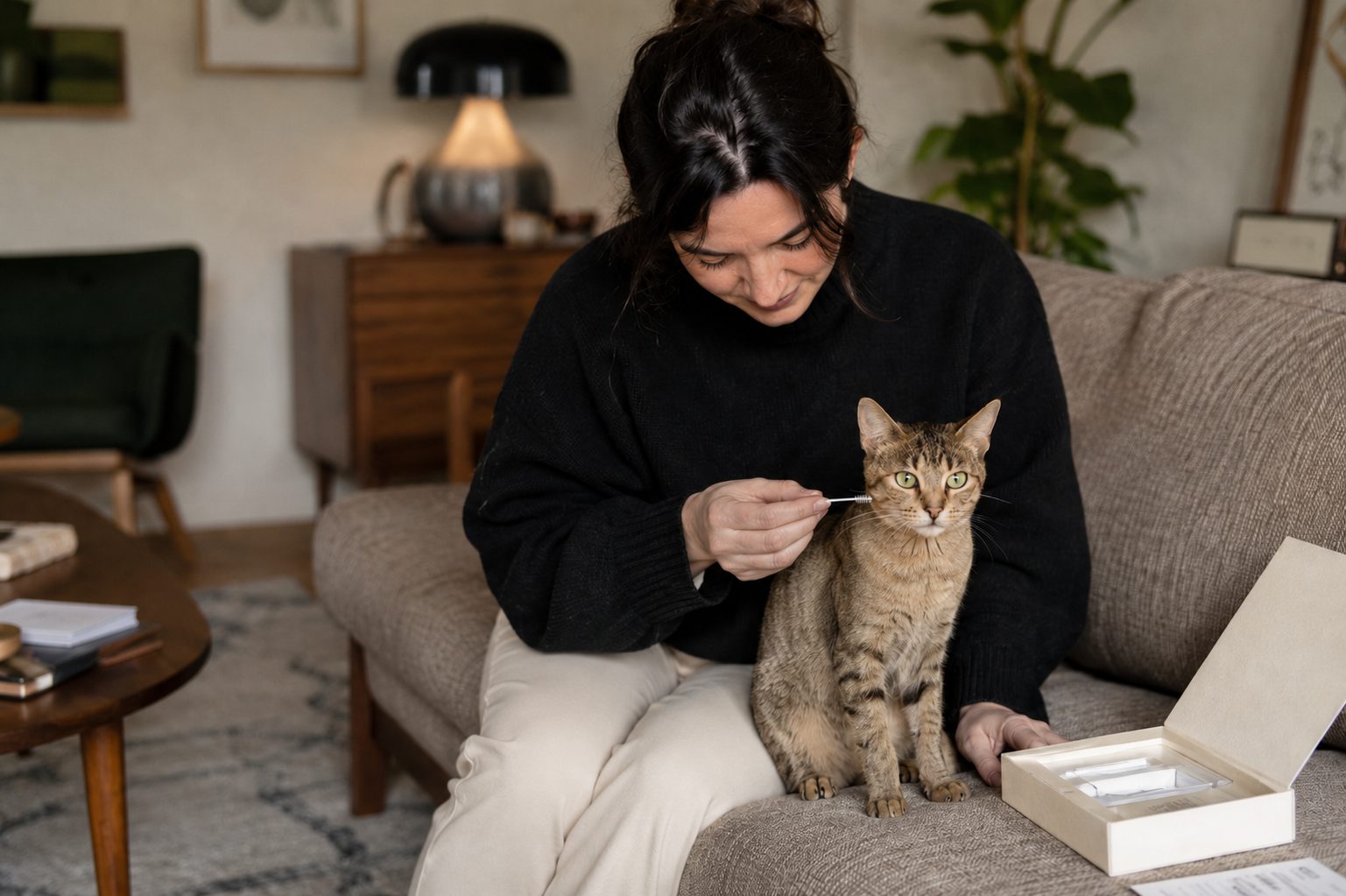
A cat genetic test can be a little rude. You picture some dramatic reveal that finally explains your cat’s face, attitude, and ongoing belief that household rules are for other species. Then the report shows up and the answer is not “surprise, definitely Siamese.” It is broader, softer, and less tidy than the breed-percentage fireworks dog owners are used to seeing.
That does not mean the category is fake. It means cat ancestry needs different expectations. A cat genetic test can still be useful, but it helps to stop asking it for pedigree drama and start asking what it is actually built to show. If you are still deciding whether to buy one, Best Cat DNA Test is the shopping page. This article is about reading the results without talking yourself into nonsense.
Why cat ancestry often feels less definite
Dog owners have trained all of us to expect ancestry results like sports stats. Cat ancestry usually does not land that way. A lot of household cats do not come from the same breed-history setup that makes dog reports feel so emphatic. So a cat ancestry test often reads more like lineage context and similarity than like a clean breed verdict.
That is the first adjustment most owners need to make. A cat ancestry test can still be interesting and still be accurate in the sense that it reflects the company’s reference material honestly. It just may not tell a story the way people imagine before they buy the kit.
This is also why genetic testing for cat breeds needs different framing from the start. If what you really want is formal proof that your cat is purebred, a consumer feline DNA test is the wrong tool. If what you want is broader ancestry clues, trait information, and health-related context, the category starts making much more sense.
What a cat genetic test can actually tell you
The useful answers are usually more practical than dramatic. A cat genetic test can give you ancestry context, trait information, and health screening that sharpens the questions worth asking next. Wisdom Panel Complete for Cats, for example, currently says it screens for 70+ breeds and populations, 45+ genetic health conditions, 25+ physical traits, identifies blood type, and returns results in 2-3 weeks. That is a real information package, not just a novelty card.
Basepaws takes a different angle. Its current Breed + Health Cat DNA Test says it compares a cat’s genetics to 21 prominent breeds, screens for 43 genetic feline diseases, reports 25 genetic traits, includes oral-health context, and returns results in 4-6 weeks. That gives owners another version of feline genetic testing that leans harder into health and day-to-day relevance instead of treating cat ancestry like a perfect breed scoreboard.
So yes, a feline DNA test can tell you something meaningful. It can help you understand broad cat ancestry patterns. It can give you a clearer read on inherited traits. It can surface health findings worth discussing. It can even answer practical questions you did not expect, like blood type in Wisdom Panel’s case. What it cannot do is turn your cat into a fully solved mystery.
What a cat ancestry test cannot tell you
This is where owners get themselves into trouble. A cat ancestry test cannot hand you pedigree papers. Basepaws is especially direct about this on its own site. The company says the test is not a breed verification test and does not determine pedigree or purebred status. That is not a tiny disclaimer. It is the whole point of reading the report correctly.
A feline DNA test also cannot diagnose disease on its own. Health findings are useful because they give you something to bring into a veterinary conversation, not because they replace one. Genetic testing for cat breeds and health markers can sharpen the questions. It does not replace an exam, follow-up care, or clinical judgment.
It also should not become a personality horoscope. Cat ancestry can offer context. It cannot fully explain why your cat screams before dawn, hates one exact houseguest, or behaves like a disappointed landlord whenever you move furniture.
The two big mistakes owners make
The first mistake is overreading small signals. If your report hints at certain breed groupings or ancestry patterns, treat them as clues, not courtroom evidence. Cat ancestry usually works better when you read it in broad strokes.
The second mistake is dismissing the useful parts because the ancestry feels less dramatic than expected. A cat genetic test can still do good work even when it does not give you the cinematic reveal you imagined. Health markers, traits, oral-health context, and broader lineage information are not consolation prizes. For many owners, they are the part of the report that stays useful longest.
This is where the phrase genetic testing for cat breeds can throw people off. It sounds like a promise of final breed identity. In practice, a lot of feline genetic testing is better at giving context than certainty.
How to read a feline DNA test without getting carried away
Start with the broadest answers first. What does the report say about lineage, health, traits, or blood type? What is consistent across the categories? What is the company careful not to claim? Those are better questions than “which tiny detail can I now turn into family lore by dinner?”
Then pay attention to the brand’s language. Basepaws frames its ancestry side through similarity and explicitly avoids breed verification claims. Wisdom Panel gives a broader breed-and-population picture plus health and blood-type information. Those are different flavors of cat ancestry, and they should be read that way.
If you catch yourself trying to squeeze formal proof out of a consumer feline DNA test, that is the moment to stop. The report is strongest when you let it do the job it actually does. For the brand-specific breakdowns, go to Basepaws Cat DNA Test Review and Wisdom Panel Pet DNA Test Review.
When a cat genetic test is still worth it
A cat genetic test is usually worth it when you are curious in a realistic way. You want better cat ancestry context, not a fantasy reveal. You want health information that may matter later. You want a clearer sense of inherited patterns in the mix. That is all reasonable.
It is less worth it when you want official breed confirmation, behavior prediction, or a shortcut around veterinary care. A cat ancestry test is not a replacement for any of those things. It is an information tool. Keep the assignment that simple and the category holds up much better.
For the wider category picture, Complete Guide to Pet DNA Tests connects the cat-side story to the rest of the market. If you want the lighter personal version of the same tension, Testing Luna with an At-Home Cat DNA Test Because Curiosity Finally Won gives you the cat-owner angle.
FAQ
Is a cat genetic test accurate if the ancestry feels vague
Sometimes yes. A cat genetic test can still be accurate in the sense that it is reflecting the company’s reference data honestly. The result may feel vague because cat ancestry is often less tidy than dog ancestry, not because the report is automatically wrong.
Can a cat ancestry test prove my cat is purebred
No. A cat ancestry test can offer useful lineage clues, but a consumer report should not be treated as formal proof of pedigree or purebred status.
Is genetic testing for cat breeds the same as a veterinary diagnosis
No. Genetic testing for cat breeds and health markers can provide useful context, but it does not replace veterinary diagnosis or follow-up care.
What is the difference between feline genetic testing and a feline dna test
For most readers, not much. Feline genetic testing and a feline DNA test usually point to the same kind of consumer product. The useful distinction is what the report emphasizes: ancestry, health, traits, or some mix of those.
Final take
A cat genetic test makes more sense once you stop asking it to behave like a dog report. Cat ancestry is usually broader, softer, and more interpretive. That can feel less satisfying at first, but it does not make the category pointless. It just changes what counts as a useful answer.
Read a cat ancestry test for lineage clues, health context, and traits. Use genetic testing for cat breeds as a way to understand patterns, not certify identity. If you can do that, a good feline DNA test can still be genuinely helpful.