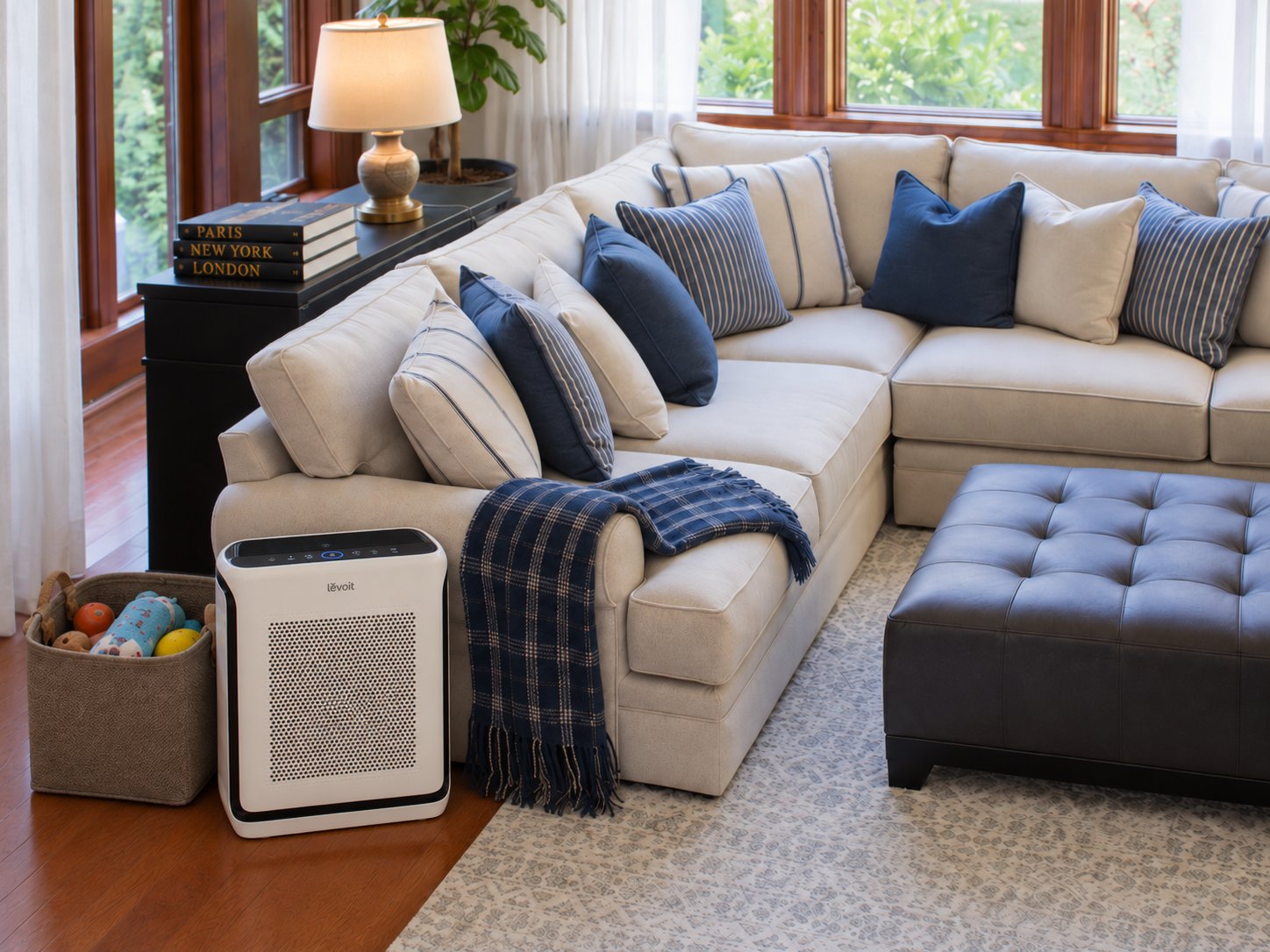
An air purifier for homes with pets should be sized for the room that is actually full of life—not for the whole house simply because a product page makes a broad claim. Think of the room where your dog sleeps through the movie, your cat claims the warm chair, and people keep opening the kitchen door. That room should lead your choice. A closed bedroom upstairs needs its own consideration.
A bigger label can be useful, but it cannot slip around walls, corners, tall ceilings, or a fan speed everyone finds too loud. The practical goal is to give the occupied room enough particle-cleaning capacity for the way your family uses it, then add a second unit when a separate room matters.
Start With the Room, Not the House
Measure the primary room’s length and width. If ceilings are unusually high, include height too. An open living room may look like one space but still contain a dining nook, stairwell, or kitchen edge where air does not move as evenly as the floor plan suggests.
Then ask yourself three questions:
- Where do your family and pets spend the longest stretch of the day?
- Which door is usually closed?
- Is your concern airborne dander and dust, visible shed hair at the intake, ordinary odor support, or a mix?
Portable air cleaners are intended for a room or area, not an entire multi-level home. EPA’s air-cleaner guide recommends matching a cleaner to the space. That is why the room your family shares deserves its own plan before you shop for a machine that claims to cover a house.
Read Capacity Claims in Their Test Conditions
Square footage is not a universal unit of performance. A maker may state a large room at one air change per hour, while another gives a smaller figure at faster turnover. Those are not competing numbers until you know the condition behind them.
CADR, or clean air delivery rate, is often more useful particle context because it describes air-cleaning output. The published condition still matters. For example, Coway lists its Mighty model with particle CADRs and a 361-square-foot reference at 4.8 air changes per hour. Levoit lists the Vital 200S-P at 250 CADR and 388 square feet at 4.8 air changes per hour. These are examples of how to read a product page, not a ranking or a promise that either model fits your room.
A useful buying question is: “What room size does this model state at a turnover I can compare?” A less useful question is: “Which product has the biggest square-foot headline?”
When One Unit Is Enough
One correctly sized unit can make sense when your main pet-and-people room is reasonably open, the machine can run at a usable speed, and the bedrooms do not depend on it. It should have breathing room around its intake, but this guide does not replace the practical question of where to put the unit.
One-unit planning works best when you are honest about its borders. It can support airborne particles in the room where it operates. It cannot vacuum the sofa, pull fur from another floor, or clean the room behind a closed door.
When Two Units Are the More Honest Answer
A second unit is often the better choice when:
- A pet sleeps in a closed bedroom that matters to an allergy-sensitive family member.
- The living room is open but the kitchen, hallway, or stairwell creates a second zone.
- One large machine would need a loud speed to keep up, so it would be switched off during meals, calls, or bedtime.
- You use a main shared room plus a litter-adjacent room with a separate need.
This is not an argument for buying more equipment for its own sake. It is a way to avoid putting every expectation on one appliance. A quiet bedroom unit can run steadily where a large shared-room unit would be unnecessary, while the shared-room unit handles the high-traffic space.
Keep Up With Fur and Filter Care
Hair usually asks for cleaning before it asks for an air purifier. In a shedding season, inspect the prefilter and intake more often than an app reminder suggests. A blocked intake cuts into the airflow you chose the purifier for.
Keep the rest of your home routine realistic too. Vacuuming, washing pet bedding, grooming, and cleaning litter scatter deal with material that has already settled. An air cleaner can support airborne particles that reach it; it does not replace those parts of caring for your home.
A Simple Sizing Walk-Through
1. Name the room
“Open main floor” is not a measurement. Write down the living-room dimensions and whether adjoining zones are truly open.
2. Compare like with like
Prefer a published CADR or a room figure that names the air-change condition. Do not compare a fast-turnover bedroom claim with a one-ACH large-room claim as though they mean the same thing.
3. Choose the speed you will live with
The quietest setting may be perfect for a bedroom and too slow for a busy shared room. The best setting is one you can keep running when your pet and family are in the room.
4. Plan the second zone
If a separate bedroom, office, or litter room matters, size that space separately. It is usually easier to live with than moving one heavy unit back and forth.
Frequently Asked Questions
Does a multi-pet home always need a giant purifier?
No. It needs enough capacity for the particular room and a plan for any separate zone. Two room-sized units can be more useful than one oversized promise.
Is a large coverage number enough?
Not by itself. Check whether the manufacturer says how often the room air is turned over or provides CADR. The test condition changes what the number means.
Can one purifier cover an open floor plan?
Sometimes, for the main occupied zone. Treat distant corners, stairs, and closed rooms as possible separate needs rather than assuming air travels evenly.
Should I size for fur or dander?
Size for airborne particle-cleaning capacity and keep the intake maintained. Most visible fur needs vacuuming and cleaning, not a bigger purifier.
Where do I put a large-room unit?
Use the room’s lived-in center and keep the intake clear. The dedicated placement guide covers the furniture, bedroom, and litter-area details.
Final Takeaway
A good air purifier for homes with pets is a room-by-room decision. Start with the shared room, compare CADR or disclosed air-change conditions, choose a speed your family will actually use, and add a second unit when a separate room deserves clean-air support.
For the particle-selection decision itself, read Best Air Purifiers for Pets: Allergies, Dander, and Hair. For the wider decision map, return to the Pet Air Purifier Buying Guide: How to Choose for Dander, Hair, and Odor.