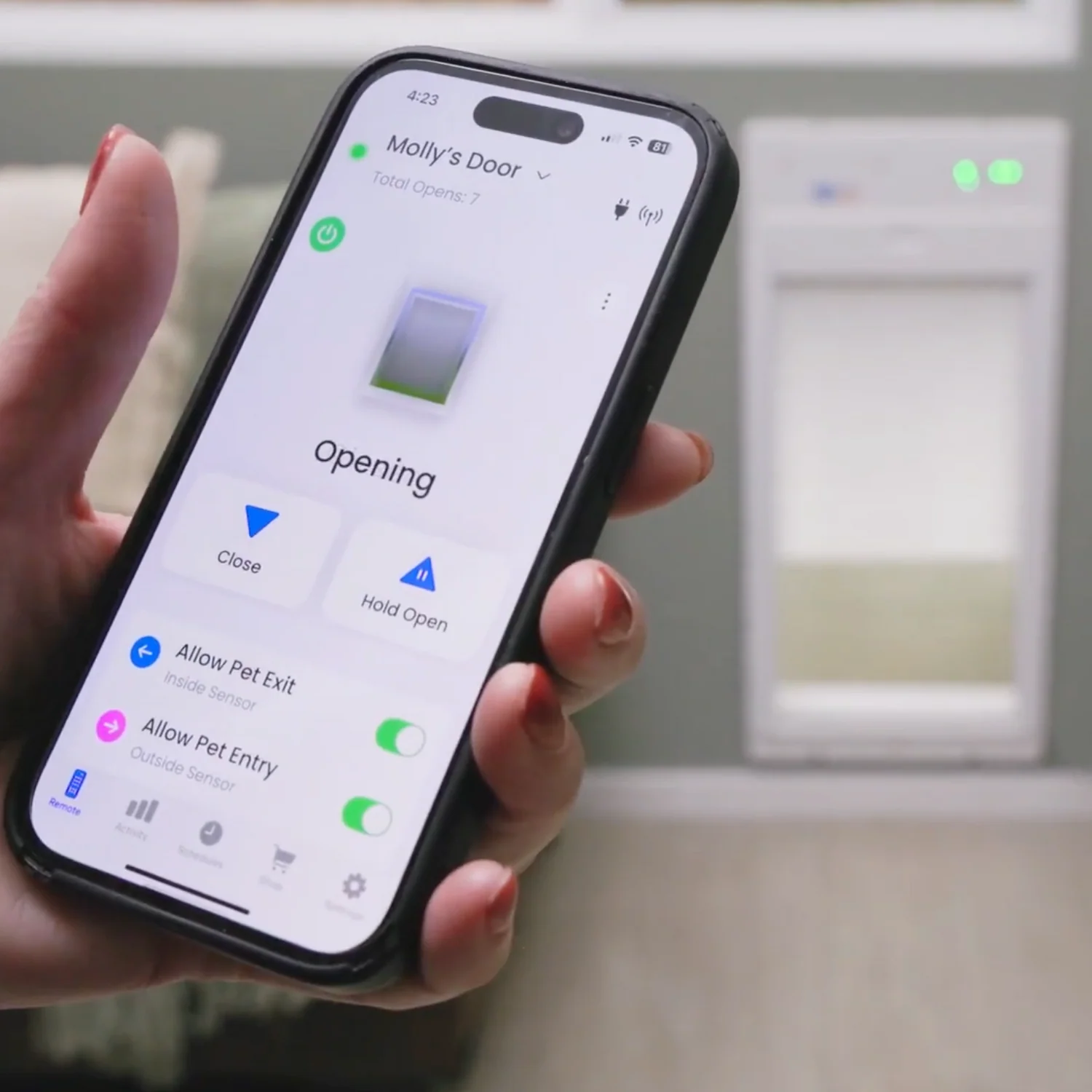
A WiFi pet door sounds wonderfully civilized right up until the router takes a personal day. Then the question gets much less glamorous: can the dog still get out, can you still lock the thing, and do you have any idea what it’s doing without a cheerful notification to tell you?
The app earns its place when it answers a real question rather than giving your phone another reason to buzz. Before you buy an app controlled dog door or a WiFi cat door, separate four things that product pages love to blur together: Wi-Fi, power, recognition, and local operation. They’re related. They are not the same system, and they fail independently.
What Wi-Fi actually adds
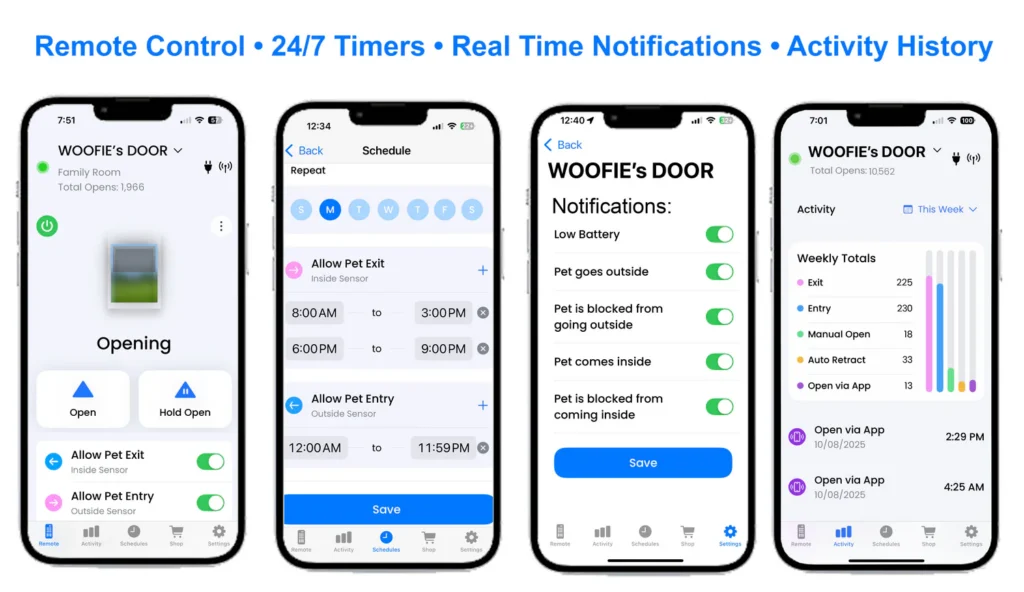
A WiFi pet door can offer remote lock and unlock, schedules, notifications, and access history. PetSafe SmartDoor Connected is a connected flap with app-based routines for keyed pets. Pawport layers connected control and activity tools onto a retrofit cover.
These features are genuinely useful. A smart dog door app lets you lock access before a storm rolls in, confirm the dog came back before you commit to a long meeting, or change the evening routine from someone else’s couch. What none of it changes is that you still own a physical product with a pet, a power source, and a hole in your house. The app is a layer, not the system.
Wi-Fi, power, and recognition fail separately
A WiFi dog door can lose connectivity while the door itself still has power and works normally. It can have power and lose app access because the account won’t authenticate. It can report a door event without having any idea which animal caused it. An electronic dog door with app control may depend on a collar key for access; a microchip product may identify a pet perfectly while having no Wi-Fi at all.
That distinction gets sharper for a WiFi cat door. A cat owner needs to know whether selective entry still works during an outage, whether the curfew holds, and whether the access log actually names the right cat. A dog owner mostly needs to know whether yard access stays predictable when the app is unavailable. Both are reasonable questions and neither is reliably answered on a product page — ask the brand about the specific model.
Build the local fallback before you need it
The useful question isn’t “does this have an offline mode?” It’s “what do I do at 10 p.m. on a wet Tuesday when it isn’t behaving?”
Work through this before you buy, not after:
Does the door have a physical lock control on the unit itself, reachable without the app? Most do. Some are more accessible than others.
What happens to the lock state when power drops — does it fail open, fail locked, or hold whatever it was? This is the single most important answer on the list, and it’s different for every product.
Is there a battery backup, is it included, and how long does it hold?
Can the pet’s tag or key still open the door with the network down, or does recognition route through a Hub?
Does anyone else in the house know how to work it manually? A system only you can operate is a system that fails the moment you’re away, which is precisely when you were counting on it.
Alerts and logs are useful, within limits
Product pages are vague here, so ask directly: does the alert identify the pet, the direction of travel, or only that the door moved? Can you change a mode remotely, or only receive notifications? An electronic dog door with app control and an electronic dog door with Wi-Fi notifications are sold with nearly identical language and are not the same purchase.
An alert can tell you a door event happened. It can’t always tell you why, whether the pet is safe out there, or whether a second animal slipped through behind them.
Worth being clear about the smart-home vocabulary too. MyQ pet portal, Chamberlain MyQ pet portal, and Z-Wave dog door phrases turn up constantly in smart-home searches, but they describe integration standards and adjacent products rather than pet-access systems we recommend here. A Z-Wave dog door and a Wi-Fi app door can behave completely differently when the network drops, because they’re not even the same kind of network. Compatibility with your phone doesn’t make something a good pet door.
Which architecture holds up best without a network
Rank them by how little they need the internet and a clear order appears.
A collar-key or microchip door with no app at all is the most robust thing you can buy. Recognition happens on the device, the lock is mechanical, and the only failure mode is a dead battery. If reliability matters more to you than visibility, this is the honest answer and it’s also the cheapest.
A connected flap — PetSafe SmartDoor Connected, for instance — sits in the middle. The recognition and the lock are local; the app is a layer on top. Lose Wi-Fi and you generally lose the remote features while the door keeps working for the pet.
A smart retrofit cover such as Pawport is the most capable and the most dependent, since the motorized cover is the access control. Confirm its manual override and power arrangement specifically — that’s the detail to ask about before buying, not after.
Frequently Asked Questions
Does a WiFi pet door need internet to let a pet through?
Usually no, but it depends on the model. Connected functions need Wi-Fi; local tags, sensors, locks, and powered movement often have entirely separate behavior. Confirm it in the documentation rather than assuming.
Is the best WiFi dog door also the best option for a cat?
Rarely. A WiFi dog door emphasizes physical access and schedules; a cat household usually needs selective entry and per-pet permission control. Start from the pet’s access problem, not the connectivity spec.
Can I use a remote control dog door during a power outage?
That depends on the device, its backup battery, its manual controls, and how it’s installed. A door that keeps working in an outage is a design choice, not a given.
What happens if the app account or servers go down?
Local controls should still work on any product worth buying — which is exactly why you check for a physical lock control on the unit before you commit. Remote features depend on the service being available; a temporary outage and a permanent shutdown are different situations.
The practical takeaway
Buy a WiFi pet door because its app control or alerts solve a specific problem in your routine, not because Wi-Fi sounds like an upgrade. Once you know the local fallback, the lock behavior on power loss, and the limits of what the activity data actually reports, connected access becomes a convenience instead of a small recurring household mystery.