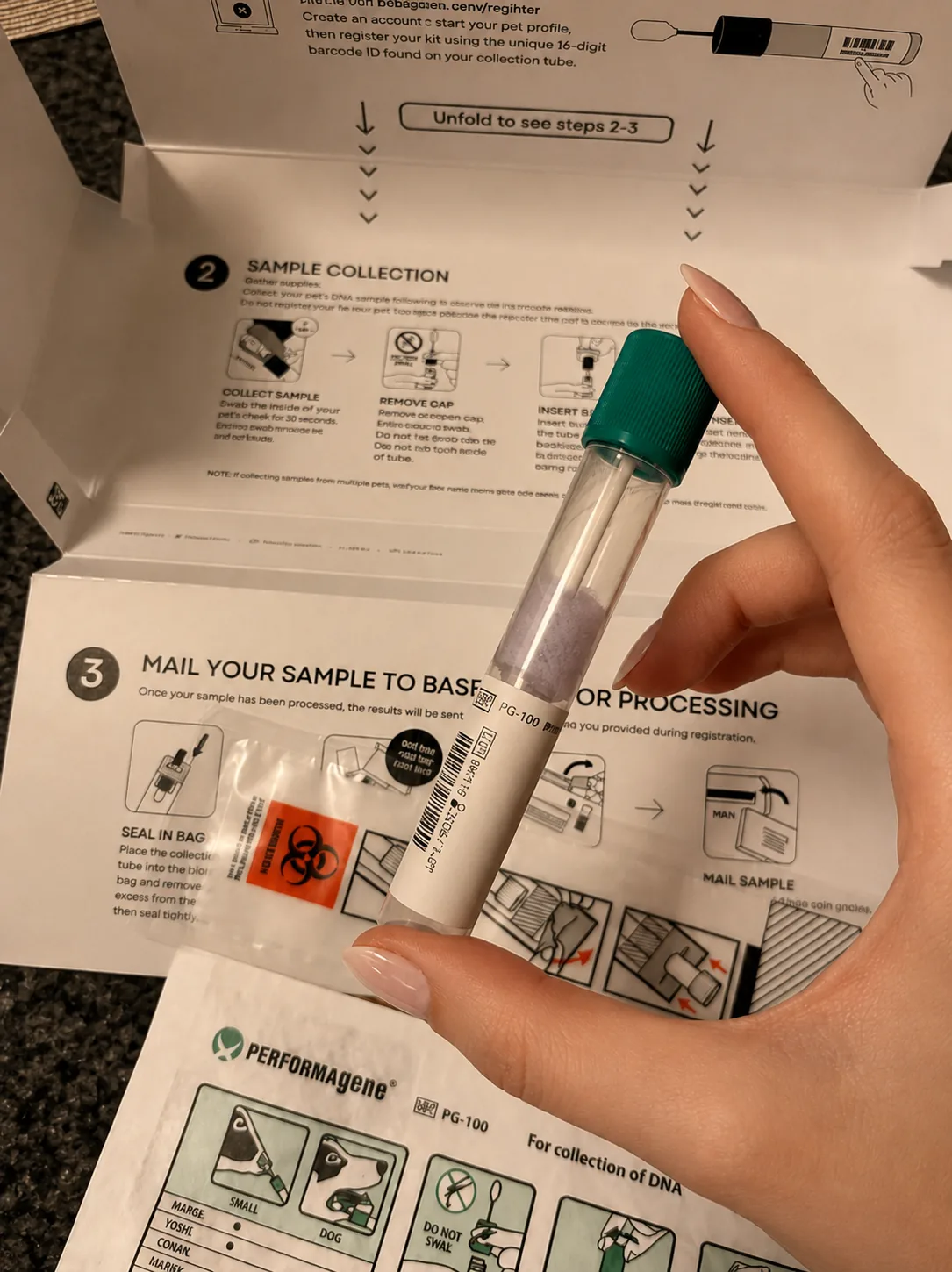
An at home dog dna test sounds simple right up until you are crouched on the kitchen floor trying to swab a mouth that has decided this is a personal violation. The sales pitch is easy to picture: order the kit, mail the sample, get the report, solve the mystery. In real life, an at home dog dna test is more procedural than magical, which is exactly why it helps to understand the workflow before the box lands on your counter.
The same goes for an at home cat dna test, except cats tend to add a layer of offended dignity that dogs usually skip. If you are still choosing products, Best Dog DNA Test Kit and Best Cat DNA Test are the shopping pages. This article is about what actually happens after you buy.
The process is simple, but not automatic
Most kits follow the same broad script. You order the test, receive the box, register or activate the kit, collect the sample, package it, mail it, and then wait for the report to show up by email or in your account.
That does not sound hard, and mostly it is not. But owners still skip steps. They forget to activate the kit. They assume turnaround starts when they place the order instead of when the lab receives the sample. They think the science is the tricky part, when the real challenge is often getting a clean swab from a pet that does not understand why your Saturday suddenly got weird.
That is true for an at home dog dna test and for an at home cat dna test. The outline is simple. The real-life execution is where the friction shows up.
Swabs do most of the work in this category
If you are imagining a needle, you are usually picturing the wrong category. The mainstream consumer kits in this cluster are swab-first products.
Embark’s current instructions tell owners to swab the cheek pouch and under the tongue for at least 30 seconds, activate the kit online, and mail it back in a prepaid envelope. Wisdom Panel says owners activate the kit, swab for 15 seconds, and use the prepaid mailer. Basepaws tells cat owners to swab the gums and teeth for 5-10 seconds. Those details matter because they are the whole front end of the report.
DNA My Dog also sits squarely in the swab-based consumer lane, with an about-3-weeks turnaround claim on its live site. HomeDNA helps round out the picture because it currently has live products for mixed-breed dog identification, dog health screening, and cat health screening. That makes it a good example of how normal the mail-in swab model has become across at-home pet genetics.
Dogs and cats use the same logic, but not the same energy
An at home dog dna test usually feels physical and mildly chaotic. The dog may lick the swab, wiggle away, or treat the whole thing like a suspicious new game, but most owners can at least imagine finishing the job.
An at home cat dna test runs on the same basic logic with a completely different mood. Cats are less inclined to cooperate for the sake of your curiosity, and cat owners are more likely to question whether they got a clean enough sample. Wisdom Panel Complete for Cats and Basepaws make this especially clear. Wisdom Panel keeps a 2-3 week turnaround on the cat side. Basepaws says 4-6 weeks and uses a quick 5-10 second gums-and-teeth swab. It’s not impossible to get a clean sample, but each cat is different. We recommend swaddling if your cat can handle that.
If you want the cat-owner version of the scene, Testing Luna with an At-Home Cat DNA Test Because Curiosity Finally Won captures the domestic comedy. If you want more on the products, Wisdom Panel Pet DNA Test Review and Basepaws Cat DNA Test Review are the more direct follow-ups.
Turnaround is mostly just patience
People talk as if the swab is the big event. Usually the wait is harder.
Embark says results return in 2-4 weeks after the sample reaches the lab. Wisdom Panel says 2-3 weeks. Basepaws says 4-6 weeks. DNA My Dog says about 3 weeks. Those numbers are helpful, but they also create one of the most common misunderstandings in the category: people think the clock starts when they click buy or drop the package in the mail.
That is not how these brands describe it. Lab receipt matters. Processing time matters. Mail time matters. If a sample needs to be rerun or replaced, the wait stretches. That does not mean the kit failed. It means the process is still a physical chain of steps, not instant digital magic.
Why samples fail or get delayed
The usual problems are ordinary. The swab was too short. The pet had just eaten. The kit never got activated. The sample sat around too long before mailing. The owner assumed any quick brush of the cheek counted as enough.
That is why this topic deserves its own page. An at home dog dna test is convenient, but it still rewards a little discipline. So does an at home cat dna test, maybe even more so because cat owners often feel like they only get one decent shot before the whole household mood changes.
If your real concern is timing with a very young dog, Puppy DNA Testing: When It Helps and When to Wait is the better next read.
Where dog dna blood test questions fit
This is where the language gets slippery. People search dog dna blood test or blood test for dog dna and assume they are asking for a more serious version of the same at-home kit.
Usually, in this cluster, that is not the case. The mainstream consumer ancestry products here are swab-based. If you are searching dog dna blood test or blood test for dog dna, you may be drifting toward a different collection method or a different genetics question than the one these at home household kits are built to answer.
That does not make blood tests at the doctors office unimportant. It just means it is not the default collection option for the consumer ancestry kits most readers are actually shopping. I mean, would you really want to give your dog a blood test when saliva is so much easier to collect? So when people say they want a dog dna blood test, what they often need first is not a needle. It is a clearer sense of whether they are buying an at-home ancestry report, a specialty veterinary path, or something narrower altogether.
What the process can and cannot do for you
The whole appeal here is lower friction. You do not need a clinic visit just to start asking a breed or ancestry question. That convenience is the main reason an at home dog dna test feels normal now, and it is why an at home cat dna test no longer sounds like an eccentric side hobby.
But convenience does not erase the limits of the result. The report can help with breed context, traits, and health-marker awareness depending on the kit. It cannot replace veterinary diagnosis. It cannot make a cat report behave like a dog report. It cannot turn a rushed swab into a perfect answer.
If you want the wider category map, Complete Guide to Pet DNA Tests is the best place to zoom out. If you mainly want help interpreting cat-side results, Cat Genetic Test Accuracy and Ancestry: What Results Can and Cannot Tell You is the stronger next article.
FAQ
How hard is an at home dog dna test in practice
An at home dog dna test is usually straightforward, but it is less automatic than people assume. You still need to activate the kit, collect a clean sample, mail it promptly, and wait for the lab to do its part.
Is an at home cat dna test basically the same process
Mostly yes. An at home cat dna test follows the same general mail-in logic, but collection tends to feel fussier because cat cooperation is less reliable.
Is a dog dna blood test better than a swab kit
Not by default. A dog dna blood test may point to a different collection path or a different testing context, but it is not the standard mainstream workflow for the consumer ancestry kits in this cluster.
What does blood test for dog dna usually mean
Blood test for dog dna usually means the reader is imagining a different collection method than the swab-first kits sold to most pet owners. It does not automatically mean the better test for a normal household question.
Final take
The at-home DNA workflow becomes much less mysterious once you stop imagining the result screen and pay attention to the steps before it. An at home dog dna test is mostly activation, swabbing, mailing, and waiting. An at home cat dna test is the same basic script with more feline resistance and, sometimes, a longer turnaround.
The glamorous part is the report. The useful part starts earlier. Get the sample right. Know what kind of kit you bought. Treat dog dna blood test and blood test for dog dna as boundary questions, not as proof that the mainstream swab workflow is somehow unfinished.