The best electronic cat door answers a question no dog owner ever has to ask: how does your cat get home without the kitchen quietly becoming a members’ lounge for every cat on the block? This is a permission problem, not a movement problem. The right door combines a recognition method your cat will tolerate with house rules you can actually enforce — and the doors that enforce the most rules are the ones worth buying.
Quick Comparison
| Award | Product Name | Who It’s For | Key Feature | Additional Key Feature | Key Specs | Price Range |
|---|---|---|---|---|---|---|
| Top Pick | Cat Mate Elite Microchip Cat Flap | selective entry plus a real nightly curfew | onboard timer control layered on chip recognition | LCD status display, runs entirely on the device | See product section | $$ |
| PetSafe Microchip Cat Door | chip-free and chipped cats under one roof | microchip or compatible SmartKey recognition | four-way manual lock, US service network | See product section | $ | |
| Best for Large Cats | SureFlap Microchip Pet Door / Connect | large cats, small dogs, and full app control | chip or RFID collar tag recognition | Connect adds alerts, curfew, remote lock | See product section | $$ |
How we pick: each comparison names one Top Pick and up to two Best for awards, chosen on features, build, support and fit. Brands can’t buy a pick.
Best Electronic Cat Doors and Microchip Cat Flaps
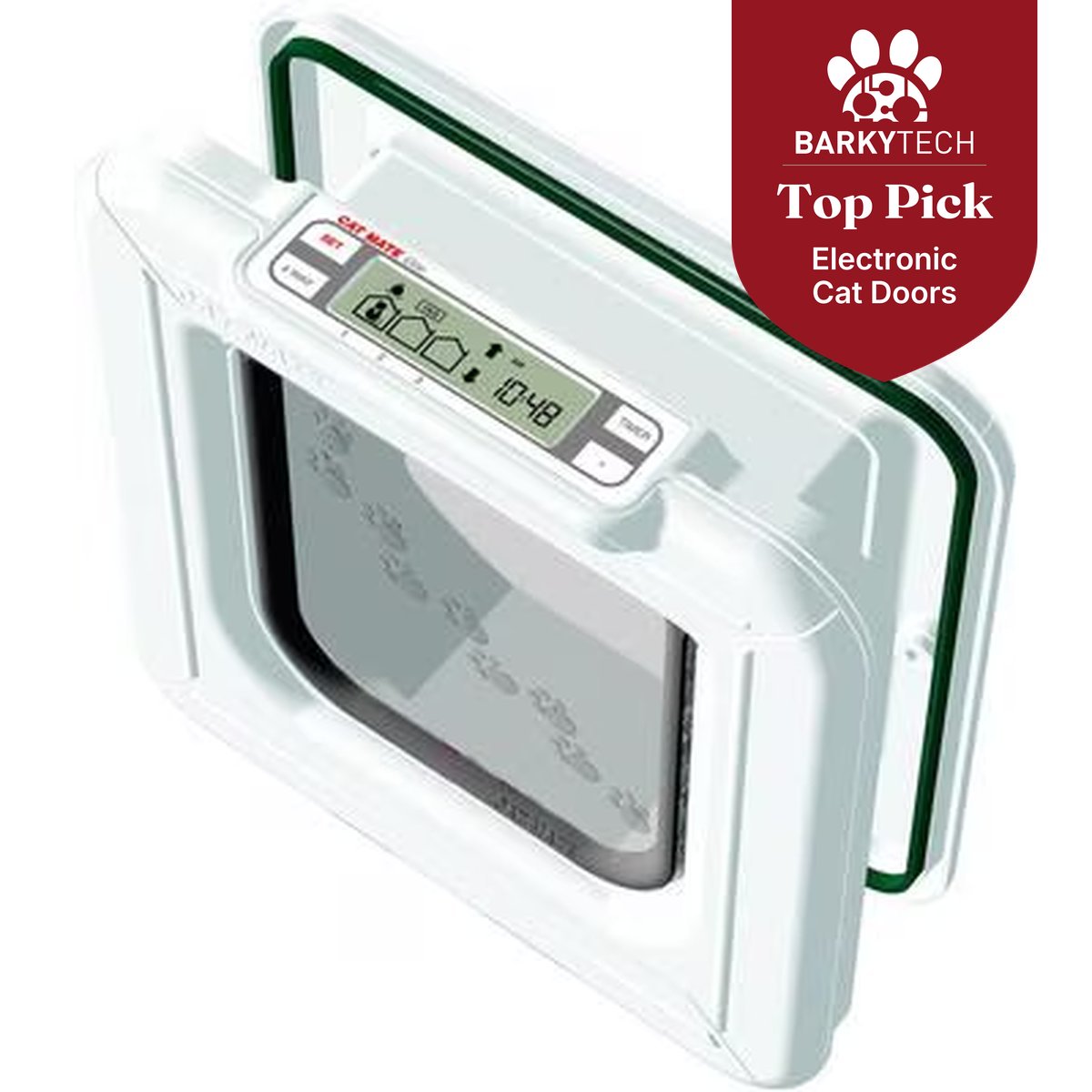
Cat Mate Elite Microchip Cat Flap — Top Pick
Quick Verdict: The most capable local cat door here, and the answer for the cat who treats “bedtime” as an opening bid.
Pros:
- Onboard timer control creates a genuine nightly curfew, a rarer feature than the category suggests
- Microchip recognition works on a credential the cat cannot shed in a hedge
- LCD shows lock status and time since last use, so the door reports back
- Runs entirely on the device — no hub, no account, no outage to wait out
- Four-way lock control on top of the timer
Cons:
- The timer applies to every enrolled cat, not one schedule each
- Stores nine cats, which is a limit rather than a landslide
- More controls to learn than a plain flap
Who It’s For: A household with a real evening routine that wants the door enforcing it, not the owner.
Key Specs:
- Microchip recognition
- Timer-based curfew control
- LCD status display
- Four-way manual lock
Detailed Analysis: If you’re searching for a timer cat flap, this is the one, and it’s very nearly the only one — a built-in cat door timer is genuinely scarce in this category, which is the first reason the Elite is the pick rather than a plain recognition flap. The second is where that timer earns its keep. A curfew that closes the door at 10 p.m. stops the 2 a.m. flap percussion before it starts, and it does it without asking you to open an app, wait for a hub to reconnect, or discover at midnight that the account logged itself out. The schedule lives in the door. That is a reliability argument, not a simplicity one: a curfew that depends on nothing outside your hallway is a curfew that holds during a router reboot.
The LCD is the quietly useful part. Lock state and time since last use turn “I think she’s in” into something you can check on the way to bed. Combine that with chip recognition — a credential your cat cannot lose, unlike a collar tag — and the Elite covers the two things that actually go wrong with cat doors: the wrong cat getting in, and your cat getting stuck out.
The word that shapes the fit is “shared.” One timer, all cats. If everyone in the house follows the same rule, this is the strongest door on the page. If you need one cat in and another out on genuinely independent schedules, no microchip flap here delivers that — that is a category limit, not a Cat Mate one. Our Cat Mate microchip cat flap covers the full range including the step-down models.
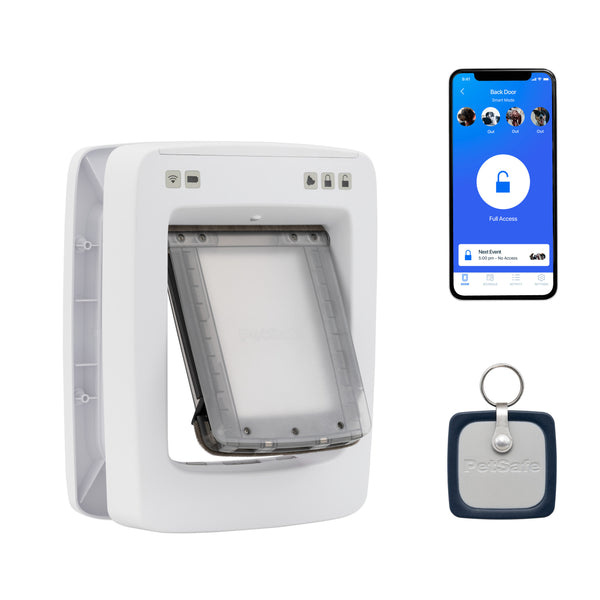
PetSafe Microchip Cat Door
Quick Verdict: The PetSafe route when not every cat in the house has a working chip.
Pros:
- Accepts an implanted microchip or a compatible SmartKey, so an unchipped foster or rescue is still covered
- Four-way manual lock gives in-only, out-only, open, and closed control
- Properly cat-scaled, with an approachable setup
- Backed by PetSafe’s US service and warranty network, which is a real difference when a door fails in year two
Cons:
- No timer or scheduling of any kind
- Fewer stored identities than the Elite
- Not for large dogs, and a genuinely large cat should be measured first
Who It’s For: A household running a mix of chipped and unchipped cats, or one that wants recognition with a manufacturer that answers the phone.
Key Specs:
- Microchip or compatible SmartKey recognition
- Four-way manual lock
- Local access settings
- Cat-door form factor
Detailed Analysis: The dual-credential design is the reason this door is here rather than a footnote. Most microchip flaps assume every cat arrives pre-chipped and correctly registered, which is a fine assumption right up until a foster cat lands in the spare room or a rescue turns up with a chip nobody can trace. PetSafe lets that cat carry a SmartKey while the resident cats use their implants, on the same door, with no compromise for either.
The four-way lock is the other genuinely practical control: in-only when you want everyone home before dark, out-only when the carrier is coming out of the closet, and full closure when the weather does something dramatic. It is manual rather than scheduled, which is the honest trade against the Elite — you are the timer.
Keep this one in its lane. PetSafe also sells connected dog-door products and the shared logo pulls people into the wrong aisle. Our petsafe smart door separates the four lanes properly.
Choose the PetSafe Microchip Cat Door when chipped and unchipped cats share the same doorway.
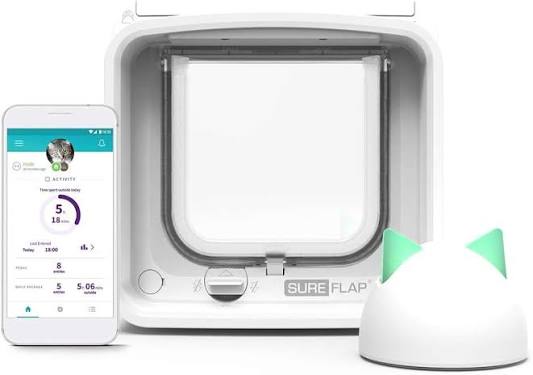
SureFlap Microchip Pet Door and Connect — Best for Large Cats
Quick Verdict: The alternate worth knowing about when you want to see which cat came home, and when, and lock the door from a hotel.
Pros:
- Reads implanted microchips or RFID collar tags, so either credential works
- Sized for large cats and small dogs, a larger opening than anything else on this page
- Connect adds per-pet activity history, alerts, curfew, and remote lock/unlock
- The standard non-Connect model gives the same recognition without the hub
Cons:
- Connected functions require the Hub, and the hub is another thing to keep online
- Selective entry still doesn’t stop a determined tailgater
- Not a large-dog opening, whatever the “pet door” name suggests
Who It’s For: A multi-cat household that will genuinely use alerts and activity history, or one with a Maine Coon or a small dog that the other flaps here won’t fit.
Key Specs:
- Microchip or RFID collar-tag recognition
- Hub-linked Sure Petcare app on the Connect model
- Large-cat and small-dog sizing
Detailed Analysis (SureFlap microchip pet door reviews, in short): SureFlap is the brand people search by name, so it’s worth being specific about what you’re choosing between. The standard SureFlap Microchip Pet Door is a chip-or-tag flap with local four-way locking, distinguished mainly by its larger opening. The Connect version is the same door with a Hub and an app, and that app is the reason to pay the difference.
Credit where it is due: on app depth, SureFlap Connect is the strongest door on this page. It tells you which enrolled pet went out and when, lets you change a curfew from anywhere, and locks the door remotely when the weather turns. That is real per-pet visibility, not a motion sensor reporting that something moved — and the reason it works is that the intelligence sits on top of genuine recognition rather than beside it.
The opening is the real differentiator against the Elite. If your cat is a Maine Coon, or a small dog shares the doorway, SureFlap is not the alternate here — it is the only thing on this page that fits. That is a sizing call, and sizing beats everything else.
Cat doors with collar sensors: when the tag beats the chip
A cat door with collar sensor reads a tag, magnet, or RFID disc worn on the collar rather than an implanted chip. Cat Mate’s electromagnetic flap works this way, and SureFlap accepts an RFID collar tag as an alternative to a chip. So does an automatic cat door with collar recognition from most brands that offer both.
The chip is usually the better credential, for one obvious reason: it can’t come off. A collar in a hedge is a cat locked outside in the rain. But there are real cases where the tag wins. A cat who isn’t microchipped and whose owner would rather not schedule a vet visit for it. A rescue whose chip registration is a mess. A foster cat passing through. A chip whose frequency the door doesn’t reliably read — rare, but it happens, and a tag sidesteps the problem entirely.
If your cat wears a collar happily today, a collar-sensor door is a perfectly good decision. If your cat has removed every collar you’ve ever bought with the quiet competence of an escape artist, buy the chip reader. The RFID vs microchip guide works through the trade-off in more depth.
Buying Guide
Intruder cats and what selective entry really does
Selective entry cuts unwanted visitors dramatically. It does not build a force field. Check whether the specific door controls entry, exit, or both, and accept that a bold cat can occasionally follow your cat through while the flap is still swinging. That’s a limitation of physics, not of any one brand.
Timers, curfews, and multi-cat permissions
A cat door timer and an app curfew solve the same problem from opposite directions. A timer cat flap like the Cat Mate Elite runs the schedule on the device — no Wi-Fi, no Hub, no account, and it keeps working when the internet doesn’t. An app-based curfew on SureFlap Connect is more flexible and can be changed from anywhere, but it depends on the Hub staying online. Decide what rule you’re actually trying to enforce before you shop, because the products differ sharply here. A shared curfew that has to hold every night is a Cat Mate Elite. Per-cat visibility and remote control is SureFlap Connect. What none of them do is give each cat its own independent exit schedule — if that’s the requirement, no flap on this page satisfies it.
Size the opening for the largest cat
A Maine Coon is not a standard cat, and most of these flaps are built for one. Measure shoulder width and the height of the cat’s natural stride through a doorway before cutting anything. SureFlap’s larger opening is the one designed with big cats and small dogs in mind, and no amount of feature list closes a gap the cat physically cannot fit through.
Training and location
Flap noise, tunnel depth, where the reader sits, and whether another cat guards the passage can all matter more than the technology. The microchip cat-door training guide gives the setup process the time it deserves — and it deserves more than an afternoon.
Where smart features fit here
A smart cat flap adds alerts, activity, and remote locks, and those are the features owners keep using long after the novelty of a new door wears off. What they cannot do is create recognition where the hardware doesn’t have it — which is why SureFlap Connect works and a generic smart-home flap doesn’t: its app sits on a chip-and-tag access system. The dog comparison covers app control on dog-sized doors and powered patio panels.
FAQ
What is the best microchip pet door for multiple cats?
The Cat Mate Elite, in most multi-cat homes — chip recognition for every cat plus one shared curfew the door enforces on its own. Choose SureFlap Connect instead if you want to see which specific cat used the door and when, or if one of your cats is too big for a standard flap. Either way, each cat has to be enrolled and tested individually.
Are SureFlap microchip pet doors worth the money?
Yes, when you are buying it for the larger opening or the app. The standard SureFlap competes on recognition alone; where it pulls ahead is sizing for large cats and small dogs, and the Connect model’s per-pet activity reporting and remote locking. If neither the size nor the app is what you’re solving for, the Cat Mate Elite’s onboard timer does more for a nightly routine.
Are electronic cat doors good for cats that hate collars?
Microchip flaps are ideal for exactly this — recognition doesn’t depend on anything the cat can shed. Confirm chip compatibility, then introduce the flap slowly. If one cat in the house isn’t chipped at all, the PetSafe door’s SmartKey option covers that cat without leaving the others behind.
Does an electronic cat door work in a sliding glass door?
The installation surface and the access mechanism are separate purchases. An electronic cat door for sliding glass door use needs a compatible panel or adapter solution; the location doesn’t supply the recognition.
Is there a cat flap with a built-in timer?
Yes — the Cat Mate Elite Microchip Cat Flap has a timer control that sets a shared access window for every enrolled cat, managed on the device rather than through an app. It is the most straightforward timer cat flap here. SureFlap Connect can run a curfew too, but through the app and Hub rather than an onboard cat door timer.
Can a microchip cat door handle a cat that comes home after curfew?
It depends on the model. Several curfew modes stop cats leaving while still letting them return, which is usually what you want. Test it yourself before you rely on it overnight.
Final Recommendation
Buy the Cat Mate Elite Microchip Cat Flap, our Top Pick. It is the most capable door here for the job this page is about: chip recognition your cat cannot shed, plus an onboard timer that enforces the evening curfew without a hub, an app, or a working internet connection standing between you and a closed door at 10 p.m. That combination is genuinely scarce in this category, and it is the difference between a door that recognises your cat and a door that runs your household.
Two cases send you elsewhere, and both are about fit rather than spend. If your cat is a Maine Coon or a small dog shares the doorway, SureFlap Connect is Best for Large Cats — a larger opening and the deepest app on this page, with per-pet history and remote locking. If some cats in the house are chipped and others aren’t, the PetSafe Microchip Cat Door takes both credentials on one flap.
This is a door your cat will use several thousand times a year, in the dark, in the rain, while you are asleep or three time zones away. It is not the place to cut corners on the control layer. Pick the recognition method your cat will accept, then buy the version that enforces the rule for you. For the wider category, start with the Complete Guide to Automatic Pet Doors for Dogs and Cats. If you are solving for a dog instead, Best Electronic Dog Doors for Large Dogs, Small Dogs, and Wall Installs is the right list. For sliding-glass placement questions, see Where to Install an Automatic Pet Door: Wall, Standard Door, Patio Panel, or Sliding Door.