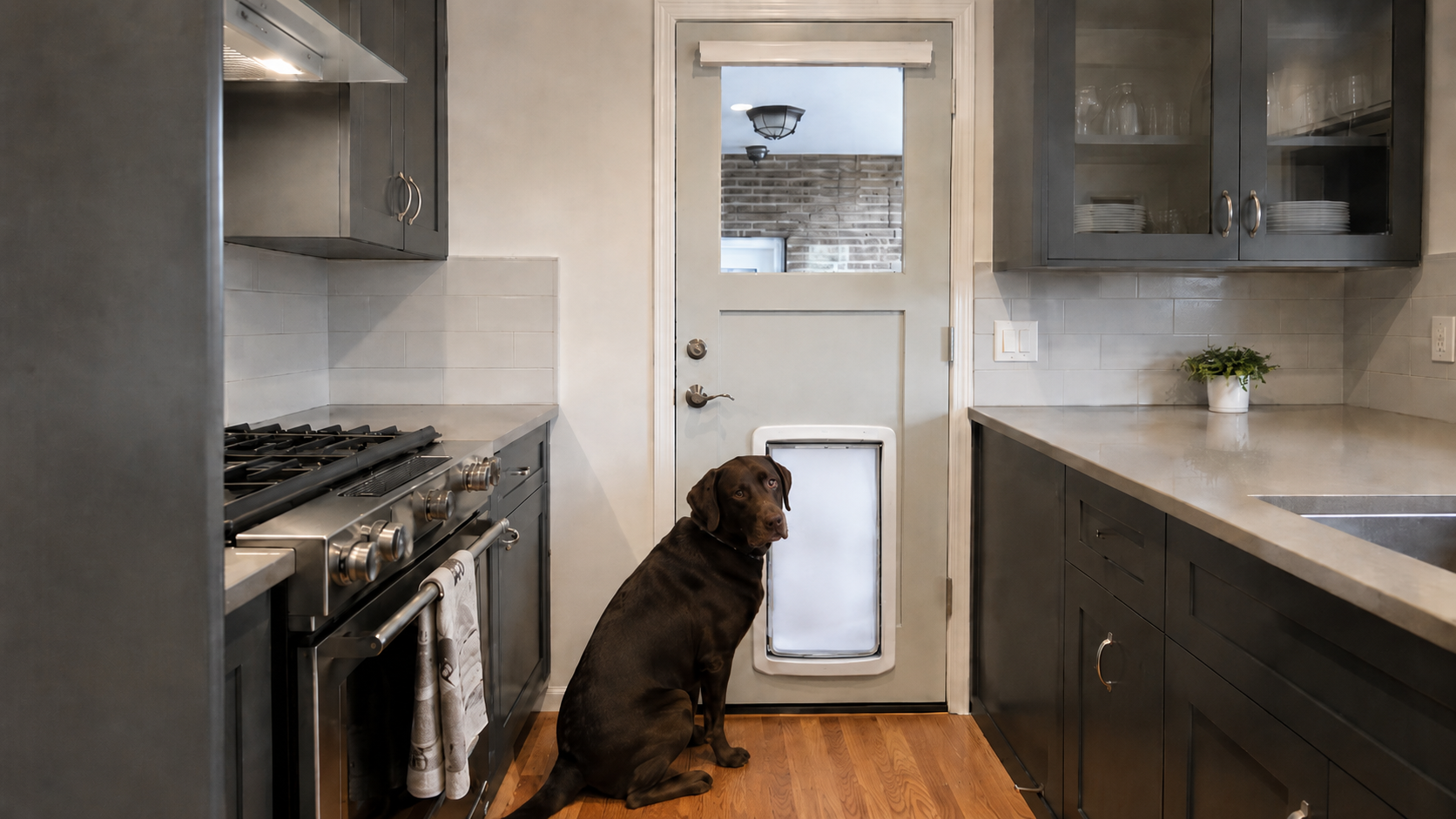
The best electronic dog door is the one your dog uses without making a production of it. That means a clear opening, an unobstructed approach, and an installation that survives both the weather and a seventy-pound retriever hitting it at full enthusiasm. Get the passage right, then buy the most capable control layer you can put on top of it — because a door your dog uses six times a day is not the place to economise on the part that locks.
Quick Comparison
| Product Name | Best For | Key Feature | Additional Key Feature | Key Specs | Price Range |
|---|---|---|---|---|---|
| Pawport Smart Pet Door | upgrading an existing opening to full smart control | motorized cover with app, schedules and tag access | dual-deadbolt locking and multiple power options | See product section | $$$ |
| High Tech Pet Power Pet | a new cut for a large dog who hates flaps | motorized panel that opens on approach | collar-activated with directional sensing | See product section | $$$ |
| PlexiDor Electric | permanent wall installs and heavy weather | rigid RFID-triggered panel that slides up | genuinely substantial hardware | See product section | $$$$ |
| PetSafe Electronic Pet Door | authorized-only access on a standard flap | electronic collar key unlocks the flap | widely available with easy replacement keys | See product section | $$ |
Best Electronic Dog Doors
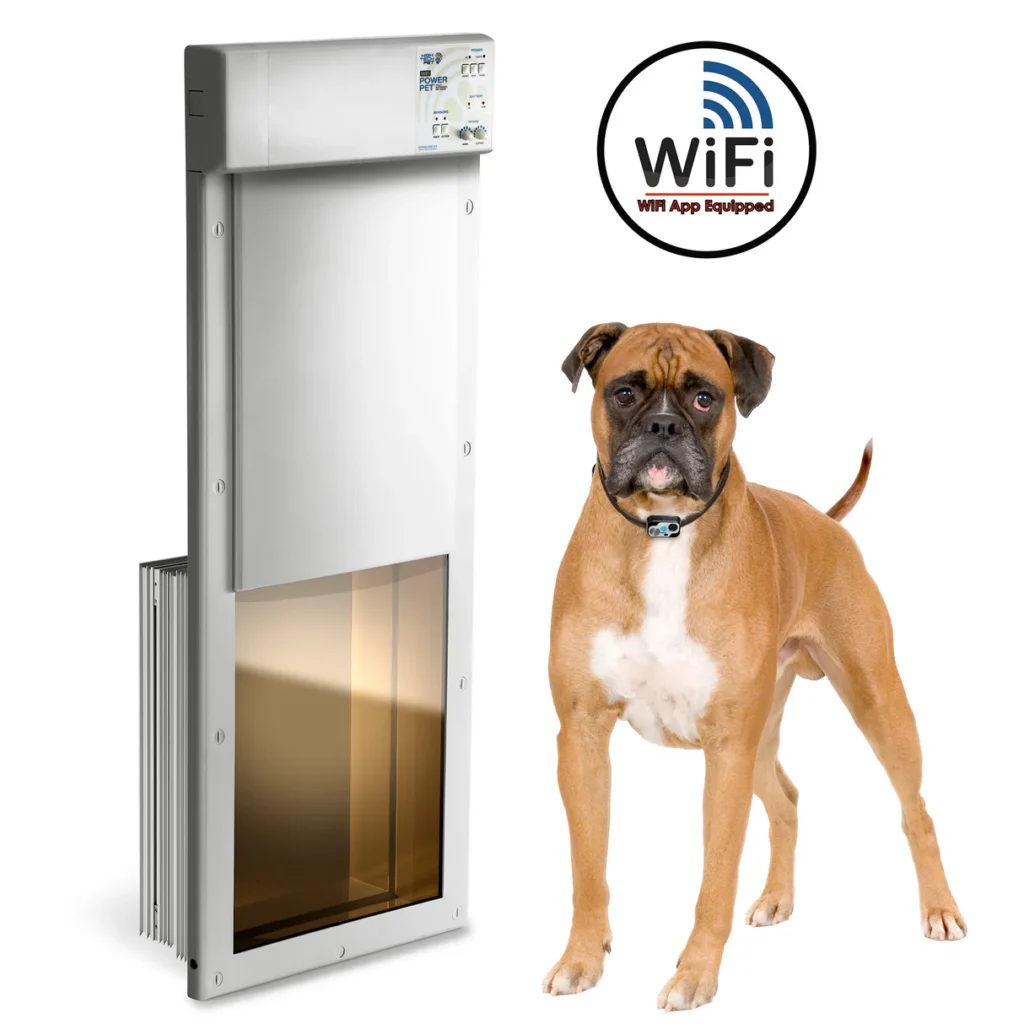
Pawport Smart Pet Door — the one to buy
Quick Verdict: The most capable door on this page, and the answer when there’s already an opening in the wall worth keeping.
Pros:
- Motorized cover opens on tag approach, so a big dog never has to shove through anything
- Full app control: remote lock, schedules, activity information, and lighting
- Two deadbolts and a rigid cover put it in a different security class from a flexible flap
- Retrofits a compatible existing opening, so no second hole in the house
- Plug-in, hardwired, battery-backup and solar-assisted power options
- Built for genuinely busy multi-dog traffic
Cons:
- Requires a compatible existing pet-door opening
- The dog has to wear the Smart Pet Tag
- App-managed access means an account and a network to keep healthy
Best For: A large-dog or multi-dog household with an existing pet door that has outlived its usefulness — unsecured, unmanaged, or open to whatever wanders up to it.
Key Specs:
- Motorized retrofit cover over an existing opening
- Smart Pet Tag collar credential
- App scheduling, remote lock, activity information, lighting control
- Dual-deadbolt locking
- Multiple power configurations including solar assist
Detailed Analysis: Pawport is the most feature-rich product in this comparison and it isn’t close. Everything else here gives you one control idea — a motor, or a rigid panel, or a latch that releases. Pawport gives you the motor, the rigid cover, the deadbolts, the schedule and the phone, on top of an opening you already own.
Two things make it the pick for large dogs specifically. Nothing has to be pushed: the cover drives out of the way on tag approach, which matters for a big dog who plants his feet at a stiff flap and matters more for an older one with sore hips. And the locking is in a different class — a dual-deadbolt rigid cover rather than a flexible flap that anything with a head can nose through, on what is the largest unsecured opening most houses have.
The app is where the daily value accumulates. A schedule means the door is shut at 11 p.m. whether or not you remembered; remote lock means the dog walker’s visit doesn’t leave the back of the house open all afternoon; activity information means you know the dog went out at 2 p.m. rather than guessing. That’s the difference between hardware you installed and a system that runs a routine for you.
The constraint is geometry, not budget: measure the existing frame, rails and usable clearance before ordering, because owner reports include having to size up when the old door’s rails ate into the fit. If there’s no opening yet, cut one for High Tech Pet instead. Our full Pawport smart pet door review goes through compatibility properly.
High Tech Pet Power Pet — best for a new install
Quick Verdict: The pick when you’re cutting a fresh opening and want the panel to move for the dog.
Pros:
- Motorized panel opens on approach, so nothing has to be shoved
- Door, wall, and patio variants give you real placement options
- Directional sensing means the door isn’t triggered by a dog merely walking past it
- Four-way access control on the unit itself, so the routine holds during a network outage
- Purpose-built rather than retrofitted, so the opening is sized correctly from the start
Cons:
- The dog has to reliably wear the collar transmitter
- Power, clearance, and installation are part of the purchase, not afterthoughts
- No app layer — control is local
Best For: A large-dog household putting in a new powered passage where none exists.
Key Specs:
- Powered opening panel
- Collar-triggered activation with directional sensing
- Door, wall, and patio variants
- Local four-way access control
Detailed Analysis: High Tech Pet wins the new-install case because it addresses movement rather than permission, and does it with a passage built to the right size from day one. A big dog who plants his feet at a stiff flap will usually walk straight through a panel that’s already open. Where it separates from a plain motorized door is directional sensing: the unit distinguishes a dog approaching to go out from a dog walking past on the way to the kitchen, which stops the door firing all day and hauling your heating out with it.
The trade-off is honest: you’re buying a system, not a product — a collar, a power arrangement, and a cut in your wall or door. If a slider is your actual doorway, the smart pet door comparison is the right page. Our full Power Pet automatic door review goes model by model on sizing and the patio variant.
PlexiDor Electric — the alternate for a permanent wall install
Quick Verdict: The alternate worth knowing about when a rigid panel set into a wall is the whole point.
Pros:
- RFID collar key controls exactly what activates the door
- Rigid panel and automatic locking are a different category of security from a flexible flap
- Door and wall formats support a proper permanent installation
- Seals against weather better than anything flexible
Cons:
- No app, no schedules, no activity history
- Commitment is well above a standard flap — this is building work
Best For: A large-dog household ready to treat the pet door as a piece of the building rather than an accessory.
Key Specs:
- RFID collar-key activation
- Rigid vertically sliding panel
- Door or wall installation
Detailed Analysis: PlexiDor’s strength is a solid barrier that opens only for the programmed collar key and locks itself the rest of the time — which is what you want in a wall that faces a street. On raw build and weather sealing it is arguably the most substantial hardware on this page, and it’s fair to say so plainly: if the only question is how well the thing holds up in a wall for a decade, PlexiDor answers it well.
Where it lands behind Pawport is the control layer — no schedule, no remote lock, no record of when the dog went out. The intelligence stops at “the right collar opened it.” For a household that wants a permanent architectural install and nothing on a phone, that’s a clean fit. The requirements are equally solid: the right wall or door, a power route, and a realistic view of what a decade of traffic and weather will do. This is the one you buy once.
PetSafe Electronic Pet Door — best for a collar-key upgrade on a standard flap
Quick Verdict: The PetSafe route when the job is authorized-only access on an ordinary flap opening.
Pros:
- Collar key unlocks the flap for your dog and nothing else in the neighbourhood
- Runs entirely locally, so the access rule holds through an outage
- Widely available with easy replacement keys, and a US service network behind it
- Fits standard flap openings without specialist installation
Cons:
- The dog still pushes through a flap — nothing moves out of the way
- No schedules, no remote control, no activity record
- The key has to stay on the collar to be worth anything
Best For: An owner replacing an unsecured flap who needs authorized access solved and nothing else.
Key Specs:
- Pet Door Key access on the collar
- Standard flap the dog pushes through
- Local operation, no hub or network
Detailed Analysis: The important PetSafe comparison happens inside PetSafe. The Electronic Pet Door is the local, uncomplicated proposition: the key approaches, the lock releases, the dog pushes. It solves exactly one problem — that an ordinary flap admits anything with a head — and the section should be read that way.
Where it earns its place is availability and support: replacement keys are easy to get, it fits standard flap cut-outs, and PetSafe has a US service network behind it, which counts on a device that lives outdoors. PetSafe also sells the app-connected SmartDoor Connected — if schedules and remote locks are what you’re after, that lives on the smart pet door comparison, and Pawport above does more of it. Note before you shop: PetSafe limits microchip pairing to compatible cats on a Medium SmartDoor, so a dog household should plan around a paired Pet Door Key either way. Our PetSafe smart door review untangles the full range.
Collar-activated dog doors: how the access actually works
Every product on this page is a collar activated dog door, and the phrasing shifts depending on who’s selling it — collar operated dog door, dog door with collar sensor, automatic dog door with collar, collar activated doggy door. They all describe the same arrangement: your dog wears a credential, and the door responds to it.
What differs is what the door does once it recognizes the credential, and the gap between those responses is the whole buying decision. Pawport’s Smart Pet Tag drives a motorized cover off the opening and can throw two deadbolts behind it. High Tech Pet’s collar transmitter triggers a motor that lifts a panel out of the way. PlexiDor’s RFID key releases and raises a rigid panel. PetSafe’s Pet Door Key releases a latch and leaves the pushing to the dog. Same trigger, four completely different experiences for the animal walking up to it — and four very different answers to what happens at 3 a.m. when nobody is watching the door.
Two practical points decide whether a collar system works in your house. First, the dog has to wear the collar consistently — including at 6 a.m., including after a swim, including after a bath when it’s still hanging on the hook. Second, directional sensing matters more than the spec sheet suggests: a door that fires every time the dog walks past it on the way to the kitchen will run its battery down and let heat out all day. High Tech Pet’s directional approach exists specifically to solve that.
Collar activation also solves a problem people don’t buy it for: it keeps other animals out. An old flap opens for anything with a head, which is how a neighbourhood cat ends up eating your dog’s food — a situation we followed all the way to its conclusion in When the Neighbor’s Cat Tried to Move In, My Parents Needed a Dog Door That Locks Automatically.
If your dog refuses collars outright, this whole category is the wrong shelf. Implanted-microchip recognition is overwhelmingly a cat-sized product lane, so a collar-averse large dog is usually better served by a well-sized manual or powered opening without selective access at all.
Buying Guide
Large dogs and physical clearance
Measure the moving dog, not a posed photo. Shoulder height, chest width, hip clearance, and the angle of the turn into the opening all count. An electronic dog door for large dogs should feel unremarkable to the dog — if it looks like a daily dare, it’s too small. Weight ratings are a rough proxy at best: a lean 90-pound shepherd and a broad 70-pound bulldog need different openings, and only one of those numbers appears on the box.
Small dogs and moving panels
Small dogs don’t automatically want the smallest opening. They want a route that feels secure, a panel they’ll approach without flinching, and controls that don’t leave them standing in a draft waiting for something to happen. The collar key also has to sit high enough on a small dog’s neck to trigger the reader reliably, which is a genuinely different fitting problem than it is on a Labrador.
Wall versus standard-door installation
An electronic dog door for wall installation creates a dedicated route, which is ideal when the human door is busy or badly placed. It also brings wall depth, exterior finish, power routing, and weather into the conversation. A standard exterior door is simpler when the dog already uses that path. If there’s already an opening in either location, a retrofit like Pawport upgrades it without a second cut. Pick the location first — the installation guide is built for exactly that decision.
Weather and security
Weather sealing and lock behavior matter more than any marketing adjective. Rigid panels seal better than flexible flaps; powered panels that close and deadbolt behind the dog seal better than either. On security, an authorized collar key limits what activates the door, but it can’t promise another animal never follows your dog through. Combine the door’s lock modes with a secure yard and you’ve covered the realistic risks.
Multi-dog households
Every dog needs its own key or transmitter, and the opening has to fit the largest one comfortably. Worth checking before you buy: whether the door stays open long enough for two dogs who always travel as a unit, and whether your system charges for extra collar hardware. Doors with per-pet activity reporting are worth more in a multi-dog house than a single-dog one, because “somebody went out” stops being a useful sentence.
Where smart features fit here
App control adds schedules, remote locking and activity records on top of physical access, and those are the features owners keep using long after installation day. Pawport is the one on this page that brings them. If automating an existing human sliding door is the real attraction rather than a pet-sized opening, start with the smart pet door comparison instead.
FAQ
What is the best electronic dog door for a large dog?
Pawport, if there’s already a suitable opening — a motorized cover, dual deadbolts, tag access and full app scheduling, If you’re cutting a new opening, High Tech Pet Power Pet is the pick, and PlexiDor Electric is the alternate for a permanent wall install. All of them need a comfortable clear opening and a dog who’ll wear the collar.
What is a collar activated dog door?
A door that unlocks or opens when it detects a transmitter or RFID key on your dog’s collar, so unauthorized animals can’t use it. Pawport, High Tech Pet, PlexiDor, and PetSafe all work this way, though what happens after recognition differs — a motorized cover, a lifting panel, a rising rigid panel, or a released latch.
Can electronic dog doors go through a wall?
Several can, PlexiDor and High Tech Pet included. Wall depth and construction, power routing, and weather requirements all have to be settled before any cutting starts. If a wall opening already exists, a Pawport retrofit avoids opening the wall a second time.
Can multiple dogs use one electronic dog door?
Yes, provided the opening fits the largest authorized dog and each dog has the required collar key or tag. Check whether extra transmitters are included or sold separately. In a multi-dog house, Pawport’s per-pet activity information is the feature that stops “the dog went out” from being a guess.
What is the best electronic doggy door for a simple collar-key setup?
The PetSafe Electronic Pet Door. It’s a collar-key flap that runs entirely locally with no hub or account, which makes it the straightforward choice when authorized access is the only problem you’re solving. If you want the door to also lock on a schedule, report activity, or respond to your phone, that’s Pawport.
Final Recommendation
Buy the Pawport Smart Pet Door if you have an existing opening it fits. It is the most capable dog door in this comparison: a motorized cover so a big dog never pushes, two deadbolts on the largest unsecured hole in the house, and an app that actually runs the routine — schedules, remote lock, and a record of who went out and when. Measure the existing frame and clearance first; that’s the one thing that decides whether it’s an option.
Cutting a new opening instead? High Tech Pet Power Pet is the one to put in — a powered panel sized correctly from the start, with directional sensing so it isn’t firing every time the dog crosses the kitchen. For a permanent wall install where the hardware matters more than anything on a phone, PlexiDor Electric is the alternate, and it seals and survives as well as anything here.
Get the passage right first — clearance beats every feature list on this page. Then put the strongest control layer you can on top of it. This is not the place to cut corners on the part that locks. For the wider category, start with the Complete Guide to Automatic Pet Doors for Dogs and Cats. If the pet you are solving for is a cat, Best Electronic Cat Doors and Microchip Cat Flaps for Selective Entry is the right list. If the doorway you want automated is a slider you already walk through, see Best Smart Pet Doors and Pet Door Openers for App Control and Alerts.