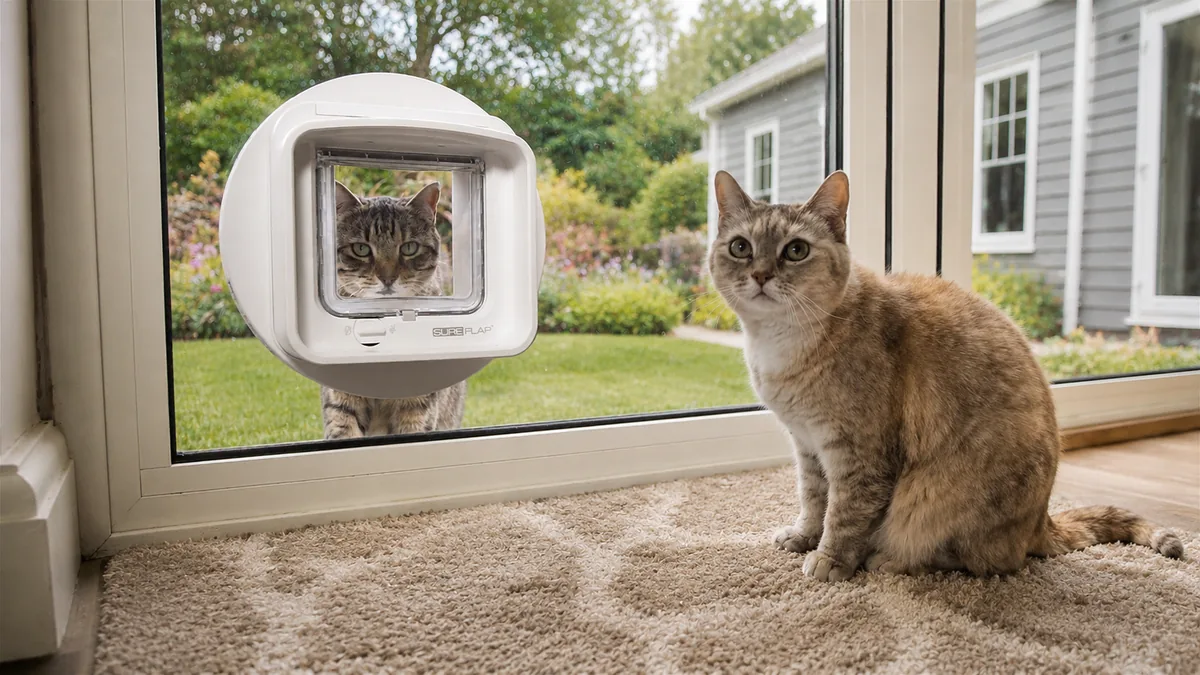
Microchip cat door training gets complicated the moment a second cat has an opinion. One will march through the new flap like she commissioned it personally. The other will regard it as a haunted lunchbox you have installed in the wall for reasons known only to you.
Both reactions are completely normal, and neither is a reason to rush. The goal for the first week is not independence — it’s making the door boring. Permissions, curfews, and neighbor-cat management all work better once the flap has stopped being an event.
Start with the calmest possible version of the door
Before a microchip activated pet door becomes selective, make the opening easy to approach. Follow the product’s setup instructions, check the flap swings smoothly, and let the cats investigate with the lock in a mode that won’t startle them mid-sniff.
Treats, a favorite toy, or a familiar blanket on the far side all help. Pushing a cat through does not. That single act converts a doorway into a personal enemy, and cats keep grudges with real administrative rigor.
If you’re setting up a SureFlap microchip pet door, a Cat Mate, or a PetSafe model, enroll each chip or tag exactly as instructed before relying on any of it. A cat door with collar sensor needs the tag sitting where the reader can see it. A microchip pet door needs the reader to catch the chip at the angle your cat naturally approaches — which is rarely the angle in the manual’s illustration.
A week-by-week introduction that actually works
This pace suits a cautious cat. A confident one will sprint ahead of it, which is fine — let her.
Days one and two: door installed, flap taped or propped fully open if the manufacturer allows it, lock disabled. The cat should be able to walk through an open hole without anything moving or clicking. Feed nearby. Do nothing else.
Days three and four: let the flap hang closed but stay unlocked, so it swings freely with a light push. Sit on the far side and call the cat through. Reward the approach, not just the passage — a cat who investigates and retreats has still made progress.
Days five and six: enable recognition for one cat. Watch how the unlocking sound lands. Some cats ignore it completely; others need another day to accept that the click is not a threat.
Week two: enroll the remaining cats one at a time, and only then start testing the permission rules you actually bought the door for.
Train one cat at a time
In a multi-cat home, test each cat separately before making the door responsible for household boundaries. Start with the confident cat only if that won’t make the cautious one feel crowded — and it often does, so consider working with the nervous one first while the house is quiet.
Don’t assume one successful pass means the automatic cat door with collar or chip settings are ready for a curfew. Repeat the approach from both sides. Watch for a cat who slows because the flap brushes her back, a tag that catches on the frame, or a reader that wants a more centered approach than your cat is inclined to offer.
The cat who guards the door
This one surprises people, and it has nothing to do with the technology. In a multi-cat household, one cat will occasionally decide the new flap is hers, and station herself in front of it.
The tell is a cat who stops using a door she’d already mastered, or one who circles the room rather than approaching directly. The technology is working perfectly. The politics are not.
The fix is spatial rather than technical: clear the approach so no cat can loom over it, make sure there’s more than one route into that room, and where possible put the door somewhere without a natural ambush point. A flap at the end of a narrow hallway is an invitation to a toll booth.
Set permissions after the passage feels normal
Selective entry is most useful once the cat knows the route cold. Then decide what you actually need: should every resident cat get in, should one indoor-only cat stay in, should the door lock overnight, or is this fundamentally about keeping the neighbor’s cat out? Those are four different settings problems and the products handle them differently.
An app-connected smart cat flap can add alerts or let you change a curfew remotely, but don’t let phone controls substitute for testing. Run each scenario while you’re home. Most multi-cat door dramas start when an owner assumes a setting means “only this cat can go out” and the product’s actual rule is “all enrolled cats may enter.”
Troubleshoot the cat who refuses
Look for the smallest obstacle first, because it’s usually the smallest obstacle: noise, flap weight, an unfamiliar smell, a tag tapping the frame, or another cat holding the approach.
Go back a step rather than making the cat prove a point. Prop the flap if the manufacturer permits it, shorten the sessions, and reward investigation rather than passage. Senior cats, anxious cats, and cats with a history of being startled all need more runway, and giving it to them costs nothing.
If the underlying question turns out to be whether a collar tag or an implanted chip suits your cat better, the RFID vs microchip guide covers it. If the real problem is the door itself, the electronic cat-door comparison is the honest next step — training cannot make the wrong physical opening feel right, and there’s no amount of patience that fixes a flap that’s too small.
When the technology isn’t the problem
Sometimes the scanner works flawlessly and the cat simply declines to participate.
Return to the least dramatic version: a propped flap where permitted, a calm approach route, and rewards for curiosity rather than achievement. Cat Mate, PetSafe, and SureFlap each have their own setup details — and none of them can hurry a cat who is still deciding whether the doorway is beneath her.
Keep the goal modest
The first goal isn’t a perfect independent routine. It’s one calm, repeatable pass through the opening while the cat knows you’re nearby. A few short sessions at the same quiet time beat a long attempt during the household’s busiest hour.
End every session while the cat is still relaxed. That’s the single highest-value habit in this whole process, because it makes the next one feel familiar instead of like a test she’s already failed once.
Frequently Asked Questions
How long does microchip cat door training take?
There’s no honest universal answer. A confident cat may take an afternoon; a cautious one may need three weeks of short sessions. Progress matters more than pace, and a cat who is going backward usually means the last step moved too fast.
Can several cats use one microchip pet door?
Usually yes, if the model stores enough identities and the permissions suit the household. Enroll and test one cat at a time before trusting the group behavior.
What if my cat refuses a collar sensor?
A microchip pet door is probably the better fit. Don’t force a collar just to make a door’s technology work — that’s solving the wrong problem at the cat’s expense.
Can a smart cat flap stop a neighbor cat?
Selective recognition reduces unwanted entry substantially. No opening can promise another animal never tailgates behind a permitted cat. Check the model’s entry and exit rules before you rely on the door to hold a boundary overnight.
My cat used it once and now won’t. What happened?
Something startled her, or another cat is guarding the approach. Go back to a propped flap for a few days and watch the room rather than the door.
The practical takeaway
Make the doorway boring, enroll carefully, test one cat at a time, and add the household rules last. A microchip cat door should hand your cats more independence — not schedule a new standing committee meeting at the back door.